
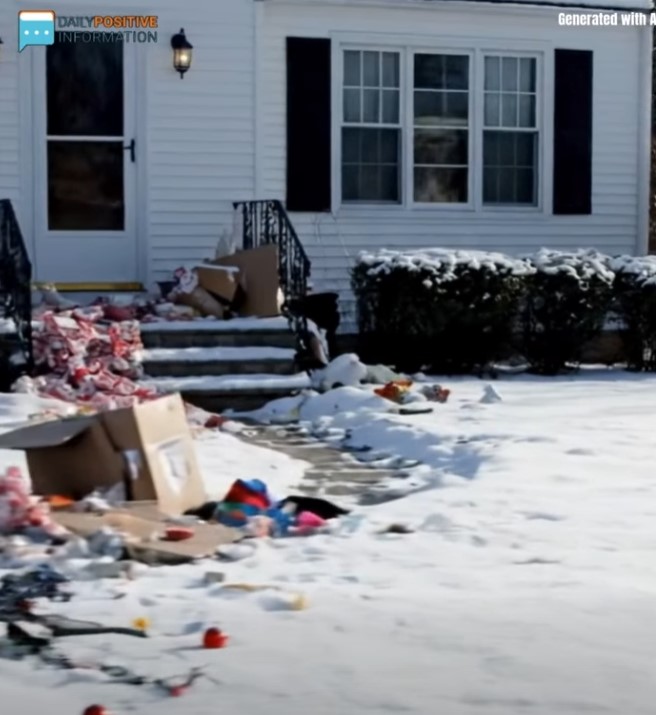
The morning of Christmas Day arrived with a sky the color of a bruised plum, heavy with unfallen snow.
I woke up before Ella, my body humming with a strange, frantic energy. Yesterday had been a breakthrough, but breakthroughs are fragile. They’re like spun sugar; one wrong move, one humid breath, and they dissolve into sticky nothingness.
I paced the kitchen, brewing coffee strong enough to strip paint. I kept looking out the window at Marlene’s house. Her curtains were drawn tight again.
Was yesterday a fluke? A moment of temporary insanity brought on by exhaustion and loneliness?
“The silence wasn’t empty anymore; it was waiting.”
Ella thundered down the stairs in her flannel pajamas, hair a static-charged halo.
“Is Grandma Marlene coming for presents?” she asked before her eyes were even fully open.
My stomach twisted. I hadn’t asked. We hadn’t gotten that far.
“I don’t know, baby,” I said, handing her a cup of juice. “She might be tired. Yesterday was a big day.”
“But Santa came,” Ella said, pointing to the tree. “She needs to see.”
I looked at the pile of gifts. It was modest—single mom budget—but colorful. Then I looked at the small, wrapped box sitting on the counter. I had wrapped it late last night. A scarf. Soft cashmere I’d found on clearance months ago, intended for my sister before we stopped speaking over the divorce.
“Okay,” I said. “Put on your boots. We’ll go check.”

The Morning After the Miracle
Walking across the frozen lawn felt different this time. The anger was gone, replaced by a terrifying vulnerability. We were trespassing on grief again.
I knocked. Softly this time.
No answer.
Ella knocked. Hard. “Marlene! Santa came!”
A minute passed. Then two. I was about to usher Ella away, to tell her that some people need quiet mornings, when the lock tumbled.
Marlene looked worse than she had the day before. Her face was gray, her eyes sunken. She was wearing a bathrobe that looked like it hadn’t been washed in a week. She looked at us, and for a second, I saw pure panic. Regret. The desire to slam the door and retreat into her mausoleum.
“Marlene!” Ella shouted, oblivious to the adult tension. “Did you check your stocking?”
Marlene blinked, disoriented. “My… what?”
“Your stocking! Did Santa fill it?”
Marlene looked at me, helpless. “I don’t… I didn’t put them up.”
“Oh.” Ella’s face fell. “That’s okay. You can share mine. Come on.”
She reached out a mittened hand.
Marlene stared at that tiny pink mitten like it was a live grenade. Taking it meant stepping out of the past. It meant leaving Ben, Lucy, and Tommy behind in the quiet house to go play family with strangers.
“I can’t,” Marlene whispered. “Not today. It’s too much.”
I stepped in. I didn’t let her retreat. I knew if she closed that door now, we’d never get her back.
“Coffee,” I said firmly. “I made a fresh pot. It’s hot. And I have a cinnamon roll with your name on it. Just for an hour, Marlene. Then you can come back here and… be with them.”
I nodded toward the photo wall inside her house.
“Just for an hour,” I repeated.
She hesitated. She looked at the photos, then at Ella’s outstretched hand.
“Okay,” she croaked. “Let me get my coat.”
The Weight of a Gift
She sat in my living room while Ella tore through wrapping paper like a Tasmanian devil. Marlene held her coffee cup with both hands, using it as an anchor. She didn’t smile much, but she watched. She watched Ella spin in a new skirt. She watched her build a Lego tower.
Then, she reached into her deep coat pocket.
“I found something,” she said, her voice rusty. “In the attic. I was going to… well, I don’t know what I was going to do with it.”
She pulled out a small, rectangular box wrapped in yellowed tissue paper. She handed it to Ella.
“For me?” Ella gasped.
“It’s old,” Marlene warned. “Be careful.”
Ella peeled back the paper. It was a music box. Wooden, with hand-painted robins on the lid. She lifted the top. A tiny, delicate tune tinkled out—Edelweiss.
“It was Lucy’s,” Marlene said, the name catching in her throat. “She got it for her fifth birthday. She loved that song.”
The room went still. I looked at Marlene, realizing the magnitude of what she had just done. She wasn’t just giving a gift; she was giving away a piece of her wreckage.
“It’s beautiful,” Ella whispered. “Does Lucy miss it?”
Marlene closed her eyes for a second. “No. Lucy doesn’t need it anymore. She’d want you to have it.”
Ella stood up, walked over to the armchair, and buried her face in Marlene’s neck.
“Thank you, Christmas Grandma.”
Marlene stiffened, then slowly, hesitantly, brought her hand up to stroke Ella’s hair. I saw a single tear track through the powder on her cheek.
“You’re welcome, little one.”
That was the moment the ice didn’t just crack; it shattered. But winter is long, and grief is stubborn.

The Long January Silence
January hit us like a wet blanket. The adrenaline of the holidays faded, leaving behind the slush, the gray skies, and the reality of my bank account.
The divorce was final, but the financial aftershocks were just beginning. My ex-husband, Greg, was “between jobs” again, which meant child support was a suggestion, not a check.
Marlene retreated.
After the lights came down—a solemn ceremony where Marlene stood on the sidewalk and watched me pack the plastic clips away—she went back into her shell.
For two weeks, I didn’t see her. I’d knock, and she wouldn’t answer. I’d see her curtains twitch, but the door stayed locked.
“Where’s Marlene?” Ella asked every day after school.
“She’s hibernating,” I’d say. “Like a bear. She needs rest.”
But I was worried. I knew the statistics on grief and isolation. I knew that after the “firsts”—the first Christmas with friends, the first laugh—the crash could be brutal.
One Tuesday night, my car wouldn’t start. The battery was dead, the alternator was shot, and I was standing in the driveway crying because I couldn’t afford a tow, let alone a repair. It was snowing, that miserable, sideways sleet that hurts your face.
I kicked the tire. I screamed a word I don’t let Ella say.
The front door of the house next door opened.
Marlene stood there in her slippers, wrapped in a thick wool shawl.
“Stop kicking the car,” she called out. “It won’t help. I’ve tried.”
I wiped my face, embarrassed. “It’s dead. Everything is dead. I hate this month.”
She shuffled down the porch steps, ignoring the ice.
“Come inside,” she said. “I made stew.”
“I can’t. I have to figure this out. I have to get Ella to school tomorrow.”
“I have a car,” Marlene said. “It’s a Buick. It smells like mothballs and it’s the size of a tank, but it runs. I’ll take her.”
I stared at her. “You haven’t driven in… how long?”
“Since the grocery store last month,” she admitted. “But I can drive. Come eat stew.”
That night, the “Tuesday Night Protocol” was born.
We sat in her kitchen this time. It was the first time I’d really been in there. It was a time capsule. The calendar on the wall was from 2004. There were magnets on the fridge holding up drawings that were yellow with age. “To Mommy, Love Ben.”
We ate beef stew that was over-salted but hot.
“Why did you disappear?” I asked, dipping bread into the gravy.
Marlene looked at her hands. “I felt guilty.”
“For what?”
“For laughing,” she whispered. “On Christmas Day. Ella said something funny, and I laughed. And then… I felt like I was cheating on them. Like if I’m happy, I’m forgetting them.”
I reached across the table and took her hand. Her skin was papery and dry.
“Marlene, you’ve been punishing yourself for twenty years. Do you think Ben, Lucy, and Tommy want you to be miserable forever? Is that what you’d want for them if the roles were reversed?”
She stared at the fridge magnets.
“No,” she said softly. “I’d want them to eat stew and look at lights.”
“Exactly. You’re not replacing them. You’re just… making room.”
She nodded slowly. “Making room. I like that.”
The Intruder in Spring
Spring arrived with a vengeance. Mud season. The snow melted to reveal a yard that was mostly weeds and dog patches from the previous owners.
One Saturday in April, Greg showed up.
He wasn’t supposed to. It wasn’t his weekend. But Greg operates on Greg Time. He pulled into the driveway in his leased sports car—he couldn’t pay child support, but he could drive an Audi—and honked.
I was in the garden, trying to hack away at a dead rosebush. Marlene was sitting on her porch, supervising. She had taken to sitting out there with a crossword puzzle, guarding the neighborhood.
Greg got out, adjusting his sunglasses.
“Place looks… rustic,” he sneered, looking at the peeling paint on my shutters. “Ella ready?”
“It’s not your weekend, Greg,” I said, standing up and wiping dirt on my jeans.
“I’m in the neighborhood. Thought I’d take her for ice cream. Don’t be a shrew, Sarah.”
My blood pressure spiked. “She’s at a playdate. You can’t just drop in.”
“I’m her father. I can do what I want.” He stepped onto the lawn, his expensive shoes sinking into the mud. “God, this neighborhood is a dump. Who lives there?” He gestured at Marlene’s house. “The Wicked Witch of the West?”
I opened my mouth to scream at him, but a voice cut through the air like a whip.
“Hey! Sunglasses!”
Greg turned. Marlene was standing at the edge of her porch railing. She looked small, frail, and absolutely terrifying.
“Excuse me?” Greg said.
“You’re trespassing,” she said. Her voice wasn’t thin anymore. It was steel. “And you’re rude. Get off the grass.”
Greg laughed. “Who is this? Your bodyguard?”
“I’m the neighbor,” Marlene said. “And I have a hose. And I know how to use it. Sarah said leave. So leave.”
Greg looked at me, then at the crazy old lady with the garden hose nozzle in her hand. He scoffed.
“Fine. Whatever. Tell Ella I stopped by.”
He got back in his car and peeled out, leaving a cloud of exhaust.
I let out a breath I didn’t know I was holding. My hands were shaking. Greg always made me feel small, incompetent, powerless.
Marlene walked down her steps and over to the property line.
“He’s a prickly one,” she noted.
“He’s an ass,” I corrected.
“Language,” she tutted, but her eyes were dancing. “You know, my husband, Dave… he was big. Played football. But he was soft. He would have hated that man.”
“I hate that man,” I said. “He makes me feel like I’m failing.”
Marlene looked at my half-pruned rosebush.
“You’re raising a girl alone, fixing a house, and you managed to un-freeze a heart that’s been solid ice for two decades,” she said. “You’re not failing, Sarah. You’re just in the weeds. We all get in the weeds.”
She picked up a pair of shears.
“Now,” she said. “Cut it back to the green wood. If it’s brown, it’s dead. You have to cut the dead to let the new grow. That’s the rule.”
We spent the rest of the afternoon pruning. We cut away the dead wood. We made a pile of thorns. And for the first time, I told her about the divorce, about the loneliness, about the terror of doing it all alone.
She listened. She didn’t offer platitudes. She just handed me the shears and said, “Keep cutting.”
The Fortress of the Attic
Summer brought the heat. A humid, suffocating blanket that made the air shimmer above the asphalt.
In July, Marlene’s air conditioning unit died. It was older than me.
I went over to help her set up fans. The house was stifling. We were in the kitchen, sweating through our clothes, when she looked up at the ceiling.
“I need to go upstairs,” she said.
I paused. “Okay. Do you need help?”
“I haven’t been upstairs in twelve years,” she said. “I sleep in the den. The bathroom is down here. I just… I stopped going up.”
The upstairs was where the kids’ rooms were.
“Why do you need to go up?”
“Because the attic fan switch is in the hallway. If I don’t turn it on, the roof will bake the shingles off.”
She looked terrified.
“I’ll go with you,” I said.
We walked to the staircase. It was narrow, carpeted in a dusty blue pile. Marlene gripped the banister. Her knuckles were white.
“One step at a time,” I whispered.
We climbed. The air got hotter as we ascended. The landing was dark. There were four doors. All closed.
Marlene stood in the hallway, trembling.
“That’s Ben and Tommy’s room,” she pointed to the left. “That’s Lucy’s.” She pointed to the right. “That was ours.”
She reached for the switch on the wall—the attic fan. She flipped it. A low hum started overhead, a vibration that shook the floorboards.
“Okay,” she breathed. “We did it. Let’s go down.”
“Marlene,” I said gently. “Do you ever open them?”
“No.”
“What’s in there?”
“Everything,” she whispered. “Their clothes. The unmade beds. The homework on the desks. It’s all… just like they left it that morning.”
I looked at the doors. It was a museum of grief. A shrine sealed in dust.
“Does it help?” I asked. “Keeping it locked?”
“It keeps them safe,” she said. “If I open the door, the time gets in. And if time gets in, they’re really gone.”
“They’re gone, Marlene,” I said, knowing it was cruel but necessary. “But the love isn’t in the dusty sheets. It’s in you. It’s in the music box you gave Ella.”
She stared at Lucy’s door. She reached out a hand, hovering over the knob.
“I can’t,” she sobbed. “Not yet.”
“That’s okay,” I said, wrapping an arm around her damp shoulders. “Not today. But maybe someday. And when you do, I’ll be right here.”
We went back downstairs. We drank iced tea. We didn’t talk about the upstairs. But the seal had been broken. The geography of her house—and her heart—was no longer forbidden territory.
The Time Capsule
August. Ella was getting ready for kindergarten. We were buying backpacks and pencils.
Marlene came over with a box. Not a gift box. A cardboard moving box.
“I went up,” she said. She looked exhausted, like she’d run a marathon. “Last night. I couldn’t sleep. I went up.”
I put down my coffee. “You did?”
“I went into the boys’ room.” She sat down heavily. “It smelled like old paper and… dust. But underneath, it still smelled like them. Like grass stains and bubblegum.”
She pushed the box toward me.
“These are books,” she said. “First grade readers. Math workbooks. Dinosaur encyclopedias. Tommy loved dinosaurs.”
She looked at Ella, who was coloring on the floor.
“Ella is going to kindergarten,” Marlene said. “She needs books. Books shouldn’t sit in the dark. Stories die in the dark.”
I opened the flaps. Inside were dozens of pristine, hardcover books from the 90s. Goosebumps. The Magic Treehouse. Where the Wild Things Are.
“Marlene…”
“Take them,” she commanded. “Please. If I see her reading them, then… then Tommy isn’t just a memory. He’s useful. He’s helping.”
Ella ran over. She picked up a book about T-Rexes.
“Roar!” she screamed.
Marlene smiled. A real, genuine smile that crinkled her eyes.
“That’s right,” she said. “That’s exactly what Tommy used to do.”
The Anniversary
Autumn bled into winter. The days grew short. The shadows grew long.
December arrived.
The closer we got to the 23rd, the tighter Marlene became. She stopped eating. She grew snappy. The “Tuesday Night Protocol” became me sitting in silence while she stared out the window.
On December 22nd, I found her sitting on her front steps in the freezing cold, no coat.
“Marlene?” I rushed over with a blanket. “What are you doing?”
“Waiting,” she mumbled. “I told them I’d meet them there. I have to wait.”
She was dissociating. Slipping back into the trauma loop.
I sat down next to her and wrapped the blanket around both of us.
“They aren’t coming, Marlene,” I said into the wind. “Not that way.”
“I know,” she whispered. “But my body doesn’t know. My body is waiting for the phone call.”
“We’re going to change the ending,” I said.
“You can’t change the past.”
“No. But we can change the ritual.”
The next day—December 23rd, the 21st anniversary of the crash—I didn’t let her sit alone in the dark.
I packed a picnic basket. Thermoses of hot cocoa. Sandwiches. Ella brought the music box.
“Get in the car,” I told Marlene.
“Where are we going?”
“To see them.”
She hadn’t been to the cemetery in ten years. She told me she couldn’t bear the sight of the stones.
We drove in silence. The sky was gray and low. The cemetery was vast and snow-covered.
We found the plot. A large stone for Dave. Three smaller ones for the kids.
Marlene stood at the edge of the plot, trembling.
“I can’t look,” she said.
“You don’t have to look,” Ella said. She walked forward, her pink boots crunching in the snow. She placed the music box on Lucy’s stone. She cranked the handle.
Edelweiss drifted through the cold air. Thin, tinny, and beautiful.
“Hi Lucy,” Ella said conversationally. “I’m Ella. I have your box. I’m taking good care of it. And I’m taking care of your mom, too. She makes good stew.”
Marlene let out a sound that was half-sob, half-laugh. She walked forward. She fell to her knees in the snow in front of the stones. She touched the cold granite.
“I’m sorry,” she wept. “I’m so sorry I wasn’t there.”
I stood back, letting her have her moment. But I wasn’t leaving her alone in it.
After a while, she stood up. She wiped her face. She looked lighter. Hollowed out, maybe, but lighter.
“Okay,” she said. “Okay. I said it.”
“Ready to go home?” I asked.
“Yes,” she said. “Home.”
The Second Christmas
Christmas Eve. One year since the vandalism. One year since the police almost came. One year since the worst night became the best thing that ever happened to us.
Our house was glowing. We had bought more lights. Marlene had helped me string them. The maple tree was wrapped so tight it looked like a pillar of fire.
Inside, the house smelled of ham and pine.
Marlene was in the kitchen, teaching Ella how to make her grandmother’s shortbread cookies. Flour was everywhere.
“No, no, press gently,” Marlene instructed. “Dough has feelings. If you squish it, it gets tough.”
“Like Greg?” Ella asked innocently.
I choked on my wine. Marlene cackled.
“Exactly like Greg. Don’t be a Greg. Be a cookie.”
I looked at them. The little girl with the missing front tooth and the old woman with the tragic eyes. They were an unlikely pair. A family built from scraps, glued together with grief and stubbornness.
We sat down to dinner. The same menu as last year, plus the shortbread.
Before we ate, Marlene cleared her throat. She raised her glass of sparkling cider.
“I want to make a toast,” she said. Her hand was steady.
“To Ben, Lucy, and Tommy,” she said, looking at the empty chairs we had set, not with sadness, but with acknowledgment. “And to Dave.”
She looked at me.
“And to Sarah. Who cut the dead wood so the green could grow.”
She looked at Ella.
“And to Ella. My sparkle.”
“To sparkle!” Ella cheered, clinking her plastic cup against Marlene’s glass.
We drank. We ate. We laughed.
Later that night, after Ella was asleep, Marlene and I stood on the porch again. It was snowing lightly. The flakes danced in the light of the wooden angel that was still clipped to the gutter.
“You know,” Marlene said, looking at her own house across the way. “I opened the curtains today.”
I looked. The windows of her living room were glowing. I could see the Christmas tree she had put up—a small one, tabletop size, but it was there. And in the window, facing the street, were three electric candles.
One for Ben. One for Lucy. One for Tommy.
They weren’t hidden anymore. They were shining out into the dark, joining our lights, creating a bridge of brightness between our two broken, beautiful homes.
“It looks good,” I said.
“It looks like Christmas,” she corrected.
She leaned her head on my shoulder.
“Thank you,” she whispered. “For not calling the police. For hugging me instead.”
“Best decision I ever made,” I said.
“Merry Christmas, Sarah.”
“Merry Christmas, Grandma.”
She squeezed my hand, and we stood there, watching the snow fall, two survivors keeping the darkness at bay, one light at a time.
What do you think about Marlene joining Ella’s Christmas? Let us know your thoughts on the Facebook video, and if you like this story share it with friends and family!
