
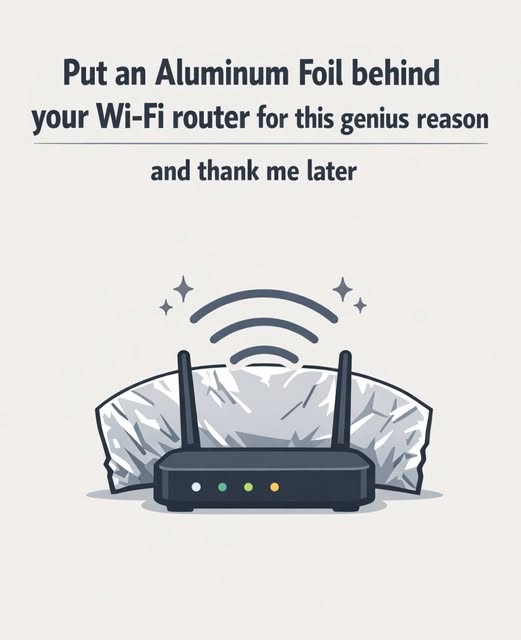
I’ve been seeing pictures of people wrapping their wi-fi routers in aluminum foil for years now. Initially, I believed this was just another one of those silly things people post online, like putting toothpaste on your car’s scratched paint job. But after hearing so many people talking about “aluminum foil & Wi-Fi,” I wanted to see if there was really anything behind this technique.
So let me tell you what this technique is, how people apply it, if it actually works, and when it may just be a gimmick rather than an actual solution. Whether you’re dealing with a slow connection and are looking for something simple that might help you out, then this article is for you.
How Does the Aluminum Foil Wi-Fi Router Technique Work?
To quickly summarize, a number of individuals have applied aluminum foil to act as a Wi-Fi signal reflector by making a curve or circle behind their Wi-Fi router’s antennas. The idea behind this application of aluminum foil is that the aluminum foil will focus the Wi-Fi signal in one direction versus letting the signal radiate outward.
No need to wrap your router, just take a sheet of aluminum foil and put it behind the router; you don’t even need to create a complex design, as a simple fold of the foil is enough. Some people have created foil covers from old soda cans, cardboard wrapped in foil, etc., and some have created their own shapes out of the foil. It’s a pretty easy and somewhat entertaining way to test out a potential solution.

Why Do People Apply the Aluminum Foil Wi-Fi Router Technique?
As mentioned earlier, Wi-Fi signals broadcast in all directions; therefore, a lot of the signal power being produced by your router is going to radiate through walls, down hallways, or totally outside of your house.
That’s where the aluminum foil comes in. Since aluminum foil can reflect radio waves, which is what Wi-Fi uses, it can send the signal that would normally be lost back into your home. People have used this technique in order to:
Get a stronger Wi-Fi signal in a single room.
Have their router placed close to an exterior wall.
To have a great Wi-Fi signal in one part of the house, but a dead zone in the rest of the house.
It’s fairly obvious as to why people find this solution attractive. No extra equipment is required. No special technical knowledge is required. It’s cheap, fast, and it looks like MacGyver could accomplish this feat. But does it actually work?
The Science Behind Aluminum Foil and Wi-Fi (Does It Actually Work?)
For a little while, let’s get nerdy. Wi-Fi signals are nothing more than radio waves. Radio waves are reflected off metal surfaces, which include aluminum foil. So, theoretically, by placing foil behind your router, it will bounce the signal forward, thus focusing the signal toward a specific area.
And guess what? This is not total garbage science. Researchers have performed tests on this technique in a controlled environment and have shown that it can produce a directional signal. Thus, if you place the foil to focus the signal on the area of your home that you want a better Wi-Fi signal, you may see a slight increase in the signal strength of your Wi-Fi.
However, and I cannot stress this enough, it will not:
Give you faster Wi-Fi speeds.
Fix a terrible Internet Service Providers (ISPs) plan.
Replace subpar or cheap router hardware.
From my own experiments, I saw a moderate increase in the adjacent room when I made a curved foil reflector behind the antennas. However, it was not a huge increase. If your signal is significantly weakened, the foil will not fix the issue.

When Will the Aluminum Foil Trick Help?
This technique will not be helpful in every case. But it may surprise you with good results in certain cases. Try the following:
Your router is placed near an external wall.
You only want to improve the signal in one direction.
You live in a small apartment or single-story home.
And you just want to give yourself a risk-free DIY solution.
When Won’t the Aluminum Foil Trick Help (and May Harm Your Wi-Fi)?
On the other hand, this is not a universal solution. In fact, you may be damaging your Wi-Fi signal in multiple areas of your home if you don’t do it correctly. Avoid it if:
You have a large or multi-floor home.
Your current placement of your router is already bad.
Your equipment is either old or malfunctioning.
You want equal signal quality in each room of your home.
Because you are also blocking the signal from everywhere else, you must be cautious regarding the placement of your router and its antenna.
Better Alternatives for Improving Wi-Fi Signal Quality Than Using Aluminum Foil
Tired of buffering or dropping video calls? There are far better ways to solve your Wi-Fi problems than aluminum foil art. Here are some of the solutions that have worked better for me:
Move the router to a more central location.
Try positioning the antennas at slightly different angles; do not have all of them pointed directly upward.
Consider a mesh Wi-Fi system if your home is larger than one floor.
Use a Wi-Fi extender to add coverage to remote parts of your home.
Connect a hardwired access point to ensure consistent speed.
Honestly, these alternatives will probably cost more than aluminum foil, but they will fix the underlying problem for good.

Is It Worth a Shot?
Is using aluminum foil to shield your Wi-Fi router a total waste of time? Not completely. It’s a safe, low-cost experiment that can produce a minimal benefit, as long as you set the right conditions and have realistic expectations.
However, if you envision having high-speed fiber Wi-Fi via a kitchen hack, no. To obtain meaningful improvements, you’ll need to consider higher-end equipment or a different setup.
So, the next time you’re bored and you have some loose foil laying around, try it out. At worst, you’ll have a cool science experience. At best, your bedroom Wi-Fi will be decent.
