
CHAPTER 1: The Snap
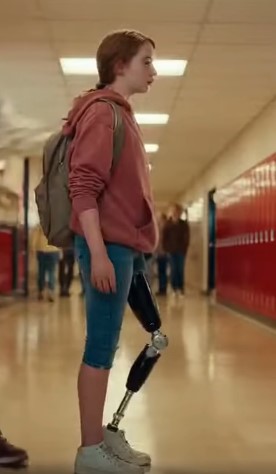
The high school hallway smelled like floor wax, stale cafeteria pizza, and cheap body spray—a sensory combination that always made my stomach turn. I clutched my history textbook against my chest like a shield, keeping my head down, counting the tiles on the floor. One, two, three. Breathe. Just get to third period. I knew the drill better than anyone. Don’t make eye contact. Don’t react. Don’t exist.
But I could hear them behind me. The heavy, rhythmic thud of Timberland boots and the distinct, sharp click-whir of my own left leg.

“Yo, Robo-Cop! You squeaking today!”
It was Tyler. Of course, it was Tyler. He was the quarterback, the golden boy of Creekwood High, a kid who wore his varsity jacket like a suit of armor that protected him from consequences. His cronies, passing a foam football back and forth in the crowded corridor, erupted in laughter that sounded like barking dogs.
“Better plug yourself in, Carter! Battery’s running low!” another voice jeered. I think it was Brad, Tyler’s shadow.
I bit my lip so hard I tasted iron. I was fifteen. I just wanted to disappear. But you can’t disappear when you walk with a mechanical gait that echoes off the metal lockers. I picked up my pace, the custom carbon-fiber joint my dad had machined in our garage working overtime to keep up with my rising anxiety. I could feel the piston compressing, the slight resistance in the knee hinge. It was a masterpiece of engineering, but right now, it felt like an anchor.
I was three feet from the corner. Three feet from the safety of the stairwell where the teachers sometimes monitored the traffic.
Suddenly, a varsity jacket flashed in my peripheral vision. It wasn’t an accident. It was calculated. A foot hooked behind my good ankle—my flesh and bone ankle.
It wasn’t a stumble. It was a crash.
I went down hard, my books scattering across the linoleum like frightened birds. My binder exploded, sending papers drifting through the air. But the sound that silenced the hallway wasn’t the books hitting the floor.
It was a sickening CRACK.
It didn’t sound like bone. It sounded like a gunshot muffled by a pillow. Like metal shearing under stress.
My leg—the one my dad had spent months designing, pouring his soul and his paycheck into so I could walk without pain—was bent at a horrific, unnatural angle beneath me. The main strut, a titanium alloy rod, had snapped clean through near the ankle joint.
The laughter exploded instantly, deafening and cruel. It washed over me like a cold wave.
“Look at that! She’s malfunctioning!” Tyler roared, looming over me, his face twisted in ugly amusement. “Call tech support! We got a system failure on aisle four!”
I tried to stand, instinctively putting weight on my left side, but the device collapsed. I fell again, hard, scraping my palms raw on the gritty floor. Tears, hot and humiliating, blurred my vision. I looked up at them, hoping for a shred of empathy. I saw none. Just teeth and the black eyes of phone cameras recording my misery. Flashlights blinded me.
“Looks like you aren’t going anywhere, freak,” Tyler sneered. He kicked my history book down the hall, sending it skidding toward the lockers. “Maybe your dad can build you some training wheels next time.”
They walked away, high-fiving, leaving me in the wreckage of my dignity and the broken pieces of my father’s hard work. I sat there, surrounded by staring students who did nothing. Some looked away, ashamed. Others kept filming. I clutched the twisted metal, feeling the sharp edge where it had snapped.
They didn’t know.
They saw a quiet mechanic’s daughter. They saw a victim. They saw easy prey.
They didn’t know that the man who built this leg wasn’t just a mechanic. They didn’t know that before he fixed cars in a quiet suburban garage, he fixed problems for the US government in places that don’t exist on maps. They didn’t know that “Dad” was a title earned after “Commander.” And they certainly didn’t know that breaking his work was the same as declaring war.
CHAPTER 2: The Assessment
I managed to drag myself to the nurse’s office, the broken strut grinding and screeching with every agonizing movement. It felt like dragging a bag of rocks attached to my hip. The nurse, Mrs. Gable, gasped when she saw me, her hands fluttering to her mouth. She offered to call the principal, to file a report, but I shook my head.
“Just call my dad,” I whispered, wiping my snotty nose on my sleeve. “Please.”
Reporting Tyler never worked. His dad was on the school board. His uncle was the town sheriff. It would only make things worse. I just wanted to go home.
When my dad’s truck—a beat-up 2005 Ford F-150 that he kept running purely out of spite—pulled up to the curb, I was waiting in a wheelchair by the entrance. He got out slowly. He was a big man, not bodybuilder big, but dense. Solid. Like a tree trunk that had weathered a thousand storms. He wore his usual grease-stained gray t-shirt and work boots.
He saw me. He saw the wheelchair. He saw the leg resting on my lap, detached.
His eyes didn’t widen. He didn’t rush over screaming. He went perfectly, terrifyingly still. It was a stillness I had seen only once before, when a stray dog had tried to attack me in our yard.
He walked over, took the handles of the wheelchair, and loaded me into the truck in silence. He didn’t look at the school building. He didn’t look at the students filing out for the buses. He looked through them, scanning the environment like he was looking for a sniper in the trees.
The ride home was silent. The radio was off. The only sound was the hum of the tires.
Back in our garage, he carried me to the stool by his workbench and set the broken leg on the table under the bright inspection light. The garage smelled of sawdust, motor oil, and old metal—my favorite smell in the world. It was usually a place of safety. Today, it felt like a war room.
He put on his spectacles and ran his calloused thumb over the fracture point. He inspected the jagged titanium.
“This didn’t happen from walking, Lily,” he said softly.
“I tripped,” I lied, looking at the concrete floor. “I’m clumsy. You know that.”
“No,” he corrected, not looking up from the metal. He picked up a caliper and measured the bend. “Physics doesn’t lie, Lil. This is high-grade titanium alloy. It’s designed to withstand three thousand pounds of vertical pressure. To snap it like this…” He turned the leg over, pointing to a scuff mark. “Force was applied laterally. Someone kicked it, or trapped it and leveraged it until it snapped.”
He looked at me then. His blue eyes were usually warm, crinkled with smile lines. Now, they were shards of ice.
“Who did this?”
I tried to hold it in. I really did. But the image of Tyler laughing, the feeling of the floor hitting my face, it all came rushing back. I broke. I sobbed. I told him everything. Tyler. The trip. The mockery. The way they kicked my book.
He didn’t yell. He didn’t throw a wrench. He didn’t curse.
He just slowly wiped the grease from his hands with a red rag, taking his time, cleaning every finger. He walked over to the large red tool chest in the corner, the one he told me never to open. He unlocked the bottom drawer.
Inside, there were no hammers or screwdrivers. There was a stack of files, a small lockbox, and an old, brick-like satellite phone.
He picked up the phone. He pulled up the antenna. He dialed a number from memory.
“We have a situation,” he said into the receiver. His voice was different. It wasn’t “Dad” voice. It was a voice of command. “Code Black at the perimeter. Family involved… Yes. I need the cleanup crew… No, legal first. Then… persuasive.”
He hung up and looked at me. The ice in his eyes melted just enough to let the dad back in.
“Go do your homework, sweetheart. You’re taking the day off tomorrow. I’ll fix the leg tonight.”
“Dad, please don’t go to the school,” I begged, terrified. “Tyler’s dad is on the board. You’ll just get in trouble.”
He kissed my forehead, a small, sad smile playing on his lips. “I’m not going to get in trouble, Lily. And I’m not going alone.”
CHAPTER 3: The Arrival
The next morning, I stayed in bed, staring at the ceiling, dreading what might be happening at Creekwood High. I imagined my dad shouting in the principal’s office, maybe getting arrested by the local cops who were buddies with Tyler’s dad. I felt sick.
But at 8:00 AM, my phone blew up.
Ding. Ding. Ding.
It was my best friend, Sarah.
SARAH: OMG LILY ARE YOU SEEING THIS??? SARAH: [Photo Attachment] SARAH: DUDE YOUR DAD IS A LEGEND.
I clicked the photo. My heart stopped.
The photo was taken from the second-floor library window looking down at the school parking lot. Usually, the front circle was reserved for buses and the Principal’s sedan.
Today, the circle was blocked off by three massive, black Chevrolet Suburbans. Tinted windows. Government plates. No local police markings. Just heavy, imposing, black steel.
Standing next to the lead vehicle wasn’t just my dad. It was my dad in a suit—something I had never seen him wear—flanked by four other men. They weren’t cops. They wore tactical pants, polo shirts tight around the biceps, and sunglasses. They stood with their hands clasped in front of them, scanning the area.
I scrolled down to the next text.
SARAH: The Principal is outside literally shaking. Tyler’s dad is there too and he looks like he’s gonna throw up.
I jumped out of bed, hopping on my good leg to the window, even though I lived miles away. My dad wasn’t a mechanic. I realized then, truly, that I didn’t know what he was. But I knew one thing: The balance of power had just shifted.
At the school, the atmosphere had changed from a typical Tuesday into a scene from a spy movie. The silence in the hallways was absolute. Students were pressed against the windows.
My dad didn’t scream. He didn’t make a scene. He simply walked up the front steps of the school, the four men falling into a V-formation behind him. They moved in perfect synchronization, their boots making a heavy, unified thud on the concrete.
Principal Higgins met them at the door. “Mr. Carter, I—I wasn’t expecting—”
“We need to talk,” my dad said. His voice wasn’t loud, but it carried across the courtyard. “About the safety protocols of this institution. And about a hate crime committed on federal property.”
“Federal property?” Higgins stammered. “This is a public school.”
“My daughter,” Dad said, stepping closer, “is a dependent of a Tier One asset. Her prosthetic is classified medical hardware issued by the Department of Defense. Destroying it isn’t vandalism, Mr. Higgins. It’s sabotage of government property.”
He wasn’t lying. Not technically. But he was weaponizing the bureaucracy in a way that made the blood drain from Higgins’ face.
“Bring me the boy,” Dad said. “And bring his father.”
CHAPTER 4: The Meeting
I wasn’t there, but Sarah live-texted me everything she heard from the office aides.
They were in the conference room. My dad sat at the head of the table. The four men stood against the wall, silent sentinels with arms crossed. Tyler sat opposite my dad, looking small. He wasn’t wearing his varsity jacket anymore. He was slumped in his chair, pale and sweating. His father, Mr. O’Connell—the bigshot local businessman—was red-faced, blustering.
“This is ridiculous!” Mr. O’Connell shouted, slamming his hand on the table. “Kids play rough! It was an accident! I’ll write a check for the damn leg. How much is it? Five hundred bucks?”
My dad didn’t blink. He slid a folder across the table.
“The prosthetic is a prototype carbon-titanium weave,” Dad said calmly. “Cost of materials and fabrication: eighty-five thousand dollars.”
Mr. O’Connell choked. “Eighty… for a fake leg?”
“For a limb,” Dad corrected. “But we aren’t here for the money. We’re here for the assault.”
“It wasn’t assault!” O’Connell yelled. “It was a hallway prank!”
Dad nodded to one of the men against the wall—a guy named “Mike” who I recognized as one of Dad’s ‘fishing buddies’ from years ago. Mike pulled out a tablet and tapped the screen.
Suddenly, the video played. The video from the hallway. Not the one Tyler took. A different angle. High definition.
“Where… where did you get that?” Principal Higgins asked, trembling.
“We have access to the cloud backups of every device that was recording in that hallway,” Dad said simply. “Including the deleted ones.”
The video showed it clearly. The trip. The malicious intent. The laughter. The way Tyler kicked the book.
“That,” Dad pointed at the screen, “is assault with bodily injury. It is harassment of a disabled person. And since you posted it online, it’s cyberbullying.”
He leaned forward. The room temperature seemed to drop ten degrees.
“Mr. O’Connell, I know about your construction permits in the north county. I know about the zoning bribes.”
O’Connell went dead silent.
“And Tyler,” Dad turned his gaze to the boy. Tyler flinched. “I know you want to play college ball. Ivy League, right?”
Tyler nodded, tears welling up.
“Assault charges look very bad on a transcript,” Dad said. “So does a federal investigation.”
“What do you want?” O’Connell whispered. He was defeated. He knew he was out of his depth. He was a shark in a pond, but he had just run into a Orca.
“I want her safe,” Dad said. “And I want him gone.”
CHAPTER 5: The Ghost in the Hallway
The next Monday, the air at Creekwood High felt different. It wasn’t just the humidity; it was the pressure.
My dad had spent the entire weekend in the garage. He didn’t just fix my leg; he upgraded it. He reinforced the strut with an aerospace-grade alloy he had “leftover in storage” and dampened the hydraulics so the click-whir sound was almost non-existent.
” stealth mode,” he had said with a wink as he calibrated the ankle joint. “So they never hear you coming.”
When his truck pulled up to the school drop-off zone, the change was instantaneous. Usually, nobody looked at the beat-up Ford. Today, heads turned. Conversations stopped mid-sentence. Eyes darted from the truck to me, then quickly away.
“Head high, Lily,” Dad said, unlocking the doors. “You didn’t do anything wrong. You survived. Walk like it.”
I stepped out. My foot hit the pavement—solid, silent, strong.
I walked toward the double doors. The path cleared. It was like parting the Red Sea. The same kids who had giggled when I fell, who had retweeted Tyler’s video, were now suddenly fascinated by their shoelaces or their phones.
I reached my locker. Sarah was there, her eyes wide.
“Dude,” she whispered, grabbing my arm. “What did your dad do?”
“He just talked to them,” I said, opening my locker.
“Talked?” Sarah hissed. “Lily, Tyler isn’t here. His locker is cleaned out. Empty. Gone.”
My stomach dropped. “What?”
“Rumor is his parents pulled him out on Friday afternoon. Shipped him off to some boarding school in Wyoming. Or military school. Nobody knows for sure because his Instagram is deleted. Deleted, Lily. Who deletes their Instagram?”
I looked at Tyler’s locker, three doors down. It was usually plastered with football stickers and photos of himself. Now, it was bare metal. The ghost of his presence was gone, scrubbed away as if he had never existed.
But it wasn’t just Tyler. It was the hierarchy.
The “Varsity Jacket Crew”—Tyler’s entourage—were huddled in the corner near the water fountain. They weren’t loud today. They weren’t throwing footballs. When I looked in their direction, Brad, the one who had made the battery joke, turned pale. He gave me a stiff, terrified nod. It was an apology wrapped in fear.
They thought my dad was a hitman. Or a mob boss. Or something worse.
“I heard your dad is Secret Service,” Sarah whispered as we walked to first period. “Jenny said her mom heard he used to be a cleaner for the cartel. Is it true?”
I laughed, a dry, nervous sound. “He fixes transmissions, Sarah. He likes fishing.”
But as I sat in History class, the same class where I had been tripped, I looked out the window. A black sedan was parked across the street. It wasn’t my dad. It was just a car. But for the first time, I noticed how it was positioned—perfect line of sight to the school entrance.
Was it always there? Or was I just starting to see the world through my father’s eyes?
Principal Higgins came on the PA system for the morning announcements. His voice sounded shaky. “Students, a reminder that Creekwood High has a zero-tolerance policy for bullying. Any… any reports will be dealt with severely. Have a great day.”
I realized then that my dad hadn’t just removed a bully. He had dismantled the culture of the school. He had scared the administration so deeply that they were actually doing their jobs for the first time in ten years.
I walked through the cafeteria at lunch. No flying food. No snide comments. Just respectful silence. I wasn’t the “Cyborg” anymore. I was the girl with the dangerous father. It was a lonely kind of power, but as I ate my sandwich in peace for the first time ever, I decided I could live with it.
But peace, I would soon learn, is just the loading screen for the next level.
CHAPTER 6: The Midnight Visitor
Two weeks passed. The quiet settled into a new normal. I started to relax. I even joined the debate club, something I’d been too afraid to do when Tyler was around to mock me.
But my dad didn’t relax.
If anything, he became more vigilant. He installed new motion-sensor lights in our driveway. He started checking the mail with gloves on. He told me it was just “precautions,” but I knew the look. It was the look of a man waiting for the other shoe to drop.
It dropped on a rainy Tuesday night.
I was in my room finishing an essay on The Great Gatsby. The rain was hammering against the roof, a relentless drone that masked most sounds. But it didn’t mask the sound of a engine roaring up our driveway.
It wasn’t a car. It was a heavy diesel engine.
I peeked through my blinds. A massive, lifted pickup truck—brand new, chrome gleaming under the lightning—had pulled up right to our garage door, blocking us in.
I recognized the truck. It belonged to Mr. O’Connell, Tyler’s dad.
My heart hammered against my ribs. I grabbed my phone to call the police, but before I could dial, I heard the front door downstairs open.
Not slam. Open.
My dad didn’t wait for them to knock. He went out to meet them.
I crept to the top of the stairs, peering down into the hallway, then to the living room window that looked out onto the driveway.
Mr. O’Connell stumbled out of the truck. He was swaying. A half-empty bottle of expensive scotch was clutched in his hand. He looked like a man who had lost everything and had nothing left to trade but his anger.
“Carter!” O’Connell screamed over the rain. “You ruined me! You hear me? You ruined me!”
My dad stood on the porch, under the overhang. He was wearing his flannel pajamas and slippers, holding a mug of tea. He looked like he was watching a neighbor complain about a barking dog, not a drunk millionaire threatening his life.
“Go home, Bob,” Dad said. His voice was low, but it cut through the storm. “You’re drunk.”
“My contracts!” O’Connell shouted, stumbling closer. He was a big man, heavy-set, fueled by liquid courage. “The city pulled the zoning permits! The bank froze my credit line yesterday! They said I’m a ‘high-risk liability’!”
He threw the bottle. It shattered against the porch steps, glass exploding near Dad’s feet. Dad didn’t flinch.
“You did this!” O’Connell roared, reaching into his jacket. “You made some calls! Who the hell are you? Who do you know?”
When O’Connell’s hand went into his jacket, the air in the universe seemed to freeze.
In less than a second—faster than my eyes could track—my dad moved.
He didn’t retreat. He stepped into the rain. He closed the distance in two strides. He grabbed O’Connell’s wrist—the one inside the jacket—and twisted.
O’Connell yelped, forcing to his knees in the mud.
Dad didn’t hit him. He just held him there, pinned by a pressure point, face-to-face.
“I didn’t make the calls, Bob,” Dad said, his voice terrifyingly calm. “The investigation did. When the feds looked into your son’s assault, they had to look at the parents. They found the bribes. They found the tax evasion. You did this to yourself.”
“I have a gun!” O’Connell sobbed, though he couldn’t move his hand to get it.
“I know,” Dad said. “It’s a Smith & Wesson .38 snub nose. It’s in your inside pocket. The safety is on. And if you try to pull it out, I will break your arm in three places before you can blink. Do we understand each other?”
O’Connell nodded frantically, tears mixing with the rain on his face.
Dad released him. He reached into O’Connell’s jacket, removed the gun, unloaded it, and tossed the bullets into the bushes. He handed the empty weapon back to the sobbing man.
“Get in your truck,” Dad said. “Go home to your wife. If you come back here, if you ever say my daughter’s name again, I won’t call the lawyers next time.”
Dad waited until O’Connell scrambled back into his truck and reversed out of the driveway, tires spinning on the wet asphalt.
Only when the taillights faded did Dad turn back to the house. He looked up at the window. He knew I was watching.
He came inside, locked the door, and engaged the deadbolt. He looked up the stairs at me. He was soaked, his pajamas clinging to his frame.
“Dad?” I whispered.
He sighed, a heavy, weary sound. He walked up the stairs, sitting on the top step next to me. He smelled like rain and ozone.
“I thought I left that life, Lily,” he said, looking at his hands—the hands that had just disarmed a man in two seconds. “I thought if I fixed enough cars, if I built enough birdhouses, the world would forget what I used to be.”
“Who were you?” I asked.
He looked at me, his blue eyes sad and ancient.
“I was the man they called when the diplomacy failed,” he said softy. “But now… now I’m just a dad. And I think it’s time you knew the rest of the story. Because O’Connell was just a pawn. And now that he’s made noise… others might be listening.”
He stood up and motioned to the garage.
“Come on. There’s something under the floorboards I need to show you.”
CHAPTER 7: The Blueprint Under the Floor
The garage was cold, the air heavy with the metallic tang of the storm outside. Dad walked over to the heavy hydraulic lift where he usually worked on transmissions. He knelt down, not to the lift controls, but to a grease-stained patch of concrete beside it.
He pulled a small pry bar from his back pocket and wedged it into a nearly invisible seam in the floor. With a grunt of effort, he lifted a heavy slab of concrete. It wasn’t just a slab; it was a lead-lined hatch.
Underneath, nestled in a bed of foam, was a matte black Pelican case.
“Dad,” I whispered, stepping closer. “What is this?”
He didn’t answer immediately. He pressed his thumb against a biometric scanner on the case. It beeped—a sharp, high-tech sound that didn’t belong in a suburban garage. The latches clicked open.
Inside, I expected to see guns. There were a few—sleek, futuristic-looking pistols that looked like they belonged in a movie. There were also stacks of cash in different currencies, passports with his face but different names, and a stack of hard drives.
But what caught my eye was the blue schematic paper resting on top.
I picked it up. It was a technical drawing. Detailed. Complex.
I recognized the shape. It was my leg.
But the label at the top didn’t say “Prosthetic.” It read: PROJECT AEGIS – COMBAT INFANTRY EXOSKELETON – CLASSIFIED TOP SECRET.
“You didn’t just build this in the garage, did you?” I asked, my voice trembling.
Dad sighed, rubbing his face. “I assembled it here. But the technology… the alloy, the micro-hydraulics… I didn’t buy those at the hardware store, Lily.”
He looked at me, his eyes intense.
“When I left the service, I made a deal. I walked away, and they let me live a quiet life. But when you lost your leg in that car accident…” He swallowed hard, the memory still painful for both of us. “The doctors said you’d never walk without a cane. They offered you plastic and wood. I couldn’t accept that.”
He tapped the blueprints.
“This tech was designed for super-soldiers. It’s worth billions. I ‘borrowed’ the schematics and enough raw material to build one unit. For you. To give you your life back.”
The realization hit me like a punch to the gut.
“That’s why you were so scared when it broke,” I whispered. “Not because of the cost.”
“Because of the signature,” he said grimly. “That titanium alloy has a specific radioactive isotope marker. When Tyler snapped it, the inner core was exposed. If anyone from my old life had been scanning for it… if the wrong satellite passed over…”
“They’d find us,” I finished.
“Exactly.” He reached into the case and pulled out a small, silver chip. “That’s why I had to go to the school. That’s why I had to scare O’Connell into silence. I needed to control the narrative before the government realized what really happened in that hallway. I wasn’t just defending your honor, Lily. I was protecting our freedom.”
He stood up, closing the case and sealing the floor back up. He looked at me, not as a child, but as an accomplice.
“The leg I put on you this weekend? It’s shielded. Lead-lined. Untraceable. But we have to be careful now. The world knows I’m not just a mechanic. We can’t go back to sleep.”
CHAPTER 8: Walking Tall
Six months later.
The gymnasium was packed for graduation. The air conditioner was struggling against the heat of two thousand bodies. Parents were fanning themselves with programs, cameras at the ready.
I sat in the front row, wearing my cap and gown. Underneath the blue fabric, my left leg hummed quietly—my secret, my strength.
Tyler wasn’t there. He was somewhere in Wyoming, repeating his junior year. His father had sold his business and moved the family two towns over, keeping a very low profile. The “Varsity Jacket Crew” had disbanded, their leader gone, their confidence shattered by a mechanic in a gray t-shirt.
“Lily Carter,” the principal announced.
I stood up.
The silence that followed wasn’t the awkward silence of the hallway from months ago. It was a respectful hush. Everyone watched.
I walked across the stage. No cane. No limp. No squeak.
My stride was powerful, rhythmic, and unbreakable. The carbon-fiber piston fired perfectly with every step, a masterpiece of engineering and love.
I took my diploma, shook the principal’s hand, and turned to face the crowd.
I scanned the back of the room. He was there.
My dad stood near the exit, leaning against the wall. He wasn’t wearing a suit today. He was back in his clean button-down and jeans. He looked tired—the bags under his eyes were a little darker, his posture a little more rigid. He was still scanning the room, checking the exits, watching the hands of the strangers around him.
He was a ghost. A guardian. A warrior who had traded his rifle for a wrench to build a future for his daughter.
Our eyes locked across the sea of graduation caps.
He didn’t wave. He just gave me a single, slow nod. A soldier’s salute to a fellow survivor.
I smiled, holding my diploma high.
They had tried to break me. They had laughed when I fell. They thought they were kicking a cripple.
But they didn’t know physics. They didn’t know that when you apply pressure to the strongest metal on earth, it doesn’t just resist. It pushes back.
I walked off the stage, ready for whatever came next. Let them watch. Let them wonder.
My father built this leg to carry a soldier. Now, it was carrying a woman who knew exactly who she was.
And if anyone ever tried to trip me again?
Well, let’s just say they’d need more than a nurse. They’d need a backup plan.
