

The rain had been falling since dawn, thin and cold, turning the narrow streets into long gray mirrors. Cars rushed past in restless lines, tires hissing against wet asphalt. Shop doors opened and closed. People hurried forward with umbrellas lowered, eyes fixed on their destinations. In the middle of this moving world, something small and broken struggled to survive.
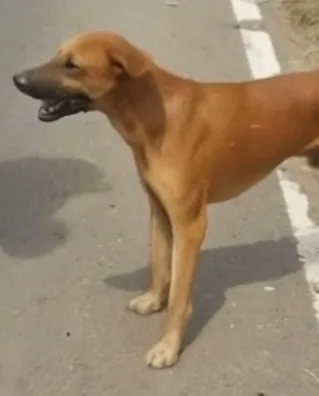
A stray dog stumbled out from between two abandoned buildings.
His fur was soaked and matted with dirt. His ribs showed through his thin sides like fragile branches beneath torn fabric. But what stopped the few who noticed him—what froze the breath in their throats—was his face.
A dirty piece of cloth was tied tightly around his head.
It covered his eyes completely.
The knot was thick and cruel, pulled so tight that the skin around it was swollen. He could not see the street. He could not see the cars. He could not see the humans passing only a few steps away. He could only hear chaos and feel fear.
With each step, he lifted his paws too high or placed them too late. He bumped into a trash bin, then a wall, then a puddle that sent icy water splashing up his legs. He flinched at every loud sound, shrinking into himself, unsure where danger might come from next.
To the world, he was invisible.
To himself, the world was darkness.

A Life Already Too Heavy
Even without the cloth, life as a stray dog is a constant battle.
Every morning begins with hunger. Not the gentle hunger that reminds you it is time to eat, but the sharp, hollow pain that curls deep inside the body and refuses to leave. It is the kind of hunger that forces a dog to search through garbage, to swallow food that tastes of rust and rot, to fight with others for crumbs that fall from careless hands.
Shelter is never certain. When the sun burns, there is nowhere cool enough to rest. When the rain comes, every corner leaks. When the night grows cold, the ground steals warmth from thin bones.
And danger is everywhere.
A careless kick. A stone thrown by a bored child. The sudden roar of an engine too close. Humans who look away. Humans who laugh. Humans who hurt.
Still, most stray dogs learn to endure.
They learn the rhythm of streets. They learn which corners are safer, which hands might offer food, which footsteps signal danger. They learn how to survive in a world that rarely notices their pain.
But this dog had been denied even that small knowledge.
Someone had taken his sight.
Not by accident.
Not by necessity.
By choice.
No one knew who tied the cloth around his eyes. No one knew when or why. There was no reason that could make sense of such cruelty. There never is.
All that mattered was what remained: a living creature trapped inside fear, walking blindly through a world that had already been too hard.
Fear Without a Shape
To be blind in a world built for sight is terrifying.
To be blind and alone is unbearable.
The dog moved slowly now, his legs trembling from exhaustion. Each unfamiliar sound made his ears flatten against his head. He did not bark. He did not growl. He no longer had the strength to defend himself.
At one point, he stopped completely, standing in the middle of the sidewalk, rain dripping from the edge of the cloth. His chest rose and fell too quickly. His body shook, not from cold alone, but from the quiet panic that had lived inside him for hours… maybe days.
People passed him.
Some noticed.
Most did not.
A few glanced, frowned, then walked on. Life was busy. Work was waiting. Problems felt heavier than a wounded dog on the street.
And so he stood there, trapped in darkness, waiting for something he could not understand.
The Man on the Bicycle
Then came the sound of a bicycle.
It was soft at first, a gentle clicking of chains and spinning wheels. It slowed. It stopped.
The dog heard footsteps approach.
He froze.
His body lowered instinctively, bracing for pain.
But no blow came.
Instead, there was silence… and then a voice.
Low. Calm. Careful.
The man knelt slowly, making sure not to startle him. He could see how tightly the cloth was tied, how swollen the skin around the dog’s eyes had become. He could see the fear carved into the small, shaking body before him.
He did not speak loudly. He did not rush.
He reached out one careful hand.
The dog flinched, pulling back, but he was too tired to run.
The man touched him gently on the shoulder, then slowly moved his fingers toward the knot.
It took time.
The cloth was old and damp, the fibers tight and stubborn. The man worked patiently, loosening it little by little, whispering softly as though the dog could understand every word.
When the final knot came undone, he pulled the cloth away.
Light returned.
Seeing the World Again
At first, the dog squeezed his eyes shut.
The sudden brightness hurt.
He blinked once.
Then again.
Slowly, he lifted his head.
His eyes were red and watery, clouded with pain and confusion, but they were alive. They searched the space around him cautiously, like someone waking from a long nightmare.
And then they found the man.
For a moment, they stared at each other.
The dog did not move.
His eyes held something fragile and overwhelming—a mixture of fear, exhaustion, and disbelief.
Then his tail twitched.
Once.
Twice.
He did not bark. He did not jump.
He only leaned forward slightly, just enough to rest his head against the man’s knee.
In that small movement was a thousand unspoken words.
Thank you.
I am still here.
I am not alone.
The man smiled, his own eyes shining.
He checked the dog quickly for other injuries, then shared what little food he had in his bag. The dog ate slowly, carefully, as though afraid the moment would vanish if he moved too fast.
For the first time in a long while, the world was not only pain.
For the first time, darkness had lifted.

A Small Act, A Great Change
That moment lasted only minutes.
But its meaning was larger than the street, larger than the rain, larger than the cruelty that had come before.
One man.
One bicycle.
One simple choice to stop.
It did not erase the suffering the dog had endured. It did not undo the fear carved into his memory. But it gave him something powerful—proof that kindness still existed.
Proof that not every human was a threat.
Proof that life could still change.
For animals, especially the forgotten ones, survival often depends on moments like this.
A door left open.
A bowl of water placed quietly on the ground.
A hand reaching out instead of turning away.
They do not ask for much.
Only to be seen.
Only to be spared unnecessary pain.
Only to live.
The Silence That Hurts the Most
Cruelty is loud when it happens.
But its greatest strength lies in silence afterward.
It grows when people look away.
When suffering becomes ordinary.
When pain becomes invisible.
The dog with the cloth around his eyes was not injured by nature. He was not broken by fate. He was hurt by a decision—someone’s choice to be cruel in a world already full of struggle.
Yet his rescue, too, came from a decision.
Someone chose to care.
And that choice mattered.
It always does.
A World That Can Be Kinder
We cannot save every stray dog.
We cannot heal every wound.
We cannot undo every act of cruelty.
But we can choose not to add to it.
We can choose to notice.
We can choose to stop.
We can choose to help when we are able.
Sometimes compassion is dramatic—a rescue, a shelter, a new home.
Sometimes it is quiet.
A bicycle slowing down.
Hands untying a knot.
Eyes meeting in the rain.
For that dog, it meant everything.
And perhaps, in a small, invisible way, it changed the man too—reminding him, as it reminds us, that humanity is measured not by power, but by how gently we treat the voiceless.
Because in a world filled with noise, pain, and rushing footsteps…
Kindness is the sound that should never be ignored.
