
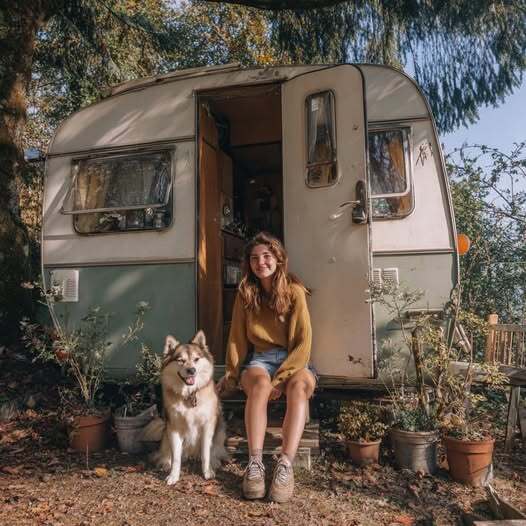
In a world dominated by sleek, mass-produced designs, the story of Ellie Yeater shines as a remarkable counterpoint. It all began not in a showroom or fancy studio, but in a dusty lot, where a weathered 1974 Williamscraft caravan sat forgotten. To most, it was nothing more than a $200 heap of corroded aluminum and water-stained wood—a relic of another era whispering only neglect. But to Ellie, fourteen years old and brimming with vision, it was a hidden sanctuary waiting to be reborn.
Her decision to buy the caravan was met with a mix of amusement and doubt. The exterior had faded to a ghostly gray, bleached by decades of sun and rain. Inside, damp air mingled with the scent of long-vanished adventures. The floorboards creaked, and the original 1970s paneling peeled away like shedding skin. Friends questioned whether she’d wasted her savings, while family feared the project would become an eyesore—a monument to youthful ambition that outpaced its creator.
Yet Ellie had a rare gift: the patience to see potential where others saw only decay. She had no professional training, no large budget, no team of contractors—only a modest savings, a small renovation fund, and an unshakable belief in learning by doing.
Her transformation process was not a slick montage from a DIY show—it was hard, relentless work. Throughout the hot summer months, Ellie became a devoted student of restoration. She scoured online tutorials, learning structural repair, how to sand away decades of grime, seal leaky windows, and navigate the challenges of a vintage interior. Each day, her hands were coated in paint, her hair dusted with sawdust, proving that determination could outweigh experience.
Ellie approached the renovation creatively, using what she had rather than buying new. Discarded wood became shelves, thrifted fabrics were sewn into cheerful curtains, and she abandoned the original drab colors in favor of airy pastels that reflected her youthful spirit. Every brushstroke was a declaration: beauty doesn’t need a luxury price tag, only vision and care.
Weeks turned to months, and the camper began to shine. The interior evolved into a whimsical, vintage-inspired retreat, with string lights casting a warm glow and carefully curated 1970s décor balanced with modern, cozy nooks for reading and reflection.
The entire project—including the initial $200 purchase—cost less than $1,000. When Ellie shared her before-and-after photos online, admiration poured in. The images went viral, inspiring thousands who saw in her work a reflection of their own untapped creativity. Many called her a “modern-day alchemist,” capable of turning a scrap heap into a sanctuary.
But for Ellie, the triumph was about more than aesthetics. Through building a home for her imagination, she built resilience, independence, and self-reliance. She learned she didn’t need adulthood or wealth to create something meaningful. The act of restoration became a teacher: nothing is truly beyond repair if you are willing to put in the work.
Her caravan now symbolizes resourcefulness and gratitude. In a culture that often discards the old and worn, Ellie’s project is a quiet rebellion—a celebration of honoring history while giving it new purpose.
Much like a person rebuilding after hardship, this forgotten $200 caravan found new life through care and determination. It’s a sanctuary not just for Ellie, but for the very idea of redemption itself, urging us to reconsider the things—and perhaps the people—we’ve deemed too old, too damaged, or too difficult to save.
Ellie Yeater’s journey is a heartfelt reminder that we all have “blank canvases”—ideas, dreams, or parts of ourselves left neglected. Her success proves that brokenness isn’t the end, but often the messy middle of a beautiful comeback.
Today, sitting in her pastel-hued nook, surrounded by the shelves and objects she restored herself, Ellie isn’t just in a camper—she’s in a testament to her own capability. With steady hands, patience, and a refusal to see only rust, she shows us that we can turn almost anything into a sanctuary. That $200 caravan is no longer a relic of 1974—it’s a doorway to a future where Ellie knows the full extent of what she can achieve. And perhaps the greatest restoration of all is the rebuilding of one’s belief in the limitless possibilities of what’s ahead.
