

Nobody looking at Ethan would guess how close he was to falling apart. He had perfected the art of the “functional mask.” He wore clean shirts, even if he had to iron them wet to get the wrinkles out because the dryer was broken. He smiled at neighbors in the hallway, a tight, polite grimace that didn’t reach his eyes, even when his stomach was growling loud enough to be heard over the radiator.
At thirty-eight years old, Ethan was a man eroding. He was raising three children alone in a cramped, second-floor walk-up in a part of the city where the streetlights flickered and the sirens never really stopped. The apartment smelled like old carpet, boiling cabbage, and leaking pipes—a scent of stale desperation that no amount of air freshener could mask. The walls were thin enough that he knew the neighbors’ television schedules and the rhythm of their arguments.
He looked at his children while they slept, and he felt a love so fierce it hurt, mixed with a terror so cold it kept him awake until dawn.
Nina was eleven, but her eyes held the weariness of a middle-aged woman. She had stepped into the void left by her mother without being asked. She braided Ruby’s hair in the morning, checked Sam’s backpack for permission slips, and knew exactly how to stretch a box of macaroni and cheese to feed four people. She was robbing herself of a childhood to keep the family afloat, and Ethan hated himself for letting it happen.
Ruby was seven, sensitive and gentle, a raw nerve in a harsh world. She was the kind of child who cried when she saw a dead bird on the sidewalk or a flower crushed by a tire. She absorbed the stress of the house like a sponge, getting stomach aches whenever the mailman dropped a red-lettered envelope through the slot.
Sam was five, a ball of chaotic energy and blind trust. He still believed that everything was an adventure. He didn’t know that “camping in the living room” was because the heat was turned off. He didn’t know that “breakfast for dinner” was because eggs were cheaper than meat. He was blissfully unaware that they were one bad month, one broken bone, one missed paycheck away from living in their 2008 Honda Civic.
Three years ago, life had been different. It had been in color.
Ethan’s wife, Lily, had been the sun in their solar system. She was vibrant, loud, and capable of making a grocery run feel like a party. Then came the aneurysm. One moment, she was laughing at the dinner table, reaching for the salt shaker, her eyes crinkling at the corners. The next, she was gone. Just like that. No goodbyes. No warnings. Just a silence that rushed in to fill the space she left behind.
The grief had hollowed Ethan out, scooping away his ambition and his joy, leaving a husk that went through the motions. But grief is expensive. The funeral costs, the ambulance bills, the single income—it all piled up like snow against a door until he couldn’t open it anymore. He had sold the house with the tire swing to pay the debts. He moved them into the apartment, promising himself it was temporary. Just until I get back on my feet, he had told the kids.
Three years later, “temporary” had calcified into “permanent.”
He worked every job he could find, piecing together a living from the scraps of the economy.
From 8:00 AM to 4:00 PM, he worked odd handyman gigs—fixing fences, painting nurseries for couples who had the future he used to have, unclogging drains that smelled of rot.
From 5:00 PM to 10:00 PM, he washed dishes at The Greasy Spoon, a diner where the steam turned his skin pruny and the manager screamed if a fork had a spot on it.
And from 11:00 PM to 3:00 AM, he scrubbed floors as a night janitor in a high-rise downtown. He pushed a heavy buffer over marble floors in silent lobbies where lawyers and bankers made millions, his reflection ghostly in the polished stone.
He barely slept four hours a night. He ate whatever the kids left on their plates—crusts of toast, half-eaten apples, the broth from the soup. Every single dollar went toward rent, shoes that fit growing feet, or groceries that were barely enough to fill the cupboards.
He was a machine of survival, running on fumes and fear.
The Park Bench
Every morning, on his walk from the bus stop to the high-rise for his cleaning shift—or sometimes on the way back, when the dawn was just breaking gray and cold—Ethan cut through majestic City Park. It saved him ten minutes, and ten minutes was precious currency.
And every morning, he saw them. The invisible residents of the city.
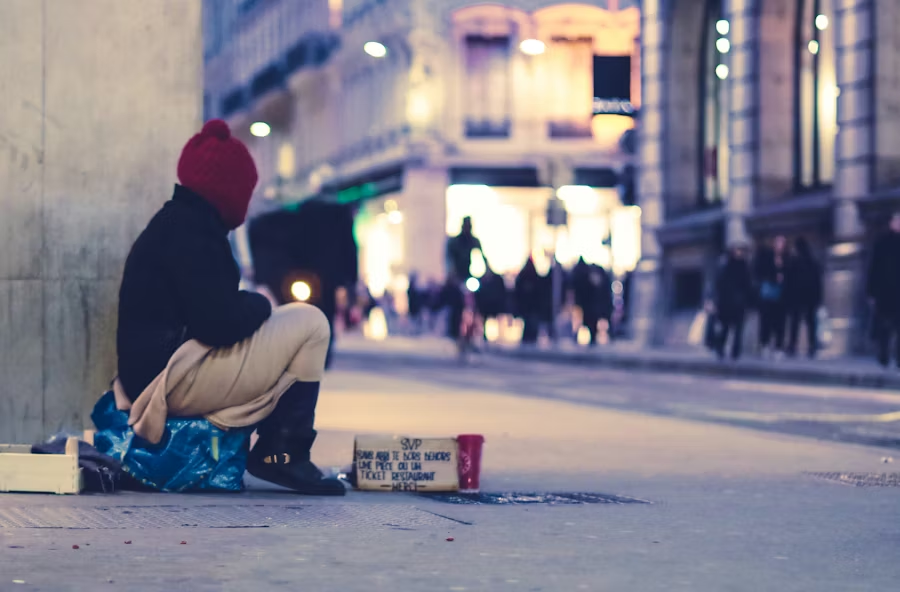
There were three homeless people who had claimed the wooden benches near the ornate, dry fountain. They huddled there, trying to catch the first weak rays of the sun or finding shelter from the wind behind the stone statues.
There was a woman who wore the same torn wool coat every day, muttering to herself, arguing with ghosts only she could see. There was a young man, barely older than a teenager, who sat shivering under the streetlights with a haunted, hollow look in his eyes, the look of someone who had seen too much too young.
And then there was the elderly man.
He sat on the furthest bench, the one under the oak tree. He had a dignity about him, even in his rags. He wrapped his hands in layers of newspaper to keep the frostbite at bay. He wore a suit jacket that was threadbare at the elbows and stained with mud, but he kept the buttons done up. He didn’t mutter. He didn’t beg. He just watched the world pass him by with eyes that were cloudy but sharp.
Ethan knew what cold felt like. He knew what hunger felt like—the sharp cramp in the belly that eventually turns into a dull, throbbing ache. Even though he had almost nothing himself, he couldn’t walk past suffering and pretend he didn’t see it. He saw himself in them—a few missed paychecks, a broken leg, a bad turn of luck away from that bench.
One Tuesday in November, the temperature plummeted. The wind cut through Ethan’s thin jacket like a knife. He had just finished a handyman job that paid in cash, $40 for fixing a porch rail. He needed that money for the electric bill.
But as he walked past the bench, he saw the elderly man shaking. Not just shivering, but vibrating with hypothermia.
Ethan stopped. He looked at the money in his hand. He looked at the man.
I can’t save everyone, he thought. I can barely save myself.
But Lily’s voice whispered in his ear, a memory of her kindness. If you have more than you need, build a longer table, not a higher fence.
He didn’t have more than he needed. He had less. But he walked to the pawn shop three blocks over.
He had an old toolbox in his backpack, a set of high-quality wrenches that had belonged to his father. They were the last thing of value he owned besides his wedding ring.
He put the toolbox on the counter. “How much?”
The pawnbroker looked at them, sneering. “Twenty-five.”
“They’re worth a hundred.”
“Twenty-five. Take it or leave it.”
Ethan took the twenty-five.
He went to the discount store. He bought three cheap fleece blankets, bright red and blue. He bought six cans of soup with pull-tabs so they didn’t need an opener. He bought a loaf of bread and a family pack of hand warmers.
He wrapped everything neatly in plastic bags to keep the damp out.
He walked back to the park. The elderly man was dozing, his chin on his chest.
Ethan placed the bag gently on the bench next to him. He didn’t want to wake him. He didn’t want the shame of gratitude. He tucked a handwritten note inside the bag, written on the back of an old utility bill envelope.
“These blankets are not lost. If you are cold, without shelter, or needing comfort, please take one. You matter.”
He didn’t sign his name. He just walked away, his breath forming clouds in the freezing air, hoping it would help. Hoping the universe might see him, too.
And he kept doing it.
It became a ritual. A tithe to humanity. Once a week, sometimes twice if he managed to pick up an extra shift or found money on the sidewalk. He brought blankets. He brought thick wool socks he found at Goodwill. He brought hot coffee in a thermos he would leave and collect later.
Some weeks, it meant skipping lunch entirely. Other weeks, it meant telling Nina they couldn’t afford new school supplies yet, seeing the disappointment in her eyes and feeling it like a physical blow to his gut.
“Why do you look so sad, Dad?” Ruby asked him one evening while he was heating up a can of beans.
“I’m just tired, baby,” he lied. “Just tired.”
But he couldn’t stop. Something inside him needed to help. It was a way of fighting back against the darkness that threatened to swallow him whole. It was a way of proving to himself that he was still a man who could provide something, even if it wasn’t for his own kids.
One morning, Ethan lingered. The elderly man was awake, eating a soft granola bar Ethan had left.
The man looked up. His eyes were a piercing blue, surprising in a face so weathered.
“You’re the one,” the man rasped. His voice was like dry leaves skittering on pavement.
Ethan froze. “I… I just had some extra.”
“Nobody has extra these days,” the man said. He gestured to the bench. “Sit?”
Ethan checked his watch. He had ten minutes before his shift. He sat.
“I’m Harold,” the man said. He extended a hand wrapped in a mitten Ethan had bought.
“Ethan.”
“You have kind eyes, Ethan. Sad, but kind.”
“Life is heavy,” Ethan admitted, surprised by his own honesty.
“Heavy,” Harold agreed. He looked at the skyscrapers looming over the park. “I used to work in one of those. Or maybe I didn’t. My memory… it’s like a book with pages torn out. But I remember the cold. And I remember the warmth you brought.”
They sat in silence for a moment. It was a comfortable silence, devoid of expectation.
“Why do you do it?” Harold asked.
“Because I’m afraid,” Ethan whispered. “I’m afraid this is where I’m headed. And I hope if I land here… someone will bring me a blanket.”
Harold nodded slowly. “Karma is a circle, Ethan. What you put out, it travels the world, but it always comes back home.”
Ethan stood up. “I have to go. Work.”
“Go,” Harold said. “But thank you. Not for the blanket. For seeing me.”
What Ethan didn’t know was that Harold saw him too. He saw the frayed cuffs. He saw the exhaustion. He saw the man holding the weight of the world.

The Note on the Bench
A month passed. Winter settled over the city like a frozen iron shroud. The temperatures dropped into the single digits. The wind was a physical assault.
Ethan’s situation was deteriorating. His hours at the diner were cut. The handyman gigs dried up in the cold. He was falling behind.
But he kept making his quiet morning trips to the park. He left them blankets, food, hand warmers. He even bought a small stuffed bear for the homeless woman, who had cried when she found it, clutching it to her chest and rocking back and forth, whispering a name Ethan didn’t know.
One morning, the routine broke.
Ethan approached the bench, a bag of hot breakfast sandwiches in his hand. The bench was empty. The blankets were gone.
In their place sat a single folded piece of paper, weighted down with a smooth gray stone to keep it from blowing away in the biting wind.
Ethan picked it up. His hands shook from the cold and a sudden spike of fear. Had something happened to Harold? Did the cold finally take him?
He unfolded the paper. The writing was shaky, slanted, written with a pencil that had been pressed hard into the paper.
“Thank you, whoever you are. You’re saving lives. I may not be here when you return, but I will not forget. You are the only warmth in a cold world.”
Ethan stared at the note. His eyes stung with unexpected tears. He hadn’t heard words like that in years. Nobody thanked him for working three jobs. Nobody thanked him for holding his family together with duct tape and hope. To the world, he was just a struggling dad, a statistic, a man failing in slow motion.
But to Harold, he was warmth.
He folded the note and put it in his wallet, next to the picture of Lily.
The Eviction
Life, however, does not run on karma alone. It runs on rent.
Two days later, reality kicked down the door.
Ethan came home from his night shift at 4:00 AM. He was bone-tired. He walked up the stairs, his boots heavy.
There was a paper taped to his apartment door. A bright orange piece of paper that glowed in the dim hallway light.
He knew what it was before he read it. He felt the nausea rise in his throat.
The tape made a harsh ripping sound as Ethan pulled it free. His hands trembled as he read the bold, black letters.
EVICTION NOTICE
“To the Tenant of Apt 2B: You are two months behind on rent. Total arrears: $2,400. You have one week to pay in full or vacate the premises. Failure to comply will result in Sheriff removal.”
One week. Seven days.
$2,400 might as well have been a million. He had $43 in his bank account.
Ethan unlocked the door and stepped into the silent apartment. He walked to the kids’ room. He stood in the doorway, watching them sleep. Nina was curled up tight. Ruby had her thumb in her mouth. Sam was sprawled out, kicking the blankets off.
If he didn’t fix this, they would be on the street. They would be the ones on the bench.
He went to the kitchen table and sat down. He put his head in his hands and wept. Silent, racking sobs that shook his shoulders. He didn’t make a sound. He couldn’t wake them. He couldn’t let them know their father was broken.
The next week was a blur of panic.
Ethan sold everything that wasn’t bolted down. The TV. The microwave. His winter coat (he told the kids he liked the cold). He went to a payday lender, but his credit was so shot they laughed him out of the office. He asked for advances at work. The diner boss said no. The cleaning company said it was against policy.
He scanned the apartment for anything of value. He looked at his wedding ring. A simple gold band. Lily had put it on his finger ten years ago.
“For richer or poorer,” she had said.
He took it off. He held it up to the light. It was the last piece of her he carried.
He walked to the pawn shop. The same man was there.
“Gold band,” Ethan said, his voice dead.
“Fifty bucks. Maybe sixty for the weight.”
Ethan took the ring back. He couldn’t do it. It wouldn’t make a dent in the rent, and it would cost him his soul.
He put the ring back on.
Day six.
He had raised $600. It wasn’t enough.
He sat the kids down for dinner. It was spaghetti with butter and salt. No sauce.
“Listen,” he said, trying to keep his voice steady. “We might… we might have to go on a little trip soon.”
“A trip?” Sam asked, eyes wide. “Like a vacation?”
“Sort of,” Ethan said. “We might have to stay at a motel for a while. Or maybe… with a friend.”
He didn’t have friends. He had alienated everyone in his grief and poverty.
Nina looked at him. She put her fork down. She knew. She saw the boxes he had started packing. She saw the orange paper he thought he had hidden.
“Dad,” she said softly. “It’s okay. We’ll be okay.”
Her bravery broke him more than her fear would have.
The Knock at the Door
Day seven. The deadline.
It was Saturday morning. The sun was bright and cruel, illuminating the dust motes in the half-packed apartment.
Ethan was sitting on the couch, staring at the door, waiting. He was waiting for the heavy knock of the landlord, or the Sheriff’s deputy. He had the bags packed by the door. He had told the kids to play in the bedroom and not come out until he called them.
He was rehearsing what he would say. Please, just a few more days. I have kids. It’s winter.
At 9:00 AM, the knock came.
It was three sharp raps. Precise. Professional.
Ethan’s stomach dropped to the floor. This was it. The end of the line.
He stood up, his legs feeling like lead. He walked to the door. He took a breath, unlocked the deadbolt, and opened it.
He expected the landlord, Mr. Gorsky, with his clipboard and his sneer.
But it wasn’t the landlord.
A distinguished older man stood on the porch. He was wearing a crisp gray suit that looked expensive. He had silver hair combed neatly to the side, and he held a leather briefcase. He looked like he belonged in a boardroom, or a country club, not on the doorstep of a crumbling apartment complex in the bad part of town.
“Mr. Ethan?” the man asked. His voice was cultured, smooth.
“Yes?” Ethan’s voice came out hoarse with worry. He gripped the doorframe. Was this a process server? A debt collector in a fancy suit?
“My name is Charles. I’m an attorney. May I come in? I have something very important to discuss with you.”
Ethan hesitated. “I… I don’t have money for a lawyer. If this is about the credit card debt…”
“It’s not about debt, Ethan,” Charles said, offering a small, reassuring smile. “Please. It will only take a moment.”
Ethan stepped aside. He had nothing left to lose.
Charles entered the apartment. He looked around at the peeling wallpaper, the boxes by the door, the distinct lack of furniture. He didn’t wrinkle his nose or look down on it; he just observed with a quiet sadness.
Nina peeked around the corner from the hallway, holding Ruby’s hand. Sam peered out from behind her legs.
“It’s okay, kids,” Ethan said, trying to keep the tremor out of his voice. “Go play for a bit. Daddy’s talking.”
They disappeared reluctantly. Charles set his briefcase on the scarred kitchen table. He opened it with two soft clicks that sounded loud in the quiet room.
He pulled out a photograph.
He slid it across the table toward Ethan.
Ethan looked down.
It was a grainy photo, taken from a distance, maybe from a car or with a zoom lens.
It was a picture of Ethan. He was in the park. He was wearing his old jacket. He was placing a stack of red blankets on the bench in the early morning light. The steam of his breath was visible. Harold was sleeping on the bench.
Ethan’s mouth went dry. His mind spun. Was helping homeless people illegal? Had he been reported for littering? For loitering? For trespassing?
“Ethan,” Charles said softly, seeing the panic in his eyes. “Please don’t be alarmed. You’re not in trouble. Quite the opposite, actually.”
Ethan stared at him with wide eyes. “Then what is this? Why were you watching me?”
Charles leaned forward, his expression warm and serious. “I think you deserve to know why I’m here. And who took that photo.”
Ethan gripped the edge of the table. His heart pounded against his chest like a bird trapped in a cage.
Charles folded his hands calmly and began to speak.
“The elderly homeless man you’ve been helping in the park,” Charles said. “The one with the frostbitten fingers. The one you sat with. His name was Harold. He was my father.”
Ethan blinked, trying to process the words. The man in the rags? The man who talked about karma?
“Your father?”
“Yes,” Charles continued, his voice thickening with emotion. “My father wasn’t always homeless. He was a successful philanthropist. He built libraries. He funded hospitals. He was a brilliant man. But five years ago, tragedy struck. His live-in caretaker… she betrayed him.”
Charles looked away, composing himself.
“She was supposed to care for him as his dementia began to set in. Instead, she stole his money. She stole his identification, his medical records, everything. She drove him to a city three hours away and left him on a street corner with nothing. She erased him.”
Ethan felt a cold horror wash over him. To do that to a human being…
“Because of his condition,” Charles said, “he couldn’t prove who he was. He was confused. Scared. The system failed him. He slipped through the cracks. He ended up on the streets, wandering, trying to find his way home but unable to remember the address.”
Ethan felt his throat tighten. He thought of the old man’s blue eyes, the flashes of clarity amidst the confusion.
“My family searched for him for years,” Charles said quietly. “We hired private investigators. We filed police reports. We put up flyers in every state. We never stopped looking. Then, three weeks ago, the police finally found him. A patrol officer recognized him from an age-progression photo we had circulated.”
Tears welled in Charles’s eyes. “He had collapsed in the park. Someone called an ambulance. They were able to identify him through old dental records once he was in the system.”
“Is he… is he okay?” Ethan asked, hope rising.
Charles shook his head slowly. “By the time we got to the hospital… it was too late. His body was too weak. The pneumonia took him the next day. He passed away surrounded by his family. He knew we were there. He knew he was loved at the end.”
Ethan’s chest ached. A heavy weight settled there. “I’m so sorry. I… I wish I could have done more. I should have brought him home. I should have—”
Charles reached out and put a hand on Ethan’s arm. “Stop. You did more than anyone. You did more than the hundreds of people who walked past him every day for five years.”
Charles wiped his eyes with a handkerchief.
“When the police recovered his belongings—what little he had in his pockets—they found a small, battered notebook. He kept it in his inside pocket, next to his heart.”
Charles pulled a small black notebook from the briefcase. It was water-stained and tattered.
“It was filled with stories about you,” Charles said. “He didn’t know your name at first. He called you ‘The Morning Angel.’ Then ‘The Kind Man.’ Then just ‘Ethan.’”
Charles opened the book to a marked page.
“He wrote about every blanket. Every cup of coffee. Every sandwich. But more than that… he wrote about how you looked at him. He wrote: ‘He looks me in the eye. He doesn’t look through me. He sits with me. He makes me feel human again when the world has forgotten I exist. He is poor, I can tell. His shoes are worn. But he gives me what he has. His kindness keeps me warm when the blankets aren’t enough.’”
Ethan couldn’t hold back his tears anymore. They spilled down his cheeks, hot and fast. He covered his face with his hands, sobbing.
“I didn’t know,” Ethan choked out. “I just… I just didn’t want him to be cold.”
Charles waited for Ethan to compose himself. Then he reached into his briefcase again. He pulled out a heavy cream envelope and a stack of legal documents.
“My father was lucid in his final hours,” Charles said. “He gave me very specific instructions. He made me promise. He said, ‘Find the man who saved me. Find Ethan. Give him the chance at life he gave me. Make sure he never knows the cold again.’”
Ethan looked down at the papers through blurred vision.
He saw a deed.
Warranty Deed. Property Address: 42 Maplewood Lane.
“This is a house,” Charles said. “It’s fully paid for. It’s in a good school district. It has a backyard for the kids. It has a new roof. It’s yours.”
Ethan shook his head. “I can’t… I can’t accept a house.”
“There’s more,” Charles said gently.
He laid a cashier’s check on the table.
Ethan looked at the numbers. He blinked. He counted the zeros.
$500,000.00
“This is enough to pay off your debts,” Charles said. “Enough to take a breath. Enough to stop scrubbing floors at 3 AM.”
He laid down another set of papers.
“And these are trust documents. My father established a scholarship fund for Nina, Ruby, and Sam. Their college education is fully covered. Tuition, board, books. Whatever they want to study, wherever they want to go. It’s paid for.”
Ethan felt like the room was spinning. The eviction notice on the counter seemed to dissolve into smoke.
“And finally,” Charles said, handing him the envelope, “a letter. He wrote this the night before he died. His hand was shaking, but he wanted you to have it.”
Ethan took the letter. He opened it with trembling fingers.
“Dear Ethan,
You didn’t know me. You didn’t owe me anything. You have your own burdens, I saw them in your shoulders. But you saw me when no one else did. You gave me warmth when I was cold. You gave me food when I was hungry. Most importantly, you gave me hope when I had none left. You reminded me that there is still good in this world, that humanity hasn’t frozen over.
I cannot take my money with me where I am going. But I can use it to lift you up. I want you to have what I can no longer use. Take care of your beautiful children. I saw them once, walking with you. They are good kids. Live the life you deserve. Be happy.
Thank you for being my angel in the park. Thank you for walking me home.
Your friend, Harold.”
Ethan sobbed openly now, his shoulders shaking with relief and grief and gratitude. The sound brought the kids running.
Nina, Ruby, and Sam ran into the kitchen. They saw their dad crying. They ran to him, wrapping their small arms around his waist, burying their faces in his shirt.
“Daddy, what’s wrong?” Ruby cried. “Are the bad men coming?”
Ethan pulled them close, smelling their hair, feeling their warmth. He looked at the eviction notice, then at the deed to the new house.
“No, baby,” he whispered, kissing the top of her head. “No bad men. The bad times are over.”
He looked at Charles.
“We’re going to be okay,” Ethan said to his kids. “We’re going to a new home.”
Charles stood, smiling warmly despite the tears in his own eyes. He closed his briefcase. “My father wanted you to know that kindness is never wasted. It always finds its way back, sometimes when you need it most.”
Ethan stood up, his children clinging to his legs. He looked different. Taller. The weight was gone.
“Thank you,” Ethan whispered. “Thank you for finding me.”
Charles shook his hand firmly. “No, Ethan. Thank you for finding my father.”

The New Beginning
A month later, the apartment was empty. The keys were left on the counter.
Ethan drove the Honda Civic up the driveway of 42 Maplewood Lane. It was a beautiful house with blue siding and a big oak tree in the front yard.
The kids screamed with joy, running into the yard, claiming bedrooms, rolling in the grass.
Ethan stood on the porch. He breathed in the fresh air. He didn’t smell cabbage or old carpet. He smelled pine and hope.
He didn’t work three jobs anymore. He worked one, at a nonprofit helping the homeless, using his experience and Harold’s grant money to change the system. He was home for dinner every night. He helped with homework. He slept.
He walked to the backyard. There was a garden bench there.
He sat down. He pulled the old, tattered notebook out of his pocket—Charles had let him keep it.
He touched the page where Harold had written about him.
He makes me feel human.
Ethan looked up at the sky.
“Thank you, Harold,” he whispered.
And in the rustle of the leaves, he felt a warmth that had nothing to do with the sun.
Let us know what you think about this story on the Facebook video! If you like this story share it with friends and family.
