
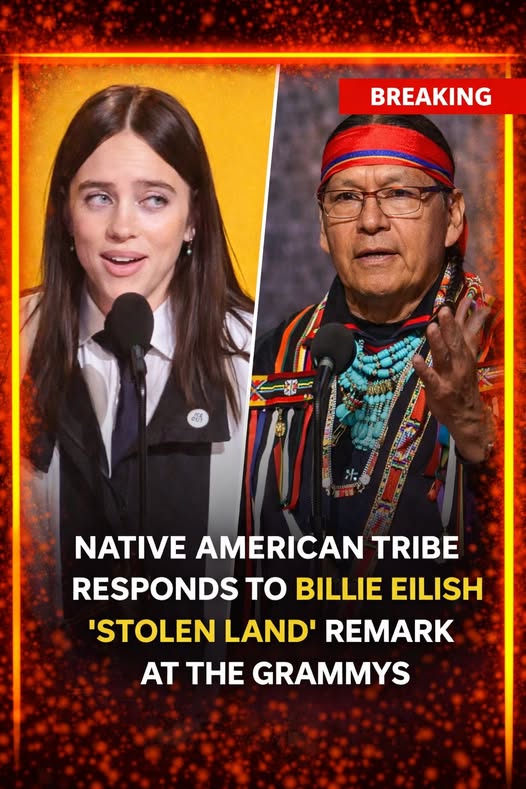
Billie Eilish’s standing ovation didn’t tell the whole story.
When she declared “no one is illegal on stolen land” from the Grammys stage, the Crypto.com Arena erupted. Cameras caught applause, nods, cheers—the kind of reaction that signals a cultural moment. Within minutes, the line ricocheted across social media, hailed by supporters as brave and condemned by critics as performative or divisive. Politicians weighed in. Pundits sharpened their knives. The backlash was loud, predictable, and relentlessly focused on Billie herself.
But somewhere beneath the noise, the people whose land she referenced were listening.
The Tongva—First People of the Los Angeles Basin and the Indigenous nation whose ancestral territory includes the very ground where Eilish lives, records, and performs—had been invoked without being consulted. For days, they watched as others debated what her words meant. Then, quietly and deliberately, they spoke for themselves.
Their response was not angry. It was measured. And that restraint made it harder to dismiss.
Yes, they said, they appreciated the visibility. In a country that has spent generations erasing Indigenous nations from public memory, hearing a global pop star acknowledge “stolen land” on one of music’s biggest nights mattered. It cracked a door that is so often sealed shut. But appreciation did not mean absolution.
The Tongva reminded the public of something rarely said aloud: Billie Eilish’s Southern California home—like the arena that applauded her—sits on Tongva land. And despite her words, there has been no direct outreach. No conversation. No relationship.
Their message cut through the political theater that followed the speech. While figures like Ron DeSantis mocked the sentiment and online commentators demanded celebrities “give their land back,” the Tongva asked for neither spectacle nor sacrifice. They did not call for her house. They did not demand punishment.
They asked for recognition that doesn’t end at a microphone.
What they want, they explained, is explicit acknowledgment—by name. They want partnerships, not slogans. Real relationships, not symbolic lines that trend for 24 hours and vanish. They pointed to tangible steps: working with the Recording Academy to normalize land acknowledgments, ensuring the Tongva name is spoken as naturally as Los Angeles itself, and using cultural power to amplify living Indigenous communities, not just historical footnotes.
In other words, they asked for something far more uncomfortable than applause.
They asked to be seen after the lights go down.
Their closing words carried a weight no standing ovation could replicate: “Ekwa Shem — We are here.” Not as a rebuke, but as a reminder. The land is not abstract. The people are not past tense. And acknowledgment, if it means anything at all, must move beyond the stage and into sustained action.
Billie Eilish’s speech ignited a conversation. The Tongva are asking whether she—and the industry that celebrated her—are willing to continue it.
