
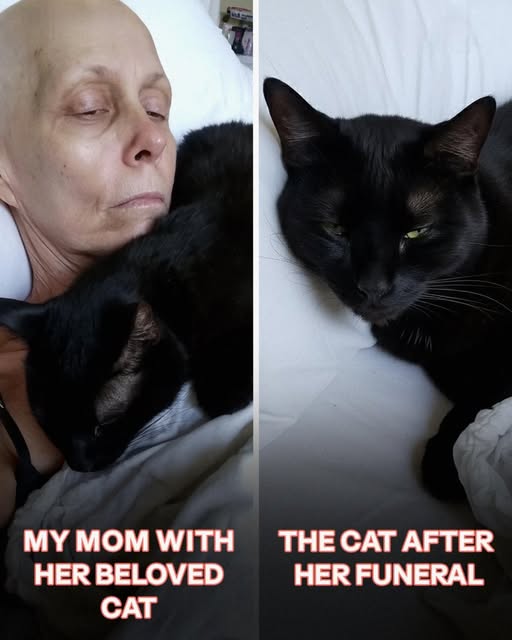
Four days before Christmas, the house felt frozen in time. The string lights my mother had insisted on hanging far too early still glowed along the window frames, casting a soft, uneven warmth that clashed painfully with the silence she left behind. She had loved Christmas lights, even when cancer hollowed her out, even when chemo took her strength. Sparkle, she said, reminded her she was still here.
Now she wasn’t. And the only thing anchoring me to her was her black cat, Cole.
My mother died a few weeks earlier, quietly, after a long fight with cancer that demanded more bravery than anyone should have to give. In her final days, she made me promise I would still decorate the tree. She made me say it out loud, her voice thin but insistent. I agreed, swallowing the scream rising in my chest, because when someone is dying, you don’t deny them comfort. You carry it for them.
Cole had been her shadow long before the diagnosis, but afterward, he became something else entirely. He slept curled on her chest, directly over her heart, as if guarding what little time she had left. She joked that he was her nurse, but I knew better. He was holding her together in a way I couldn’t. Watching them sometimes hurt so much I had to turn away.
After the funeral, Cole followed me everywhere. He didn’t meow. He didn’t wander. He stayed close, silent, grieving alongside me. He was the last living piece of my mother’s presence in that house.
Then he disappeared.
I don’t know how long he was gone before panic hit. Grief distorts time. One moment I was moving through the day mechanically, the next I noticed the couch was empty. The spot near the radiator where Cole always slept was cold. The back door hadn’t latched properly.
I searched the neighborhood in boots and tears, calling his name until my throat burned. I posted online. I taped flyers to poles. I knocked on doors and said he was special, because I didn’t know how to explain that losing him would mean losing my mother all over again.
No one had seen him.
Each night I sat on the porch wrapped in a blanket, leaving food out, listening to the wind, imagining the worst. The thought of him alone in the cold, frightened and hurt, broke something inside me that was already splintered.
Christmas Eve arrived gray and bitter. I hadn’t eaten properly in days. The tree stood half-decorated, ornaments scattered like glass wounds across the table. I sat on the kitchen floor in the dark, knees pulled to my chest, shaking from grief, exhaustion, and the crushing loneliness that comes after loss.
I whispered his name into the empty house.
Then I heard it—a soft thud against the back door.
I froze, afraid hope was playing another trick on me. When I opened the door, there he was.
Cole stood on the step, thinner than before, dirt clinging to his paws, eyes sharp and steady. In his mouth, he carried my mother’s favorite glass bird ornament, the one she always placed front and center on the tree. He dropped it gently at my feet.
Something in his posture told me this wasn’t just a return. It was an invitation.
Without a sound, he turned and walked away. I followed him barefoot into the cold, across the yard, past the frozen flowerbeds my mother once fussed over like children. He glanced back repeatedly, making sure I stayed with him.
We walked streets I hadn’t thought about in years. Then I saw it—our old house.
The one we lived in when I was little. The porch swing. The oak trees. The place where my mother used to sit with iced tea, telling me stories while summer cicadas screamed in the dusk. It was where Cole had first lived too, rescued as a shivering kitten and brought home wrapped in her scarf.
Cole padded up to the walkway and sat, waiting.
I was crying before I reached him.
The door opened, and an elderly woman stepped out, silver-haired, wrapped in a cardigan. She wasn’t surprised to see me. Her eyes softened when she saw Cole.
“There you are,” she said to him gently. Then she looked at me. “He’s been coming by for days. I figured he was looking for someone.”
Inside, the house smelled of cinnamon and warmth. She poured tea, set down cookies, and let me fall apart at her table. I told her everything—about my mother, the cat, the fear of letting go, the way Christmas felt wrong without her. She listened without interrupting.
“I lost my son years ago,” she said quietly. “Grief doesn’t disappear. It changes shape. Slowly, it makes room.”
We spent Christmas Eve together, two strangers bound by loss. Cole slept beside me, purring steadily. When I finally walked home, the glass bird was safe in my pocket.
Back in my mother’s house, I finished decorating the tree. I placed the ornament exactly where she always did. For the first time since she died, the silence didn’t feel empty. It felt full—of memory, love, and quiet resilience.
Grief doesn’t mean letting go. It means learning to carry what you’ve lost while still choosing to live. Sometimes, healing arrives in unexpected forms—on cold nights, through acts of kindness, or disguised as a cat leading you exactly where you need to go.
This story of loss, emotional healing, Christmas grief, and unconditional love reflects how pets help process bereavement, how memory anchors us after death, and how human connection appears when we least expect it. In moments shaped by cancer loss, holiday depression, and emotional recovery, what saves us isn’t forgetting—it’s remembering we are not alone.
