
Two days after my husband died, his mother told me to get out.
No condolences. No hesitation. Just a flat voice and words I still hear in my sleep: “You and your child mean nothing to me.”
My name is Mia. I was twenty-four years old, standing in the hallway of the apartment I’d shared with my husband, Caleb, holding our three-week-old son. I was still wearing the same black dress I’d worn to the funeral. Noah was pressed against my chest, warm and fragile, unaware that the ground beneath us had just disappeared.
Deborah didn’t look at me like a grieving widow. She looked at me like a mistake.
“Where am I supposed to go?” I asked, my voice cracking.
She glanced at Noah—really looked at his face—and her mouth tightened in disgust. “Not my problem.”
Then she shut the door. I heard the lock slide into place.
I stood there frozen until Noah started crying. That sound snapped me back into my body. I picked up the suitcase I’d packed without really thinking, slung the diaper bag over my shoulder, and walked out.
The only thing I took that wasn’t strictly necessary was Caleb’s hoodie. It still smelled like him. I couldn’t breathe without it.
Caleb and I had fought so hard to have Noah. Years of doctors, tests, quiet tears in bathroom stalls. When the pregnancy test finally turned positive, we cried on the bathroom floor like children. Caleb whispered promises to a baby who didn’t even exist yet.
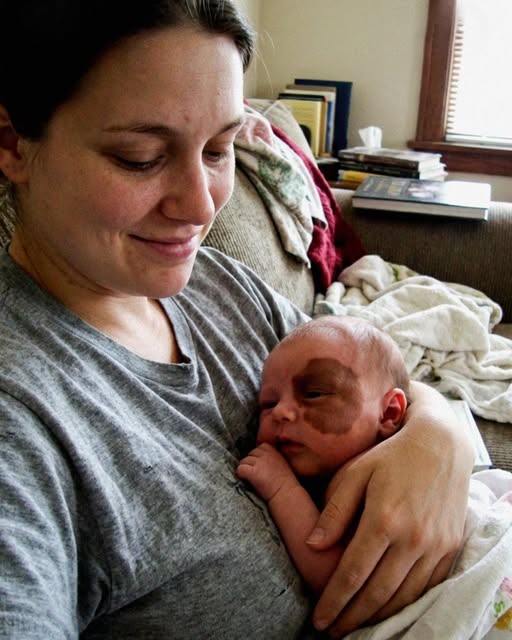
When Noah was born, the room went quiet in that awful, polite way people get when something isn’t “perfect.” He had a large birthmark covering half his face. I panicked immediately, already imagining the stares, the cruelty, the explanations I’d have to make for the rest of his life.
Caleb didn’t hesitate for a second. He kissed Noah’s forehead and whispered, “Hey, buddy. We’ve been waiting for you.”
Deborah stared too long. Then she looked at me like I’d done something wrong. Like I’d painted that mark onto my child on purpose. After that, the comments started—little doubts wrapped in polite words. Questions that didn’t sound like accusations but felt exactly like them.
Caleb tried to shield me. “She’ll come around,” he said.
He never got the chance to be proven wrong.
One normal afternoon, one ordinary day, and then a phone call that turned my blood to ice. A heart attack at twenty-seven. I don’t remember the drive to the hospital. I only remember someone saying the words out loud and the world breaking in half.
The funeral passed in a blur. Deborah cried loudly, dramatically, like grief needed an audience. I held Noah like an anchor, terrified that if I let go of him, I’d disappear too.
A week later, she showed me who she really was.
She let herself into the apartment—her name was on the lease, after all—and told me I had to leave. I was still barely sleeping, still reaching for my husband in the middle of the night before remembering he was gone.
Then she said it. That Noah probably wasn’t Caleb’s. That I’d trapped her son.
I left with a suitcase, a diaper bag, a hoodie, and my newborn.
The weeks that followed were pure survival. Friends’ couches. Cheap motels. Anywhere that would tolerate a crying baby. Every time Noah cried, I felt like I was failing him. Every stare at his birthmark felt like confirmation that the world agreed with Deborah.
One afternoon, a car splashed dirty water all over us as we walked home from the store. The driver stopped, furious—until she saw my face. Saw Noah. Saw that I couldn’t stop crying.
Her name was Harper. She was a lawyer.
I told her everything on the sidewalk, shaking, exhausted, empty. She listened without interrupting. Then she said quietly, “I know that kind of woman. And I can help you.”
A few days later, Deborah called.
Her voice was sweet, warm, almost loving. She invited us to dinner. Said she didn’t want enemies. Some broken part of me wanted to believe her.
The dinner was perfect on the surface. Candles. Home-cooked food. Deborah cooing at Noah, calling him her precious grandson. For a moment, I almost believed it.
Then she mentioned the money. The savings Caleb had set aside for us. The house he planned to buy.
And then she told me she deserved most of it.
When I refused, the sweetness vanished. She threatened to take everything. To ruin me. To fight until I was broke.
I called Harper as soon as I stepped outside.
The weeks that followed were brutal, but different. This time, I wasn’t alone. Deborah tried everything—lies, threats, even hints about taking my child—but the truth didn’t bend.
Caleb had protected us. Even after death.
When Harper finally said, “It’s done,” I didn’t understand at first. Then I cried harder than I ever had in my life. Grief didn’t disappear, but relief moved in beside it.
A month later, I signed papers for a small house. Nothing fancy. Just ours.
On moving day, sunlight spilled across the empty living room. Noah blinked up at me, his birthmark soft in the light, and for the first time I didn’t think about cruelty or loss.
I just thought, We made it.
Deborah never apologized. She never mattered again.
I learned that family isn’t blood. It’s who shows up when you’re at your lowest. Love doesn’t end when someone dies—it becomes protection, plans, and quiet safety.
Caleb isn’t here. But his love still is.
And that’s enough.
