
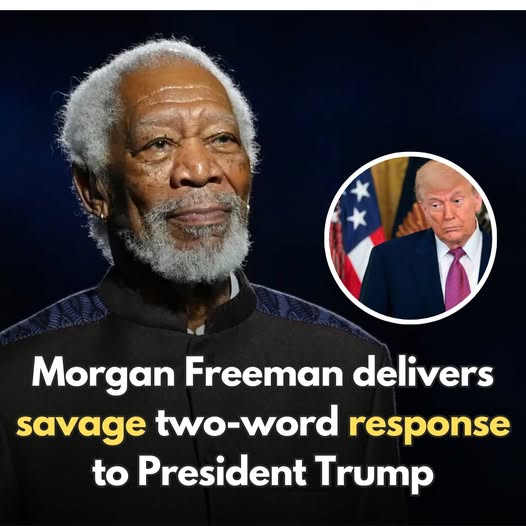
Oscar-winning actor Morgan Freeman has become the latest prominent Hollywood figure to publicly criticize President Donald Trump, adding his voice to an already heated national debate over foreign policy, presidential rhetoric, and political accountability.
Since returning to the White House in January 2025 for a second term, Trump has remained at the center of controversy. His administration has renewed aggressive immigration enforcement through Immigration and Customs Enforcement, revived discussions around an expanded missile defense concept informally dubbed the “Golden Dome,” and stirred international reaction with remarks about Greenland. Each move has drawn strong support from allies and sharp criticism from opponents.
Recently, attention has shifted to rising tensions between the United States and Iran. Reports suggest internal administration discussions have included possible military timelines, although no final decision has been publicly announced. At the same time, the White House maintains that diplomatic options remain under consideration.
Press Secretary Karoline Leavitt stated that while President Trump prefers a peaceful resolution, Iran would be “very wise” to negotiate a deal regarding its nuclear program. Her comments come amid renewed global concern over nuclear proliferation and broader instability in the Middle East.
Against this backdrop, Freeman posted a brief but pointed message on social media that quickly went viral. Rather than offering an extended statement, the 88-year-old actor shared a screenshot of a 2011 post written by Trump. Freeman’s caption contained just two words: “This you?”
The resurfaced 2011 post read: “In order to get elected, @BarackObama will start a war with Iran,” referencing former President Barack Obama. By pairing that decade-old statement with current headlines about possible military action, Freeman appeared to question whether the president’s present posture conflicts with his earlier claims.
The reaction online was immediate and polarized. Some users defended Trump, arguing he has already been elected and has no political incentive to manufacture conflict. Others praised Freeman’s brevity, calling it a sharp example of how the phrase “This you?” has become shorthand for highlighting perceived inconsistencies in public figures’ past statements.
The exchange unfolds during heightened global anxiety. The Bulletin of the Atomic Scientists and its symbolic Doomsday Clock are frequently cited in discussions about nuclear risk and geopolitical instability. While the clock itself is metaphorical, its proximity to “midnight” reflects widespread concerns about escalating international tensions.
Although President Trump has not authorized military action, major outlets report that strategic options have been reviewed. Officials continue to stress that no final determination has been made.
Freeman’s post is not his first venture into political commentary. The actor, best known for films like The Shawshank Redemption, has previously spoken about U.S. politics. During the 2016 election cycle, he appeared in a video for the Committee to Investigate Russia, criticizing Trump’s relationship with Russian President Vladimir Putin and warning about alleged election interference. That advocacy later contributed to Freeman being permanently banned from Russia in 2022.
Ahead of the 2024 election, Freeman also appeared in a campaign-style video alongside actors such as Bill Pullman, Geena Davis, Michael Douglas, and Tony Goldwyn. In the video, President Joe Biden sought fictional advice from actors who had portrayed U.S. presidents on screen, underscoring Freeman’s political alignment during that campaign season. Despite rumors to the contrary, a spokesperson previously clarified that Freeman had not endorsed Trump’s reelection.
Freeman now joins a growing list of entertainers weighing in on current policy debates. Giancarlo Esposito, known for his role in Breaking Bad, recently criticized immigration enforcement policies. Woody Harrelson has also voiced frustration with the administration. Meanwhile, Trump continues to receive support from figures such as Jon Voight, Mel Gibson, Sylvester Stallone, and Kelsey Grammer.
The divide within Hollywood mirrors broader political polarization across the country. Debates about celebrity activism, public trust in institutions, and the influence of social media continue to shape national conversation.
Freeman’s message stands out precisely because of its simplicity. In a media landscape saturated with lengthy statements and televised debates, two words were enough to spark widespread discussion. Whether President Trump will respond remains uncertain, though he has historically addressed high-profile criticism when it trends online.
For supporters, Freeman’s post emphasizes accountability and political memory. For critics, it reduces complex geopolitical realities to a viral soundbite.
What remains clear is that tensions surrounding Iran are serious and evolving. Diplomatic negotiations, sanctions, and military preparedness all factor into the situation. Any decision involving force would carry significant international consequences.
In that climate, Freeman’s brief question functions less as policy advocacy and more as a reminder that past rhetoric can resurface at pivotal moments. In today’s interconnected media environment, even two words can echo far beyond Hollywood—shaping debate at the heart of national and global discourse.
