
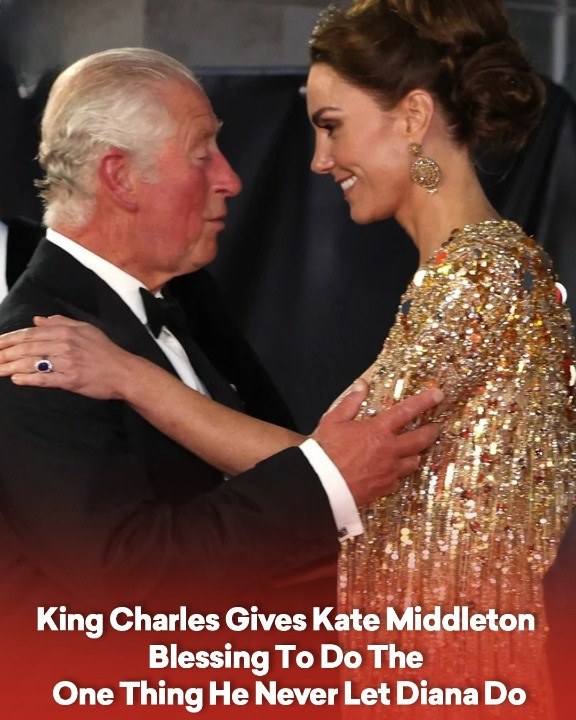
The halls of Buckingham Palace have long echoed with the tension of eclipsed influence and overshadowed prominence. For generations, the British monarchy wrestled with the delicate balance between the crown and the charisma of its members, often producing friction when a spouse’s popularity outshone the reigning figure. The most famous example remains the late Princess Diana, whose radiant presence and widespread public admiration created deep-seated strain with then-Prince Charles. Yet in 2025, King Charles III seems to have charted a markedly different course—one that signals growth, maturity, and a forward-looking vision for the monarchy. According to palace insiders, Charles has granted Kate Middleton the one thing he never allowed Diana: the freedom to occupy the public spotlight and take center stage.
Royal experts report that King Charles has officially sanctioned the Princess of Wales to step into a leading public role, essentially giving her permission to “steal the limelight.” This is a significant concession from a man who, in his youth, experienced the sting of being sidelined during royal tours, watching the adoration of the public gravitate toward Diana. During the 1980s, Charles’s frustration at the attention lavished on his young wife was palpable, and Diana herself confirmed in her famous 1995 Panorama interview that her immense popularity created a strain on their marriage.
Now, as King, Charles appears to recognize that the survival and relevance of the monarchy hinge on a willingness to share influence rather than hoard it. Earlier reports hinted at palace anxieties that Prince William and Kate’s soaring popularity might overshadow the King and Queen Camilla. Yet, the reality of 2025 shows a monarch who has evolved: Charles sees Catherine not as a rival but as a vital asset—the public-facing figure who can connect with a modern, media-savvy audience while ensuring the House of Windsor remains respected and adored.
Royal biographer Robert Jobson suggests that Charles has attained a level of personal and professional maturity that allows him to embrace the prominence of his daughter-in-law. By acknowledging that media attention and public affection naturally gravitate toward the younger generation, Charles demonstrates an understanding that the monarchy’s longevity depends on a balance between tradition and accessibility. He knows that while the crown grants him authority, the monarchy itself thrives when the public is emotionally invested in the royal family as a whole—particularly in William and Catherine.
This evolving dynamic was on full display during Kate’s unannounced visit to the Chelsea Flower Show. Once, such an appearance might have been criticized as a breach of protocol or an attempt to upstage the senior royals. Instead, the visit was received with an implicit endorsement from King Charles, signaling a strategic embrace of Catherine’s growing influence and an acknowledgment of her ability to sustain the monarchy’s relevance in the public eye.
King Charles’s blessing is as pragmatic as it is symbolic. He recognizes the importance of connecting with younger generations, who often feel distanced from the monarchy’s rigid traditions. William and Catherine have mastered modern engagement, utilizing social media to share curated glimpses of their charitable work and family life, presenting a monarchy that is both relatable and aspirational. By allowing Kate to take the lead in public engagement, Charles is effectively safeguarding the monarchy’s future, ensuring the throne remains emotionally resonant for decades to come.
This shift also marks a notable change in the internal dynamics of the royal family. Unlike the competitive tension that defined previous decades, Charles and Catherine now operate from mutual respect and shared purpose. Kate has proven herself steady, composed, and empathetic—qualities that have earned the King’s admiration. In many ways, she serves as a bridge between the old guard and the new, fulfilling a role that Diana, constrained by circumstance and protocol, could never occupy.
Furthermore, Charles’s decision is a subtle act of personal redemption. By endorsing Catherine’s visibility, he consciously avoids repeating the jealousies and conflicts that marked his own past. It reflects a leader confident in his position, secure enough to allow another to shine without feeling diminished. It is an acknowledgment that leadership is not about monopolizing attention but about empowering others to contribute to the institution’s strength.
Looking forward, the image of King Charles giving Kate Middleton his blessing represents a historic turning point. It signals a transition from rivalry to collaboration, from tension to partnership. The limelight—once a source of envy and strife—has become a shared tool for the preservation and evolution of the monarchy. While Charles wears the crown, he has entrusted Kate with the hearts of the people, forging a partnership that may well determine the institution’s longevity and public esteem.
Ultimately, Charles has embraced a truth he took decades to internalize: the sun does not lose its brilliance by allowing the moon to shine. By supporting Kate as the face of a modern monarchy, he ensures that when William eventually ascends the throne, he will do so with a consort already celebrated and embraced by the world. It is an act of grace, foresight, and leadership—proof that true strength lies not in guarding the spotlight, but in knowing when to let someone else illuminate the way.
