
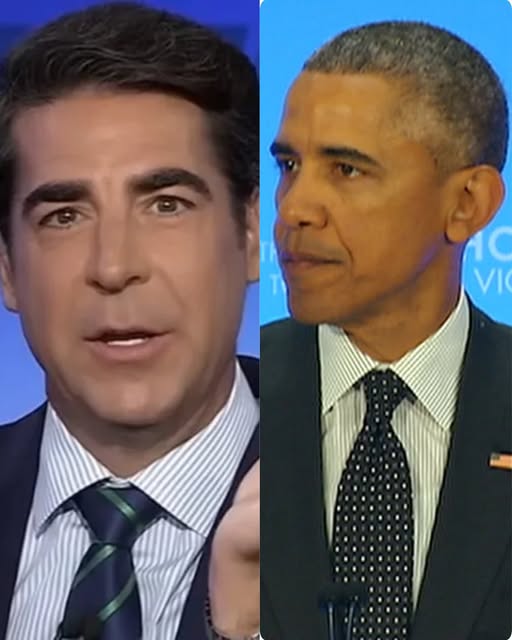
Political commentator and FOX News host Jesse Watters has once again ignited controversy after comments circulating online claimed he had “reclassified” what he calls the “deep state,” allegedly led by former President Barack Obama, as a criminal organization. The statements, widely shared on social media and partisan blogs, describe a sweeping narrative involving embedded operatives, federal task forces, and growing public support for dismantling an alleged shadow network within the U.S. government.
However, a closer examination reveals that many of these assertions are rhetorical claims rather than verified facts, and several key elements of the story lack confirmation from credible or official sources.
What Jesse Watters actually represents
Jesse Watters is known for his sharp, provocative commentary and combative political style. As the host of Jesse Watters Primetime, he frequently uses charged language to critique Democratic leadership, government institutions, and what he broadly describes as entrenched bureaucratic power. His use of the term “deep state” fits squarely within this tradition of political rhetoric rather than formal legal classification.
To date, there is no legal or institutional process by which a television commentator can “reclassify” an organization as criminal, nor has any U.S. court or federal authority designated a so-called “deep state” as a criminal entity.
Claims attributed to a spokesperson
Viral posts quote an alleged spokesperson for Watters, Jan O’Berro, asserting that “there is a deep state operating within the sovereign nation we know and love” and that it is “immoral and unconstitutional.” Yet no verified public records, press briefings, or official FOX News communications confirm the existence of such a spokesperson or such a statement.
This absence of sourcing is significant. In journalism, claims involving criminal conspiracies—particularly those implicating former presidents—require clear attribution, documentary evidence, and corroboration from multiple independent sources. None have been provided in this case.
The Justice Department task force claim
Perhaps the most consequential assertion circulating online is that the U.S. Department of Justice is allegedly forming a task force involving FBI, ATF, and other federal agents to dismantle the so-called deep state.
As of now, there is no public announcement from the Department of Justice confirming the creation of such a task force. Federal agencies routinely disclose the formation of major inter-agency initiatives, particularly those involving domestic intelligence or constitutional issues. The absence of any official record strongly suggests that this claim is either speculative or entirely unfounded.
Allegations involving Barack Obama
Some versions of the story allege that former President Barack Obama is “operating openly” while directing deeply embedded agents within U.S. infrastructure. These statements represent political accusation rather than substantiated fact.
No credible investigation, indictment, or intelligence assessment has concluded that Obama leads or directs a criminal organization within the federal government. Repeating such claims without evidence risks crossing from political commentary into misinformation.
Public opinion claims under scrutiny
The assertion that “65% of Americans support dismantling the deep state” is frequently repeated in online discourse but is not tied to a specific, verifiable poll. While surveys do show that trust in government institutions has declined across the political spectrum, framing this sentiment as majority support for dismantling an undefined entity called the “deep state” oversimplifies and distorts public opinion.
Polling experts note that responses can vary dramatically depending on how questions are worded and whether respondents interpret “deep state” as bureaucracy, intelligence agencies, political elites, or something else entirely.
Why these narratives gain traction
Media analysts argue that stories like this flourish because they combine:
-
Familiar political villains
-
Vague but ominous language
-
References to secret operations
-
A promise of dramatic revelation
When presented without evidence but repeated frequently, such narratives can feel credible—especially in highly polarized media environments.
Watters’ on-air persona thrives on confrontation and bold framing, but provocative commentary should not be mistaken for factual reporting or legal action.
The line between commentary and reality
It is important to distinguish between political opinion and institutional action. Watters, like many commentators, uses strong language to mobilize his audience and express ideological positions. That does not mean federal agencies are acting on those claims, nor that legal processes are underway.
At present:
-
No DOJ task force has been confirmed
-
No criminal designation has been issued
-
No evidence links Obama to an illegal organization
-
No verified spokesperson statements support the viral quotes
The bottom line
The story portraying Jesse Watters as spearheading an official effort to dismantle a criminal “deep state” led by Barack Obama is not supported by verifiable facts. What exists instead is a blend of political rhetoric, online amplification, and speculative storytelling presented as news.
For audiences navigating today’s information landscape, skepticism and source verification remain essential—especially when claims involve criminal accusations, national security, and former presidents.
Until credible evidence emerges, these claims remain part of political discourse, not documented reality.
