
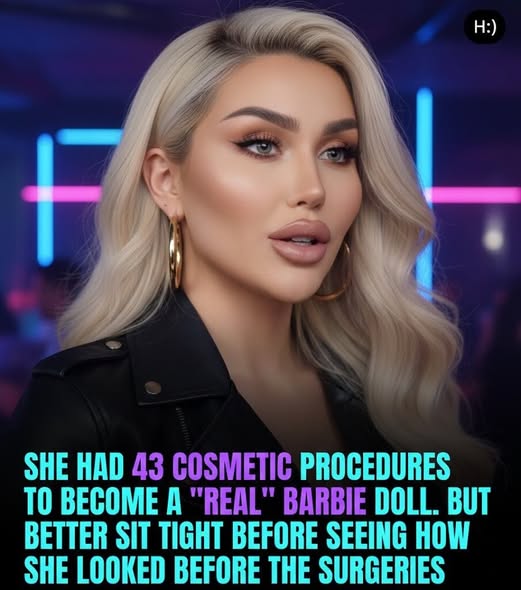
Dalia Naeem, a twenty-nine-year-old actress and television host from Baghdad, has become the center of widespread online discussion after revealing a dramatic physical transformation reportedly achieved through forty-three cosmetic procedures. Her newly unveiled appearance, marked by golden-blonde hair, pronounced facial contours, and a highly stylized aesthetic, has led many social media users to nickname her “Iraqi Barbie.” The moniker references the doll-inspired features she now embraces, including sculpted cheekbones, fuller lips, and a carefully contoured jawline designed to create a symmetrical, polished look. In a recent video appearance alongside her makeup artist, Naeem posed confidently while he complimented her transformation, telling her she looked “like Barbie.” The clip spread rapidly across platforms, drawing millions of views within days and igniting conversations not only about beauty standards but also about the cultural, psychological, and medical implications of extensive cosmetic modification. What might once have been a personal decision discussed quietly within close circles instead unfolded under the intense scrutiny of a global digital audience.
The reactions to Naeem’s transformation have been deeply divided, highlighting the complex and often contradictory attitudes society holds toward aesthetic enhancement. Supporters describe her appearance as glamorous, bold, and empowering, applauding her willingness to pursue a vision of beauty that aligns with her personal ideals. They argue that cosmetic procedures, when chosen freely and performed safely, represent autonomy and self-expression. In their view, Naeem’s confidence and public embrace of her transformation signal strength rather than insecurity. Critics, however, have expressed discomfort, with some commenters using harsh language to describe her look as unnatural or excessive. Terms such as “Zombie” and “Devil Barbie” surfaced in online threads, illustrating how quickly admiration can shift into ridicule in digital spaces. This polarized response underscores how cosmetic surgery often becomes a lightning rod for broader debates about authenticity, societal pressure, and the influence of globalized beauty ideals. While cosmetic enhancement is increasingly common worldwide, the scale of Naeem’s reported procedures has intensified the scrutiny surrounding her decision.
Medical experts frequently emphasize that undergoing numerous cosmetic procedures carries both physical and psychological considerations. Each surgery introduces potential risks, including complications related to anesthesia, infection, scarring, and prolonged recovery times. Repeated operations can also affect skin elasticity and structural integrity, especially when performed over a relatively short period. Surgeons typically assess not only a patient’s physical readiness but also their motivations and expectations, ensuring that desired outcomes align with realistic possibilities. Mental health professionals note that individuals pursuing extensive aesthetic changes may experience a range of emotional responses, from increased confidence to heightened anxiety about maintaining results. In some cases, experts caution against body dysmorphic tendencies, where individuals perceive flaws that others may not see. While there is no public indication that Naeem’s choices stem from psychological distress, her transformation has prompted renewed discussions among health professionals about the importance of comprehensive consultation and aftercare for patients considering multiple procedures.
Cultural context also plays a significant role in shaping public reaction. Beauty standards vary widely across regions, yet global media has increasingly homogenized certain ideals, particularly those associated with Western fashion and entertainment industries. The “Barbie” aesthetic—characterized by exaggerated symmetry, luminous hair, and stylized femininity—has long served as both inspiration and controversy. For some, it represents fantasy and empowerment; for others, it symbolizes unrealistic expectations and narrow definitions of attractiveness. In regions where traditional norms coexist with modern global influences, visible transformations like Naeem’s can provoke especially strong responses. Observers have pointed out that cosmetic surgery rates have risen in many parts of the Middle East over the past decade, reflecting both increased access to procedures and evolving attitudes toward self-presentation. Against this backdrop, Naeem’s transformation becomes more than a personal choice; it becomes a symbol through which conversations about modernization, identity, and cultural adaptation unfold.
Social media amplification has intensified every aspect of the discussion. Platforms that reward visual impact and rapid engagement often elevate extreme transformations, turning individuals into viral phenomena almost overnight. The algorithm-driven nature of online content means that admiration and criticism spread with equal speed, frequently detached from nuance. For public figures, this dynamic creates a paradox: visibility brings opportunity but also relentless commentary. Naeem’s video, which may have been intended simply as a celebratory reveal, instead became a focal point for global debate. Supporters rallied to defend her autonomy, while detractors scrutinized before-and-after comparisons. The speed and scale of online reaction illustrate how personal aesthetic decisions can quickly become public spectacle. In an era where digital personas are curated and filtered, dramatic physical transformations are often interpreted as both performance and statement, regardless of the individual’s original intent.
Ultimately, the controversy surrounding Dalia Naeem’s forty-three reported procedures reflects broader societal tensions about beauty, choice, and perception. Cosmetic surgery, once considered taboo in many cultures, has become increasingly normalized, yet the boundaries of acceptance remain fluid. While some view extensive enhancement as a celebration of modern medical possibility, others see it as a cautionary tale about external validation and shifting standards. Naeem herself has not publicly framed her transformation as anything other than a personal decision, and the enduring attention suggests that public fascination with aesthetic reinvention shows no sign of fading. Whether regarded as empowerment, excess, or artistic self-expression, her story invites reflection on how contemporary culture negotiates the intersection of individuality and collective judgment. In the end, the debate may say as much about the observers as it does about the woman at its center.
