
The apartment smelled like burnt toast and impending failure. It was one of those mornings where the air felt too heavy to breathe, thick with the humidity of a radiator that wouldn’t quit hissing and the frantic energy of three children who had woken up choosing violence.
I stood in the center of the kitchen, the linoleum peeling up at the corners like a sunburn, and pressed my palms against my eyes. I am Lily. I am twenty-nine years old. And if you looked at my bank account, you would think I was a magician, because making three kids survive on my waitress tips was nothing short of a sleight of hand.
“Mom! Josh ate the good cereal! The one with the marshmallows!”
Emma’s voice shattered my moment of peace. She was six, and in her world, the absence of dehydrated marshmallows was a Greek tragedy.
“I did not!” Josh yelled back from the living room. He was eight, and he was a terrible liar. “It was Max!”
Max, for the record, is four. Max was currently doing laps around the coffee table in his Superman underwear, roaring like a Tyrannosaurus Rex that had just consumed a dangerous amount of sugar.
My phone buzzed on the counter, vibrating against a stack of unopened mail. I didn’t need to look at it to know what it was. It was Thursday. Thursday meant the rent reminder text from the landlord, a man who had as much compassion as a parking meter. It probably also meant a low-balance alert from the bank.
I looked at the phone.
“Rent is due tomorrow, Lily. No extensions,” the text read.
I felt that familiar tightening in my chest, the one that feels like a fist squeezing your heart. It’s the specific anxiety of the working poor—a constant, low-grade fever of panic.
“I’m going to the store,” I announced, my voice sounding hollow in the chaos.
I opened the fridge. It was a depressing sight. A half-empty jar of mayo, a Tupperware container holding something that used to be pasta, and a carton of milk that felt suspiciously light.
I shook the carton. Empty.
I checked the bread box. One heel of wheat bread, rock hard.
“Of course,” I muttered to myself. “Why would today be easy?”
I turned to the living room, raising my voice to be heard over the dinosaur roaring.
“I’m going to the store,” I called out. “Nobody open the door. Nobody touch the stove. Nobody jump off anything higher than the couch.”
Emma appeared in the doorway, tears still clinging to her lashes. “Can we come?”
“Not this time, baby,” I said, grabbing my purse. “I’ll be ten minutes. Watch your brother.”
I stepped out into the hallway, the door clicking shut behind me, muffling the chaos. I leaned my forehead against the cool wood for a second, just breathing. Then, I headed out into the gray, biting cold of a Midwest November.
The Walk Down Main Street and the Weight of Five Dollars
The walk to the grocery store was only three blocks, but in my neighborhood, three blocks can feel like a mile. The sidewalk was cracked, pushing up weeds that had long since died in the frost. I pulled my coat tighter. It was a coat I’d bought at a thrift store three years ago, and the lining was starting to go, but it was what I had.
As I walked, I ran the mental math that never stopped playing in my head.
I had twenty-two dollars in my account. The electric bill was forty. I had a shift tonight at the diner, which meant maybe sixty dollars in tips if it was busy and people were feeling generous. If I bought milk and bread now, that was five dollars gone. If I put ten in the gas tank to get to work, that left me with seven dollars.
Seven dollars to last until… when?
I passed the pawn shop with the bars on the windows. I passed the laundromat where the dryers always smelled like scorched fabric. This was my life. It was loud, sticky, and always teetering on the edge of a cliff.
I pushed through the automatic doors of the grocery store, and the blast of artificial heat hit me. The fluorescent lights buzzed overhead, a sound that always gave me a headache.
I grabbed a basket, the plastic handle digging into my cold fingers.
Milk. The store brand. Red cap. Bread. The cheapest white loaf on the bottom shelf, the one that gets squished by the expensive artisan loaves above it.
I stood there for a second, looking at a box of cereal. The one with the marshmallows. It was four dollars.
I put it in the basket. Then I took it out. Then I put it back in. Then, with a heavy sigh, I put it back on the shelf. Not today.
I headed for the registers.
The Line Where Patience Goes to Die
Every line was long. It was 5:00 PM, the witching hour for grocery stores. Everyone just got off work. Everyone was tired. Everyone just wanted to go home and not talk to anyone.
I picked the line that looked the shortest, tucking myself behind a couple who were aggressively whispering about whose mother was more intolerable.
I stared at the back of the woman’s head in front of me, zoning out, thinking about the rent text. No extensions.
Then, the line shifted, and I noticed the person at the very front.
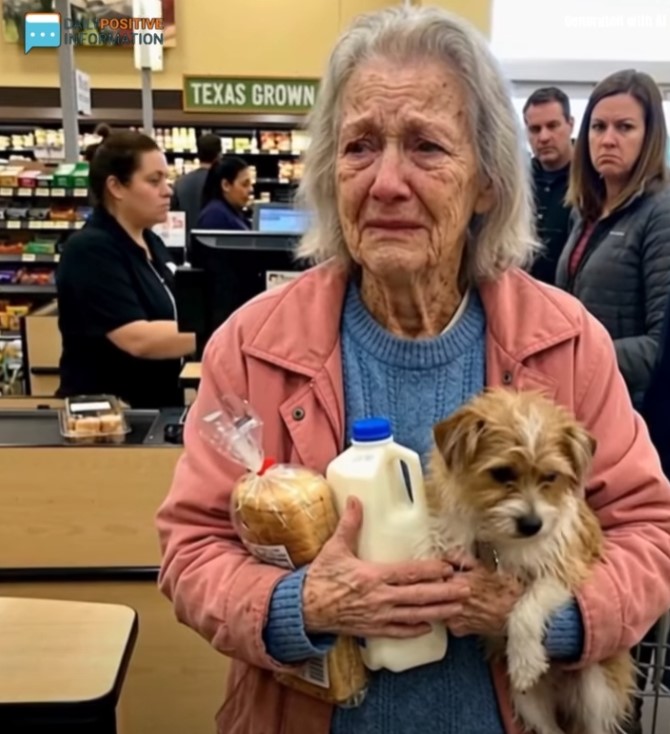
She was small. That’s the first thing I noticed. She took up almost no space in the world. She was elderly, wrapped in a wool coat that looked like it had been bought when Kennedy was president. The cuffs were frayed into strings, and the fabric was worn so thin at the elbows you could see the knit of her sweater underneath.
She had two items on the black conveyor belt. A small loaf of bread. A quart of milk.
The cashier was a young guy, dark hair falling into his eyes, looking like he’d been standing there for eight hours. His name tag said ETHAN.
He scanned the items. Beep. Beep.
“That’ll be four dollars and fifty cents,” Ethan said. His voice was flat, tired.
The old woman opened a tiny, snap-clasp wallet. Her hands were shaking. Not a little tremble, but a violent, Parkinsonian shake that made it hard for her to pinch the coins.
She started counting onto the counter. One crumpled dollar bill. Another. Then quarters. Then dimes.
She stopped. She dug into the corners of the wallet. She turned it upside down. A panicked flush started to creep up her neck.
“I… I’m short,” she whispered.
The air in the line changed instantly. It went from bored to hostile.
“I am so sorry,” she said, her voice barely audible over the beep of a scanner in the next lane.
The woman behind her—the one who had been arguing about her mother-in-law—let out a loud, theatrical sigh. She rolled her eyes so hard I thought they might get stuck.
“Seriously?” the woman said, loud enough for everyone to hear. “You can’t even pay for that?”
The old woman flinched as if she’d been slapped. She pulled the bread closer to her chest, cradling it like a baby.
“I… I will put the bread back,” the old woman stammered. “I will just take the milk. Please.”
Ethan, the cashier, frowned. He looked uncomfortable. “Ma’am, we can—”
“Come on, some of us have jobs! Move it!” a man in a business suit shouted from three spots back.
“Pathetic,” the guy muttering about his mother-in-law said. “Holding everyone up over bread. If you’re broke, stay home.”
My stomach twisted. It was a physical sensation, a knot tightening in my gut. I knew that feeling. I knew the heat of the spotlight when your card gets declined. I knew the shame of having to put back the diapers or the juice because the math didn’t work.
I looked at the old woman. She was shrinking into herself, trying to disappear inside that threadbare coat. She looked terrified.
Before my brain could catch up with my mouth, I stepped forward.
The Transaction That Cost Me Everything and Nothing
“I’ll get it,” I said.
My voice came out louder than I expected. It cut through the grumbling of the line.
Ethan looked up, blinking. “Sorry?”
“I’ll pay for hers,” I said, stepping around the angry couple. I placed my basket on the belt. “Just ring it up with mine.”
The line went quiet for half a second. Then the muttering started up again, but different this time.
“She probably does this all the time,” the angry woman scoffed, crossing her arms. “Grifters. They know how to play soft hearts.”
“You’re wasting your money,” the businessman called out.
The old woman turned slowly to look at me. Her eyes were a faded, watery blue, rimmed with red. They were sharp, though. Intelligent.
“No,” she said, shaking her head firmly. “I cannot accept. You have your own things. You look… you have your own family, I am sure.”
She was looking at my scuffed boots. My cheap coat. She saw me. She saw that I wasn’t rich.
“You’re not taking,” I said, looking her dead in the eye. “I’m giving. Let me.”
“You probably have children,” she said softly. It sounded almost like a scolding. “You should keep your money.”
I thought about the rent. I thought about the seven dollars I would have left.
“I want my kids to grow up in a world where this is normal,” I said. My voice wavered a little, but I held my ground. “Please. Let me do this.”
She stared at me for a long, stretched-out second. She was reading my face, searching for pity. I tried to keep pity out of it. I tried to show her only solidarity. Us against them. The struggling against the comfortable.
Something in her face softened. The tension in her shoulders dropped an inch.
“Okay,” she whispered.
Ethan watched me closely. His eyes flicked to the total on the screen, then to me.
“Are you sure?” he asked quietly, leaning in so the people behind me couldn’t hear. “You don’t have to do this.”
I swiped my card. I held my breath, praying it wouldn’t decline. That would be the ultimate humiliation—trying to be a savior and falling flat on my face.
Approved.
I let out the breath.
“Yeah,” I said to Ethan. “I’m sure.”
Ethan bagged her bread and milk. He did it gently, not throwing them in like cashiers usually do. He handed the bag to her.
The old woman took it. Her hands were still shaking. She looked at the bag, then up at me.
“No one has ever done something like this for me,” she said. Her voice was thick with emotion. “Not like this. Not without… asking for something.”
“What’s your name?” I asked, smiling.
“Hargrove,” she said, straightening up a little. “Mrs. Hargrove.”
“I’m Lily,” I said. “Nice to meet you, Mrs. Hargrove.”
She gave me a trembly, devastating smile.
“You have a good heart, Lily,” she said. “Do not let this world close it. It will try. Do not let it.”
“I won’t,” I promised.
She shuffled away, moving slowly past the line of people who had called her pathetic. She held her head a little higher. Their eyes slid off her like she didn’t exist, but she gripped that grocery bag like it was a bag of diamonds.
Ethan handed me my receipt.
“That was really kind,” he said. He sounded surprised.
I shrugged, picking up my milk. “I’ve been in her shoes. It sucks.”
He nodded, looking like he understood too well.
I walked out into the cold. I had practically no money left. I was terrified about the rent. But for the walk home, the air didn’t feel quite so heavy.
The Long Three Days
Then, it was back to reality. The glow of doing a good deed fades pretty fast when you’re staring at an eviction notice.
I went home. I made peanut butter sandwiches because we didn’t have the “good stuff.” I broke up three fights over the remote control. I went to my night shift at the diner and spent eight hours on my feet, serving coffee to truckers and college kids who tipped in loose change.
Friday came. I pleaded with the landlord. He gave me until Monday.
“Monday, Lily. Or I start the paperwork.”
Saturday was a blur of panic. I picked up an extra shift. I sold a few of the kids’ old clothes at a consignment shop for twenty bucks.
Sunday was the hardest. It was the day of rest, but there is no rest when you’re poor. I took the kids to the park because it was free. I pushed Max on the swing until my arms burned, watching the other moms with their Starbucks cups and their clean, matching jogging suits.
I wondered if Mrs. Hargrove enjoyed her toast. I hoped she did.
Honestly, by Monday morning, helping her felt like a distant memory. It was just one small, weird moment in a long, blurry life of survival.
Then came the knock.

The Visitor in the Hallway
It was Monday morning. I was folding laundry on the couch—a mountain of tiny socks and stained t-shirts. The kids were at school and daycare. The house was quiet, which usually made me anxious.
Knock. Knock. Knock.
It wasn’t a tentative knock. It was firm. Serious.
Knocks like that usually mean trouble. They mean process servers. They mean landlords. They mean police.
I froze with a basket of laundry in my hands. My heart hammered against my ribs.
I walked to the door, peering through the peephole.
It was a guy. Young. Dark hair.
He looked familiar, but I couldn’t place him. He wasn’t a cop. He wasn’t the landlord.
I opened the door a crack, leaving the chain on.
“Can I help you?” I asked, my voice defensive.
The guy stepped back, showing his hands. He was wearing a green polo shirt.
“Lily?” he asked.
“Yeah,” I said. “Who are you?”
“I’m Ethan,” he said. “From the grocery store? The cashier.”
I blinked. I opened the door wider, sliding the chain off. It was him. Without the fluorescent lights and the register between us, he looked younger. And sadder.
“Oh,” I said. “Right. Ethan. Did I… did I leave my card there or something?”
He shook his head. He was holding a plain white envelope in his hand. His knuckles were white.
“I’m here because of Mrs. Hargrove,” he said.
The name hung in the hallway air.
“The older woman?” I asked. A cold feeling washed over me. “Is she okay? Did she get home alright?”
Ethan looked down at his shoes, then back at me. His eyes were red-rimmed.
“She passed away,” he said softly. “Yesterday. In her sleep.”
I felt the air leave my lungs. I leaned against the doorframe. I had only met her for five minutes. I had bought her milk. But the way she had looked at me—like I was a person, not a failure—had stayed with me.
“Oh,” I whispered. “Oh my God. I’m… I’m so sorry.”
“She’d been getting weaker for a while,” Ethan said. “I guess she knew it was coming. She came into the store on Saturday. She didn’t buy anything. She just asked to see the manager.”
He lifted the envelope.
“She left this,” he said. “She told my manager, ‘Give this to Ethan. He will know the girl. The one who bought my bread.’ She described you perfectly. Your coat. Your hair. She even remembered your name.”
I stared at the envelope. My name was scrawled on the front in shaky, spiderweb cursive.
Lily.
“We managed to track you down thanks to the rewards card you swiped,” Ethan explained quickly, looking apologetic. “It’s against policy to look up addresses, I know. I could get fired. But… she made me promise. She said it was her last request.”
“Do you want to come in?” I asked. I felt rude leaving him in the hallway.
“Just for a minute,” he said.
The Letter That Changed the Atmosphere
He stepped into my tiny living room. He looked around at the peeling wallpaper, the stack of bills on the counter, the laundry basket. He didn’t sneer like the people in line. He just looked respectful.
I sat on the couch and held the envelope. My hands were shaking, just like Mrs. Hargrove’s had.
“Go ahead,” Ethan said gently.
I tore it open.
Inside, there was a folded sheet of lined yellow paper and a stack of stiff, official-looking documents clipped together.
I unfolded the yellow paper first. The handwriting was difficult to read, shaky and slanted, but the words were clear.
Dear Lily,
You may not remember me, but I remember you. Old women like me are invisible to most of the world. We are furniture. We are obstacles in the line.
You saw me.
You helped me when others called me names. You did not look at me with pity, but with kindness. You did not know if I was “deserving.” You did not ask for my history. You just saw someone who needed help, and you gave it, even though I could see that you did not have much to give.
I argued with you because I have always tried to stand on my own feet. I do not like to feel like a burden. But you told me you wanted your children to see a world where kindness is normal.
That stuck with me, Lily.
My own children are not like you. They have been waiting for me to die for a long time. They are interested in my money, not in me. They have not visited in years. They did not call on my birthday.
I decided a long time ago that I would rather leave what I have to someone with a good heart. I was waiting to find that person. I was testing the world, I suppose.
You passed.
You may think you did a small thing. To me, it was not small. It was everything.
My last request is simple:
Take care of your children. Teach them to be like you.
And when you are able, help someone else in need, fully and selflessly, as you helped me.
The papers explain the rest.
With gratitude,
Eleanor Hargrove
By the time I finished reading, tears were dripping off my chin onto the paper. I couldn’t breathe right.
“What is this?” I choked out.
I picked up the clipped documents.
“She left you everything,” Ethan said. His voice was thick.
I looked at the legal papers. Last Will and Testament.
My eyes scanned the legalese. Beneficiary: Lily [Last Name Redacted from Rewards Card Data].
“She left me… her house?” I asked, my voice squeaking.
“And her savings,” Ethan said. “My manager talked to her lawyer this morning to confirm it before I came over. It’s real, Lily. It’s a small house on the edge of town. Paid off. And there’s an account.”
I stared at him. The room was spinning.
“I barely knew her,” I said. “I bought her milk. It cost three dollars.”
“She knew what she was doing,” Ethan said firmly. “She told me once that she sat in her house every day waiting for the phone to ring. It never did. She said you were the only one who treated her with real respect in a long time. She didn’t want her ungrateful kids fighting over her things.”
I put the papers down on the coffee table. I covered my face with my hands.
“Is it… is it a lot?” I asked, feeling guilty for even wondering.
“It’s not millions,” Ethan said. “But the house is yours. Free and clear. And the savings… it’s enough to matter. It’s enough to start over.”
I thought about the landlord. I thought about the text message. I thought about the empty fridge.
“This isn’t real,” I whispered.
“It is,” Ethan said.
The Promise
We sat there in silence for a long time. The refrigerator hummed in the kitchen. The radiator hissed. But the noise didn’t feel oppressive anymore.
“She reminded me of my grandma,” Ethan said suddenly, breaking the silence.
I looked up.
“That’s why I came,” he said. “She was a regular. I used to talk to her when she came through my line. She was lonely. I should have… I don’t know. Done more.”
“You were kind to her too,” I said. “She mentioned the nice boy at the register in the letter.”
Ethan smiled, a sad, crooked thing.
“She made me promise to tell you something exactly,” he said.
“What?”
He cleared his throat.
“She said, ‘Tell Lily I did not take charity. I traded. She gave me kindness. I gave it back.’”
My throat closed up again. I nodded, unable to speak.
Ethan stood up, smoothing his green polo shirt.
“The lawyer’s info is in the packet,” he said. “They’re expecting your call. I’m sure there’s paperwork and stuff. But… yeah.”
He walked to the door.
“Thank you,” I said, standing up. “Ethan. Thank you. For bringing this. For… seeing her too.”
He shrugged. “She was a good lady. I’m glad she found you.”
He left.
I locked the door. I walked back to the couch and sat down next to the envelope.
I picked up the phone. I called the number on the legal documents.
A receptionist answered. “Law Offices of Davis and Stern.”
“Hi,” I said, my voice shaking. “My name is Lily. I think… I think Mrs. Hargrove left me something.”
“Ah, yes,” the woman said. Her voice was warm. “We’ve been expecting you, Lily. Mrs. Hargrove was very fond of you. When can you come in?”
The New Reality
When the kids came home that afternoon, the apartment looked the same. The laundry was still on the couch. The stain was still on the rug.
But everything had changed.
“Mom?” Josh asked, dropping his backpack. “Why are you crying? Did we get evicted?”
I laughed. It was a wet, bubbly sound.
“No, baby,” I said. “Come here. All of you.”
They gathered around me. Max climbed into my lap. Emma leaned on my shoulder.
“Remember the grandma I told you I helped at the store?” I asked. “The one people were mean to?”
“The bread grandma?” Emma asked.
“Yeah,” I said. “Mrs. Hargrove.”
“Is she okay?” Max asked.
“She went to heaven,” I said. “But before she went… she gave us a present.”
“What kind of present?” Josh asked suspiciously.
“A house,” I said.
Silence.
“A dollhouse?” Max asked.
“No, baby,” I said. “A real house. With a yard. And maybe… maybe a dog.”
The explosion of noise that followed was deafening. But this time, I let them scream. I let them jump off the couch. I let them run laps.
Because for the first time in their lives, I wasn’t doing mental math to see if we could afford to be happy.
The Last Demand
That night, after the excitement died down and they finally fell asleep, I sat alone at the wobbly kitchen table with the yellow letter in front of me.
I read it again.
Take care of your children.
Help someone else in need, fully and selflessly.
I thought about Mrs. Hargrove standing at the register. The way her hands shook. The way she pulled the bread to her chest to protect it. The way people looked at her like she was trash for being short a few dollars.
It hit me then that her “last request” wasn’t about the money.
She knew I was broke. She knew I was struggling.
But she also knew that poverty isn’t just about an empty bank account. It’s about a hardening of the heart. It’s about getting so focused on your own survival that you stop seeing other people.
She was saving me from that.
I used to think you had to wait until your life was perfect and stable before you could help anybody. I thought philanthropy was for rich people with foundations and galas.
But that day in the grocery store, my life was a disaster. I had negative equity in my existence.
I helped anyway.
And somehow, it came back to my front door in a white envelope.
So yeah. I paid for a poor grandma at the grocery store. Three days later, the clerk showed up with her final request and the keys to a different future.
I’m not going to just move into that house and forget. I’m not going to become the woman in line rolling her eyes at the person counting pennies.
I’m going to fulfill her request.
I’m going to take care of my kids.
And the next time I see someone standing on the edge, shaking and scared, I’m going to step forward.
Because kindness is the only currency that really matters in the end. And thanks to Mrs. Hargrove, I’m finally rich enough to spend it.
Let us know what you think about this story on the Facebook video! Did Mrs. Hargrove do the right thing leaving her estate to a stranger? If you like this story, share it with friends and family to remind them that kindness always comes back around.
