

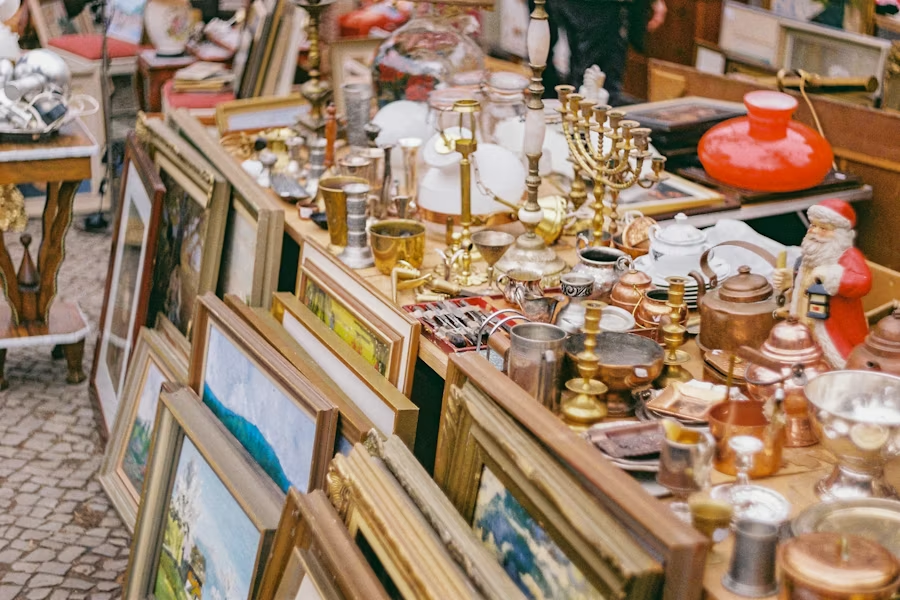
The flea market sat on the edge of town like a bruised knee—a patch of raw, exposed earth where the grass refused to grow and the wind carried the scent of rust and damp cardboard. It was located in the hollowed-out shell of a defunct drive-in theater, the kind of place that felt forgotten by time, populated by people who were trying to sell their pasts to pay for their futures.
My name is Pauline. I am thirty-four years old, and my life is measured in trash bags. I work as a janitor for the Corporate Plaza downtown, a glass needle that scrapes the sky. I spend my nights erasing the evidence of other people’s success. I empty their coffee grounds, wipe away the rings left by their expensive tumblers, and vacuum the carpets where they stand and make deals worth more than I will earn in a lifetime.
My hands are perpetually dry, the knuckles cracked from industrial solvents and cheap soap. My back carries a permanent ache, a dull thrum located right between my shoulder blades. But I don’t complain. I can’t afford the luxury of complaint.
I do it for Eve.
Eve is six years old. She is the only bright color in my gray world. She has eyes the color of polished river stones and a laugh that sounds like wind chimes in a storm. She is the kind of child who saves earthworms from puddles and apologizes to the table when she bumps into it. She is too good for the life I can give her, but she never acts like it.
Since her father, David, died of pancreatic cancer three years ago, our life has been a game of subtraction. First, we subtracted the house, moving into a one-bedroom apartment above a laundromat. Then we subtracted the second car. Then the cable TV. Then the brand-name groceries.
We were down to the bone.
David had been a carpenter. He smelled like sawdust and Old Spice. He was the sturdy frame of our house, and when the cancer took him—fast and cruel, like a thief in the night—the roof caved in. I was left in the rubble, holding a three-year-old Eve, trying to figure out how to rebuild a life without a blueprint.
Now, three years later, the rubble was cleared, but the foundation was still cracked.
The Arithmetic of Survival
It was mid-October. The Midwest sky was a flat, relentless sheet of steel. The heating bill had just arrived, a white envelope that sat on the kitchen counter like a threat.
I sat at the wobbly laminate table after Eve had gone to sleep, a calculator and a stack of receipts spread out before me. The hum of the refrigerator was the only sound in the apartment, a rhythmic rattling that sounded like a dying lung.
I punched in the numbers. My paycheck. The rent. The utilities. The car insurance I had skipped last month. The cost of winter boots for Eve, because her toes were curling in her sneakers.
I hit “Equals.”
The number on the screen was negative. It was always negative.
“Okay,” I whispered to the empty room. “Okay.”
I rubbed my face with my hands. Eve’s birthday was in three days.
She hadn’t asked for anything. That was the thing about Eve—she had learned the silent language of poverty before she learned to read. When commercials for toys came on the TV (before we cut the cable), she would look away. When we walked past the toy aisle in the grocery store, she would put her hands in her pockets and march straight ahead, a little soldier in a war against desire.
But I knew. I saw the way she looked at the other girls at school drop-off, the ones with the sparkly backpacks and the dolls that cried and wet themselves. I saw the hunger in her eyes—not for the object, but for the normalcy it represented.
I couldn’t give her a father. I couldn’t give her a house with a yard. I couldn’t give her a college fund.
But I had to give her a birthday.
I had twenty dollars.
It was money I had made by selling my own winter coat to a consignment shop, deciding I could layer two sweaters and a windbreaker and survive the season. Twenty dollars.
So, on Sunday morning, while the rest of the city was at church or brunch, I left Eve with Mrs. Janice next door—a woman who smelled of menthol cigarettes and kindness—and I drove my rusting sedan to the drive-in flea market.
The Graveyard of Objects
The market was a sprawling maze of desperation. Tables were laden with the detritus of American life: stacks of National Geographic magazines from 1988, power tools with frayed cords, porcelain figurines with chipped noses, piles of baby clothes stained with spit-up.
The air was cold, biting through my two sweaters. I walked the aisles, clutching my twenty-dollar bill in my pocket like it was a talisman.
I saw a plastic kitchen set, but it was cracked. I saw a bicycle, but the chain was rusted solid. I saw a pile of Barbies, but they were naked and missing limbs, looking more like a horror movie prop than a gift.
Despair began to creep up my throat. I was going to fail. Again.
Then, I turned a corner near the back of the lot, where the asphalt gave way to gravel.
There was a small table set up there, covered in a clean white tablecloth—an anomaly in this sea of grime. Sitting on the table, propped up against a stack of leather-bound books, was a doll.
She wasn’t plastic. She wasn’t shiny. She was vintage, the kind of doll they made fifty years ago. She had a soft cloth body and a face made of heavy vinyl, painted with delicate, realistic features. She had bright, startlingly blue eyes with real eyelashes. She wore a dress the color of faded strawberry milk, with intricate lace at the collar and cuffs. In her fabric arms, stitched to her chest, she held a tiny, miniature baby doll.
She looked… meaningful. She looked like she had a soul.
I walked toward the table.
Sitting behind it were a man and a woman. They didn’t look like the other vendors. The man wore a clean flannel shirt and a watch that looked expensive. The woman was wrapped in a thick wool coat, wearing a blue scarf. She was staring at her hands. She looked hollowed out, like a pumpkin left on the porch too long after Halloween.
I picked up the doll. It was heavy. It felt substantial in my arms, like holding a real infant.
“Excuse me,” I said softly.
The woman looked up. Her eyes were red-rimmed. When she saw the doll in my arms, a spasm of pain crossed her face so sharp I almost dropped the toy.
“How much is she?” I asked.
The woman opened her mouth, but no sound came out. She looked at her husband.
The man cleared his throat. He looked exhausted. “Five dollars.”
I blinked. “Five? Are you sure? She looks… antique.”
The woman stood up abruptly. She looked at me, really looked at me. She saw the fraying cuffs of my windbreaker. She saw the dark circles under my eyes. She saw the desperation I was trying so hard to hide.
“She needs to be held,” the woman said. Her voice was thin and brittle, like dry leaves. “She was meant to be loved. Please. Just take her.”
“I have twenty,” I said, reaching for my pocket. “I can pay—”
“No,” the man said, his voice rough. “Take it. Please. We’re just… we’re clearing things out.”
“Clearing things out,” the woman repeated, the words sounding like a curse.
I didn’t push. You learn not to push when people are giving you charity, even when it feels heavy.
“Thank you,” I said. “My daughter… this will mean the world to her.”
The woman nodded, tears spilling over her lashes. “Good. That’s good.”
I walked away quickly, clutching the doll to my chest, feeling like I had stolen something precious, though I didn’t know what.
The Morning of the Gift
Tuesday morning. Eve’s birthday.
I woke up early, before the sun. The apartment was cold; the radiator hissed and clanked but produced little heat. I went to the kitchen and made pancakes from a box I had been saving, adding a splash of vanilla extract to make them smell fancy.
I placed the doll in the center of the table. I didn’t have wrapping paper, so I had wrapped her in the Sunday comics section of the newspaper Mrs. Janice had thrown out. It was colorful, at least.
I went into the bedroom and sat on the edge of the mattress. Eve was sleeping curled in a ball, her thumb near her mouth.
“Happy birthday, baby,” I whispered, stroking her hair.
She opened her eyes. For a second, she looked confused, and then a smile spread across her face—a smile that broke my heart with its purity.
“Is it today?” she asked.
“It’s today. Come on. Breakfast is ready.”
She scrambled out of bed, her oversized t-shirt hanging to her knees. She ran into the kitchen and stopped. She saw the pancakes. She saw the juice. And she saw the bundle on the table.
“For me?” she breathed.
“For you.”
She sat down and touched the newspaper gently, reading a panel of Garfield before tearing the paper. She peeled it back carefully.
When she saw the doll, she gasped.
“Oh, Mama,” she whispered.
She lifted the doll out of the paper. She held it at arm’s length, staring into the blue eyes. Then she hugged it. She hugged it so tight her knuckles turned white.
“She’s beautiful,” Eve said. “Look, Mama. She’s a mommy. She has a baby.”
“I saw that,” I said, pouring syrup on her pancakes. “She reminded me of us. Me and you.”
Eve looked at me, her eyes shining. “I’m going to name her Rosie. Because her cheeks are pink like roses.”
“Rosie is a beautiful name.”
Eve ate her breakfast with one hand, the other arm wrapped protectively around Rosie. I watched her, sipping my coffee, feeling a rare moment of peace. I had done it. I had provided. For one morning, we weren’t poor. We were just a family celebrating.
Then, it happened.
Eve was hugging the doll, rocking her back and forth.
Crrzzzt.
A sound came from the doll. A burst of static, like a radio caught between stations.
“Did you hear that?” I asked.
“Hear what?” Eve chewed her pancake.
“That noise. It came from Rosie.”
“Maybe she’s hungry,” Eve joked.
“Let me see her for a second, baby.”
Eve handed the doll over reluctantly. I turned Rosie over. The dress was fastened with small snaps in the back. I undid them. Underneath the cloth body, buried deep in the stuffing, I felt a hard, rectangular shape.
I probed the fabric with my fingers. There was a seam that had been restitched by hand—clumsy, large stitches made with thread that didn’t quite match the fabric.
I pressed the hard shape.
And then, a voice filled our tiny kitchen.
It wasn’t a mechanical voice. It wasn’t the tinny, high-pitched “Ma-ma!” of a cheap toy. It was a recording. The quality was grainy, hushed, intimate. It sounded like someone whispering into a microphone under a blanket.
“Happy Birthday, Mommy.”
The voice belonged to a child. A little girl. She sounded about Eve’s age, maybe a little older.
“I love you to the moon and back,” the voice continued, pausing for a breath. “Don’t be sad, okay? Even if I’m not there. I’m right here. Inside. I love you, Mommy. Happy Birthday.”
Click.
Silence rushed back into the room, louder than before.
I stared at the doll. My blood ran cold.
I looked at Eve. The fork had fallen from her hand. The joy that had been illuminating her face was gone, replaced by a solemn, haunting stillness.
“Mommy,” Eve said. Her voice was very small.
“Yeah, baby?”
“That’s not for me.”
“No,” I whispered, my throat tight. “No, it’s not.”
We sat there for a long time. The pancakes went cold. The radiator hissed.
This wasn’t just a toy. This was a message. This was a ghost story wrapped in pink fabric.
“The lady at the market,” I said, mostly to myself. “She looked so sad.”
“She misses her little girl,” Eve said. It wasn’t a question. It was a statement of fact. Eve knew about missing people. She knew the shape of the hole a person leaves behind.
“We have to take her back,” Eve said. She pushed the doll toward me across the table. Her eyes were wet, but her chin was set. “That mommy needs to hear this. She needs it more than I do.”
I looked at my six-year-old daughter, who had nothing, giving away the only thing she had.
“Are you sure, Eve? It’s your birthday present.”
“I’m sure,” she said. “We can’t keep a ghost, Mama. It’s not right.”

The Second Trip
I called in sick to work.
It was a risk. If I missed a shift, I didn’t get paid. If I missed too many, they found someone else to push the vacuum. But I couldn’t go to work. Not with that voice echoing in my head.
We got in the car. Eve held Rosie in her lap, but she didn’t play with her. She held her respectfully, like she was holding a holy relic.
We drove back to the drive-in. The Tuesday morning crowd was thin. The air was colder today, a biting wind whipping the tarps.
I prayed they would still be there. Vendors at flea markets are transient; they come and go like the wind.
But they were there.
They were packing up. The table was mostly empty now. The man was loading boxes into a sleek SUV that looked out of place on the cracked pavement. The woman—Miriam—was sitting on a folding chair, staring at the empty space where the doll had been.
I parked the car. I took Eve’s hand. She carried the doll.
We walked up to the table. The gravel crunched loudly under our feet.
Miriam looked up. When she saw us—saw the pink dress—she stood up so fast the chair fell over.
“You’re back,” she breathed.
The man stopped loading the car. He froze, a box of books in his hands.
“We found something,” I said. My voice shook. “We didn’t know. I’m so sorry. We didn’t know.”
“Found what?” the man asked. He sounded defensive, tired.
“Eve,” I said. “Show her.”
Eve stepped forward. She held the doll out to Miriam.
“She has a secret button,” Eve said softly. “In her back.”
Miriam stared at the doll. Her hands were trembling violently. She reached out, her fingers hovering over the pink fabric.
“Show me,” Miriam whispered.
I stepped in. I turned the doll over. I guided Miriam’s shaking hand to the hard square beneath the stuffing.
“Press it,” I said.
She pressed.
“Happy Birthday, Mommy. I love you to the moon and back. Don’t be sad, okay? Even if I’m not there. I’m right here. Inside. I love you, Mommy. Happy Birthday.”
The sound that tore out of Miriam wasn’t human.
It was the sound of an animal caught in a trap. It was a wail of such pure, undiluted agony that I felt it in my own teeth.
She collapsed. Her knees hit the gravel. She clutched the doll to her chest, burying her face in the yarn hair.
“Clara!” she screamed. “Oh, God, Clara!”
The man—Thomas—dropped the box of books. He ran to her. He fell to his knees beside her, wrapping his arms around her. He was crying too, silent, heaving sobs.
“I didn’t know,” Miriam wept, rocking back and forth. “She must have… she must have recorded it before the hospital. For my birthday. I never heard it. Thomas, I never heard it!”
“It’s okay,” Thomas choked out. “We have it now. We have it now.”
Eve stood by my side, watching them. She slipped her hand into mine. Her grip was tight. She wasn’t scared; she was witnessing. She understood this language.
We stood there for a long time, the four of us, on the edge of a desolate parking lot, while a mother was reunited with the voice of her dead child.
Eventually, the sobbing subsided into quiet, jagged breaths. Miriam looked up. Her face was ravaged, her makeup smeared, her eyes swollen. But there was a light in them that hadn’t been there on Sunday.
She looked at me. She looked at Eve.
“You brought her back,” Miriam said. “You could have kept her. You could have thrown her away. But you brought her back.”
“She belongs to you,” Eve said simply. “It’s your birthday present.”
Miriam looked at my daughter. She reached out a hand and touched Eve’s cheek.
“My daughter… Clara,” Miriam said, her voice raspy. “She died last year. Leukemia. She was eight. This doll… Rosie… was her favorite. She took it to every chemo session. After she died… I couldn’t look at it. I couldn’t look at anything. We’re selling everything because I can’t breathe in that house anymore.”
“I understand,” I said. And I did. I knew about the ghosts that live in furniture.
“But I didn’t know,” Miriam whispered, stroking the doll’s hair. “She left me a message. She knew she wasn’t going to make it to my birthday. She left me a message and I almost sold it for five dollars.”
She looked at me with an intensity that burned.
“You saved me,” she said. “You don’t understand. I was… I was drowning. And you pulled me up.”
The Envelope and the Refusal
We left them there, holding onto the doll like a lifeline. We drove home in silence. The car felt empty without the doll, but the air felt lighter.
“You did a good thing, baby,” I told Eve.
“I know,” she said. “But I’m still a little sad.”
“It’s okay to be sad. Doing the right thing often feels heavy.”
Three days passed. We went back to our routine. I went to work. I scrubbed floors. I emptied trash. But the memory of Miriam’s voice stayed with me.
On Friday evening, there was a knock at the door.
We lived in a walk-up. Nobody knocked unless it was the landlord looking for rent or a neighbor complaining about noise.
I opened the door.
Miriam stood there.
She looked different. She had washed her hair. She was wearing a tailored coat and holding a large plastic storage bin. She looked nervous.
“Miriam?”
“Hi,” she said. “I… I looked up your address from the check you wrote for the other books on Sunday? I hope that’s not creepy. I just… I couldn’t stay away.”
(I hadn’t written a check, but I realized she must have remembered my license plate or asked the market manager. I didn’t call her on it.)
“Come in,” I said.
She stepped into our apartment. It was clean—I made sure of that—but it was shabby. The couch was sagging. The rug was threadbare.
Miriam didn’t seem to notice. She set the bin down.
“These were Clara’s,” she said. “Her books. Her puzzles. Some clothes she barely wore. The expensive stuff. Legos. Art sets.”
She looked at Eve, who was peeking out from the bedroom.
“I couldn’t give them to Goodwill,” Miriam said, her voice shaking slightly. “I couldn’t bear the thought of them being separated. But… I want Eve to have them. If that’s okay. I feel like… I feel like Clara would want her to have them.”
Eve walked out slowly. She looked at the bin. It was overflowing with treasures she had only seen in commercials.
“And this,” Miriam said. She pulled a white envelope from her purse. She handed it to me.
I opened it.
Inside was a stack of cash. Hundred-dollar bills. I thumbed through it. It had to be three, maybe four thousand dollars.
I gasped. I tried to shove it back at her.
“No,” I said. “Miriam, no. I can’t take this.”
“Please,” she said. She put her hands over mine, pushing the envelope back to my chest. “We sold the rest of the antiques. The furniture. We’re moving to a condo downtown. We don’t need the money. Thomas and I… we’re wealthy, Pauline. I’m not saying that to brag. I’m saying it because this money means nothing to us compared to what you gave us.”
“It’s too much,” I said. Tears pricked my eyes. That envelope was a car that worked. It was a winter without shivering.
“You gave me my daughter’s voice,” Miriam said fiercely. “Do you know what that’s worth? It’s worth everything. Please. Take it. For Eve. Buy her a new doll. Buy her a bicycle. Just… take it.”
I looked at Eve. I looked at the money. I swallowed my pride.
“Thank you,” I whispered.
The Architecture of a New Family
It would have been a nice ending if she just left the money and walked away. A fairy godmother moment.
But life is more complicated than that. And grief is a glue that binds people together in strange ways.
Miriam didn’t leave.
“Do you have coffee?” she asked.
“Instant,” I said.
“I love instant,” she lied.
She sat at our wobbly table. She drank the terrible coffee. And she talked. She talked about Clara. She talked about the cancer. She talked about how her husband, Thomas, was retreating into his work, leaving her alone in a silent house.
And she asked about us. She asked about David. She listened when I told her about the struggle, the loneliness, the fear.
Miriam came back the next week. And the week after that.
She started coming over on Tuesday nights, when I had the late shift.
“I’m going stir crazy in that condo,” she said. “Let me watch Eve. I’ll order pizza. We’ll do homework. It saves you the babysitter money.”
I hesitated. I was proud. But I saw the way Eve looked at her. And I saw the way Miriam looked at Eve—like a starving person looking at a feast.
“Okay,” I said.
It became a routine. Tuesday nights were Miriam nights.
But it wasn’t always easy.
One night in January, I came home to find Miriam crying in the kitchen. Eve was in her room.
“What happened?” I asked, dropping my keys.
“She laughed,” Miriam sobbed. “Eve laughed at a cartoon. And it sounded exactly like Clara. Exactly. And for a second… for a second I thought she was back. And then I remembered.”
She looked at me, her face ravaged.
“I’m using you,” she whispered. “I’m using your daughter to replace mine. It’s sick. I shouldn’t come here anymore.”
She stood up to leave.
I blocked the door.
“You’re not using us,” I said. I grabbed her shoulders. “Miriam, look at me. You’re grieving. And Eve… Eve needs you. She doesn’t have a grandma. She doesn’t have aunts. She just has me. And I’m tired. I’m so tired all the time.”
I softened my voice.
“We’re saving each other,” I said. “It doesn’t have to be perfect to be real.”
Miriam stayed.
The Crisis
In March, the test came.
Eve got sick. It started as a cold, then a fever. Then, in the middle of the night, I heard a rattling sound in her chest that stopped my heart.
Pneumonia.
We rushed to the emergency room. The same hospital where David had died. The smell of antiseptic triggered a panic attack I had to swallow down so I could sign the paperwork.
They admitted her. Her oxygen was low. She looked so small in the big hospital bed, wires taped to her chest.
I sat in the plastic chair, holding her hand, terrified. I was alone. I was always alone in these moments.
Then, the door opened.
Miriam rushed in. She wasn’t wearing makeup. Her hair was a mess. She was wearing pajamas under her coat.
“I came as soon as you texted,” she said.
She stopped at the foot of the bed. She looked at Eve, hooked up to the monitors.
I saw the terror in Miriam’s eyes. This was her nightmare. This was the scene of her trauma. The beeping machines. The smell. The fear.
She started to shake. She took a step back toward the door.
“I can’t,” she whispered. “Pauline, I can’t be here. It’s too much like Clara.”
I stood up. I was exhausted, terrified, and angry.
“I know,” I said. “I know it is. But she’s not Clara. She’s Eve. And she’s scared. And I’m scared. And we need you.”
I held out my hand.
“Please,” I said. “Don’t leave us alone.”
Miriam looked at the door. She looked at the machines. Then she looked at me.
She took a deep breath. She closed her eyes for a second, steeling herself against the ghosts.
Then, she stepped forward. She took my hand. She pulled up a second chair.
“I’m here,” she said. “I’m right here.”
She stayed for three days. She brought coffee. She argued with the nurses when they were late with meds. She read stories to Eve until her voice was hoarse.
When Thomas—Miriam’s husband—came to visit, he stood in the doorway, looking uncomfortable.
“You should come home, Miriam,” he said. “You’re exhausting yourself.”
“No,” Miriam said. She didn’t even look up from the book she was reading. “This is where I need to be.”
Thomas left. Miriam stayed.
Eve recovered. We went home. But the dynamic had shifted. We weren’t just friends anymore. We were family. Forged in the fire of a hospital room.
The Drawing on the Fridge
Two years have passed since the day at the flea market.
Our lives are different now.
I still work as a janitor, but I’m a supervisor now. I’m taking night classes for business management. Miriam paid for the tuition. She called it an “investment in the firm.”
Miriam and Thomas divorced. It was sad, but it was inevitable. His grief was a wall he built to keep the world out; hers was a door she opened to let the world in. They couldn’t live in the same house anymore.
Miriam lives in a condo three blocks from us.
Eve is eight now—the same age Clara was when she died. It’s a bittersweet milestone for Miriam, but she faces it with a grace that leaves me in awe.
I came home yesterday to find them in the kitchen. The table was covered in glitter and glue. They were making a poster for Eve’s school project on the solar system.
“Clara wanted to be an astronaut,” Miriam was saying. She smiled when she said it. The pain was still there, but the edges were softer now.
“Maybe I’ll be an astronaut too,” Eve said, gluing Saturn onto the black poster board. “And I’ll go visit her on the moon.”
Miriam stopped. She looked at Eve. She leaned over and kissed her forehead.
“She’d like that,” Miriam said.
I walked over to the fridge to get a water. There was a new drawing taped there, right at eye level.
It was done in crayon. It showed three figures holding hands under a big yellow sun.
One figure had curly hair and a janitor’s uniform. One figure had a blue scarf and silver hair. One figure was small, holding a doll in a pink dress.
Underneath, in Eve’s messy, looping cursive, it read:
MAMA, MIRIAM, AND ME.
I touched the paper.
I thought about the twenty dollars in my pocket that cold October morning. I thought about the decision to walk down that gravel path. I thought about the doll that whispered a secret.
We had all been broken. Me, by poverty and widowhood. Eve, by the loss of a father. Miriam, by the unimaginable loss of a child.
But we were like a kintsugi bowl—the Japanese art of repairing broken pottery with gold. The cracks were still there. You could see where we had shattered. but the gold that held us together—the love, the shared grief, the choice to be a family—made us stronger, and more beautiful, than we had been before.
I turned around.
“Who wants pizza?” I asked.
“Me!” Eve shouted.
“Only if it’s pepperoni,” Miriam said, winking at me.
“Deal.”
I looked at them, my impossible, patchwork family, and I knew that Rosie the doll had been right all along.
Love doesn’t die. It just changes shape. It moves from a lost child into a plastic doll, and from a plastic doll into the heart of a stranger, until the stranger isn’t a stranger anymore.
It whispers from the static: I’m right here.
And we are.
What do you think? Do you believe that objects can carry the spirit or love of those who have passed? Was it coincidence, or something more?
Let us know what you think about this story in the comments on the Facebook video, and if you like this story share it with friends and family!
