
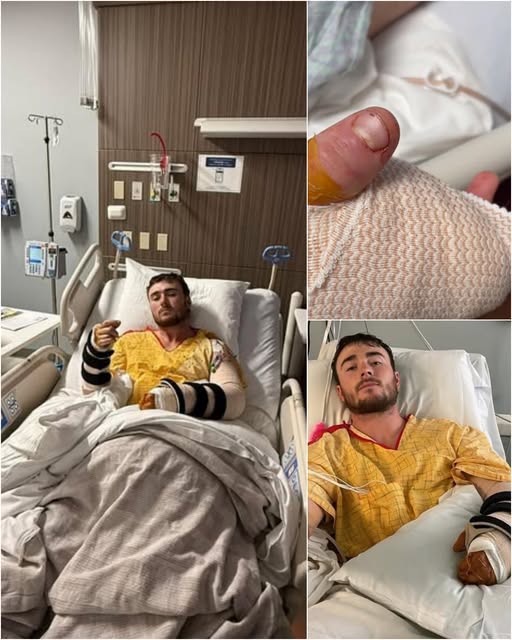
I have an update on Hunter Alexander, and it is the kind that carries both encouragement and the heavy reality of not knowing what comes next. Hunter is the 24-year-old lineman who was critically injured while restoring power for others during the winter storm, working through ice and danger so families could have heat, light, and safety.
Today, he remains in a Louisiana ICU, and his family is living hour to hour, surgery to surgery, without clear answers yet. Hope is present, but it exists alongside uncertainty that never fully lets go. This is where things stand right now.
Hunter’s father, Daren, shared an update ahead of yet another operation, one that captures the exhausting limbo his family is enduring. Schedules change, plans shift, and even the timing of surgery feels uncertain, moving between morning, evening, and the next day without warning. This is the rhythm of critical care, where nothing is fixed and everything depends on what doctors see hour by hour.
The next procedure will be another irrigation and debridement, a process where damaged tissue is removed in hopes of preserving what can still heal. It is meticulous, necessary work, and each time Hunter goes back into surgery, the stakes feel impossibly high.

Doctors have been cautiously positive about Hunter’s progress, but they have also been very clear that it is far too soon to know the final outcome. So far, Hunter has made it through two surgeries without any amputations, something his family does not take lightly.
Gratitude and fear exist side by side, because while nothing has been lost yet, the risk remains real. Every decision is measured, every procedure watched closely, and every update is received with held breath. There are no guarantees, only careful steps forward.
Hunter is fighting to save his arms after a powerful electric shock tore through his body while he was on the job. The injuries to his arms and hands are catastrophic, the kind that demand repeated surgeries and constant reassessment.
Doctors are still removing damaged tissue, using wound vacs, planning future skin grafts, and monitoring what survives and what does not. This process cannot be rushed, because the body needs time to declare what can heal. Time, however, is also what makes the waiting so hard.

One of the few bright spots in this long ordeal is that major nerves and blood vessels are still intact. His family calls this nothing short of a miracle, and doctors agree it is a crucial factor in his chances of recovery.
That single detail has become something they hold onto tightly, especially on days when fear feels overwhelming. Intact circulation and nerve pathways mean there is still hope for function, sensation, and healing. It does not erase the danger, but it keeps possibility alive.
Hunter’s story is not just about injury, but about the cost of service that often goes unseen. During the winter storm, while many people were sheltering at home, he was out in brutal conditions, working to restore power for people in need.
Linemen accept risk as part of their job, but moments like this remind us just how real and unforgiving that risk can be. One second of contact with electricity changed everything. Now, Hunter is paying a price few ever consider when the lights come back on.

There is no finish line yet for Hunter, and his family has learned to stop looking too far ahead. Right now, life is broken into manageable pieces. Just today. Just this surgery. Just the next decision. Thinking beyond that becomes overwhelming, so they focus on what is directly in front of them. Survival, healing, and preservation have become the only goals that matter.
Through it all, Hunter’s family says the prayers and messages pouring in from this page and beyond have been carrying them when they feel like they are about to break. Knowing that strangers and friends alike are lifting Hunter up has given them strength on days when their own runs thin. In moments of waiting rooms, long nights, and difficult conversations, that support becomes a lifeline. It reminds them they are not walking this road alone.
Critical injuries like Hunter’s do not follow a predictable path. There are setbacks and progress, sometimes in the same day. One surgery can bring relief, while the next brings new questions. The emotional toll of living inside that uncertainty is immense, especially for parents watching their child endure pain they cannot take away. Daren’s words reflect both gratitude and restraint, thankful for progress, but careful not to assume outcomes too soon.
Hunter is heading back into surgery again, and that moment carries weight for everyone who has followed his story. Each time he is wheeled away, there is a quiet prayer for steady hands, clear judgment, and healing tissue. There is hope for more miracles, both small and large. And there is respect for the doctors and nurses doing everything they can in circumstances where certainty is impossible.
This update does not come with closure, because Hunter’s story is still unfolding. What it does offer is honesty about where things stand and a reminder of how fragile and precious life can be. Hunter went out to help others, and now others are helping hold him up through prayer, support, and care. That exchange, painful as it is, reveals something deeply human.
Please pause and lift Hunter Alexander up right now. Pray for successful surgeries, for healing tissue, for preserved function, and for strength for his family as they continue to wait and hope. There is no finish line yet, but there is still hope, and today, that is enough.
