
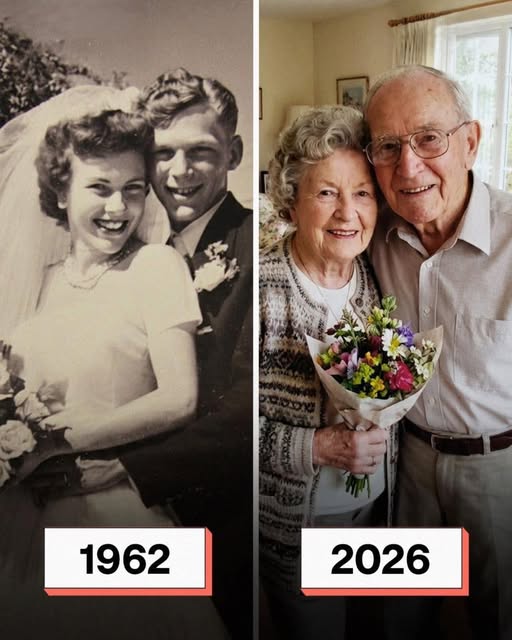
My name is Daisy. I am 83 years old, and I have been a widow for four months.
Four months is not a long time when you measure it against sixty-three years of marriage. It is barely a breath. And yet it has stretched endlessly, wide and hollow, like a house with all the windows open in winter.
Robert proposed to me on Valentine’s Day in 1962. We were twenty years old, living in a cramped student apartment just off campus. We shared a tiny kitchen with two other couples, and none of us had enough money to buy proper furniture. Our “dining table” was an old wooden crate covered with a lace curtain I found at a thrift shop.
That night, Robert came home with a single red carnation.
“I wanted roses,” he said, almost apologetic, brushing snow from his coat. “But carnations were what I could afford.”
I had never seen anything more beautiful.
He got down on one knee right there on our creaky linoleum floor. No ring yet—just a promise. His hands trembled as he said, “Daisy, I can’t give you much. But I can give you my whole life. Will you marry me?”
I said yes before he even finished the question.
We married that summer. And from that very first Valentine’s Day as husband and wife, he brought me flowers. Every year. No matter what.
When we were broke, it was a single bloom wrapped in newspaper.
When he got his first steady job, it was a modest bouquet from the grocery store.
When the children were small and money was tight again, he’d wake before dawn to pick wildflowers from the field behind our house.
There were years when life pressed hard against us. Years of layoffs and medical bills. Years when we buried his parents. Years when we sat at the kitchen table long after midnight, trying to figure out how to stretch one paycheck into two weeks.
But every February 14th, without fail, flowers appeared.
Once, during a terrible snowstorm, I told him not to bother. The roads were icy; the news warned people to stay home. I woke that morning to find a small vase beside my bed. He had walked three miles the night before, in the dark, to the only open gas station that sold flowers.
“Valentine’s Day doesn’t get canceled,” he said with a wink.
The children grew up and moved away. The house grew quieter. Our hair turned silver. His hands, once strong and quick, grew spotted and careful.
Still, every Valentine’s Day, there were flowers.
On our 50th anniversary, he gave me fifty roses. “One for every year you’ve put up with me,” he teased. But when he thought I wasn’t looking, I saw him wipe his eyes.
As the years went on, his steps slowed. His memory sometimes wandered. The doctors used words like “degenerative” and “progressive.” Words that sound clinical but feel like earthquakes.
Last Valentine’s Day was different.
He was already very weak. The hospital bed had been set up in the living room so he could see the big oak tree in the yard. His breathing came shallow and uneven, and even sitting up exhausted him.
“Don’t you dare,” I whispered a few days before February 14th, smoothing his thinning hair. “You rest. I don’t need flowers this year.”
He smiled—faint, stubborn. “You’ll always get flowers, Daisy.”
On the morning of Valentine’s Day, our daughter arrived early. She was carrying a small bouquet of white tulips.
“For Mom,” she said softly.
I looked at her, confused.
“Dad ordered them,” she explained. “He asked me to make sure they arrived today.”
I turned to him. His eyes were closed, but there was the smallest curve to his lips.
He passed away three weeks later, holding my hand.
The house has been impossibly quiet since.
I keep expecting to hear his cough from the hallway or the rattle of his newspaper at the breakfast table. Grief is strange—it sneaks up on you in the smallest moments. Folding his sweater. Reaching for a second mug. Turning to share a thought and finding only air.
This morning, I woke up to sunlight streaming through the curtains.
February 14th.
My first Valentine’s Day without him.
I told myself not to expect anything. I made tea. I tried to keep busy. But the emptiness felt sharper today, like the outline of something missing.
Around noon, the doorbell rang.
It startled me; I rarely have visitors unannounced. I shuffled to the door and opened it to find a young delivery man holding a large bouquet of daisies and red roses.
“Delivery for Daisy,” he said with a kind smile.
My hands trembled. “There must be a mistake.”
He checked the card. “No, ma’am. It’s paid in full.”
I brought the flowers inside and sat down before opening the envelope.
The handwriting was not Robert’s—but I recognized our daughter’s careful script.
Mom,
Dad arranged this last year. He worked with the florist to prepay for flowers for you for the next ten Valentine’s Days. He said, “I won’t always be there to bring them myself, but she’ll never spend Valentine’s Day without flowers.”
I pressed the card to my chest and wept in a way I hadn’t allowed myself to since the funeral.
Ten years.
At 83, ten years feels like both a gift and a miracle.
I walked to the window and looked out at the oak tree he loved so much. The branches were bare, winter-still. But I knew that in a few weeks, tiny green buds would appear, just as they always had.
Love, I’ve learned, does not end with a heartbeat.
It lives in habits and traditions.
In the way someone says your name.
In the memory of carnations bought with pocket change.
In tulips delivered to a hospital room.
In daisies and roses arriving at your door long after goodbye.
For sixty-three years, my husband brought me flowers every Valentine’s Day.
And even now, he still does.
