
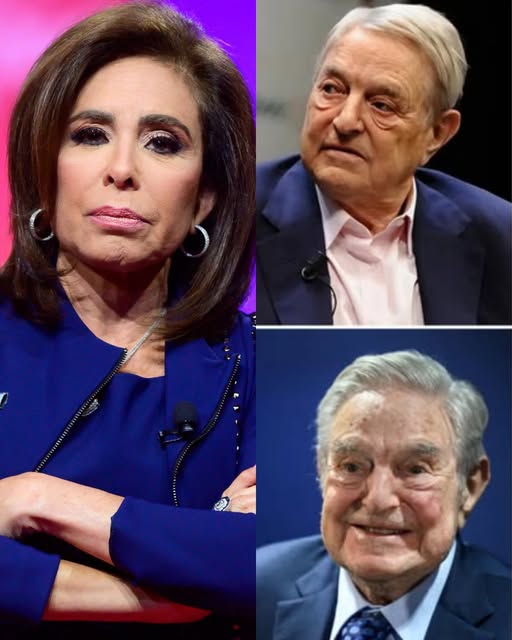
A new political and legal firestorm erupted this week after Judge Jeanine Pirro publicly called for a dramatic shift in how protest financing is examined under U.S. law. In remarks that immediately reverberated through Washington and Wall Street alike, Pirro urged federal authorities to treat the covert funding of large-scale protest activity as a potential form of organized crime — a move that, if pursued, could open the door to asset freezes and sweeping financial investigations.
The proposal, framed as a response to what Pirro described as a growing lack of transparency in political influence money, has placed billionaire philanthropist George Soros at the center of a heated national debate. Pirro did not allege criminal guilt. Instead, she argued that existing laws are outdated and insufficient to address modern, complex funding networks that operate across state and national lines.
“This is not about speech or peaceful assembly,” Pirro said in her comments. “It is about money, coordination, and accountability. When funding structures are hidden, and when the same financial channels repeatedly appear behind large-scale unrest, law enforcement has an obligation to ask hard questions.”
A proposal, not a prosecution
Crucially, Pirro’s remarks outlined a legal theory rather than an accusation. She called for investigations into protest financing to be evaluated under statutes commonly used to combat organized criminal enterprises, particularly when funding is concealed, routed through intermediaries, or tied to coordinated activity across multiple jurisdictions.
Under such a framework, authorities would be empowered to examine whether certain funding mechanisms meet the legal threshold for racketeering or conspiracy. Pirro emphasized that any such determination would require evidence, due process, and judicial oversight.
“This is about tools,” she said. “Law enforcement cannot be expected to address twenty-first-century influence operations with twentieth-century laws.”
Her comments immediately drew attention because of their scope. Reclassifying certain types of protest financing as potential organized crime activity would represent a fundamental change in how political funding is scrutinized — and it would almost certainly face legal challenges.
Why Soros became part of the conversation
George Soros, a longtime donor to progressive causes and political organizations, was referenced by Pirro as an example of the broader issue she believes deserves examination: the role of large-scale private wealth in shaping public action through complex funding networks.
Pirro did not claim that Soros had committed crimes, nor did she present evidence of illegal activity. Instead, she argued that when a small number of wealthy individuals or foundations exert outsized influence through opaque financial structures, the public has a right to transparency and regulators have a duty to investigate.
Supporters of Soros have long maintained that his philanthropic and political giving is lawful, disclosed where required, and protected by free speech principles. Civil liberties advocates echoed that position following Pirro’s remarks, warning that aggressive reinterpretations of organized crime laws could chill lawful political activity.
Shockwaves across political lines
The reaction in Washington was swift and polarized.
Some Republican lawmakers praised Pirro’s call as overdue, arguing that protest movements with national coordination and significant financial backing should be subject to the same scrutiny as any other powerful organization.
“This isn’t about ideology,” one senior Republican aide said privately. “It’s about whether the law applies equally when money and coordination are involved.”
Democratic leaders, meanwhile, pushed back sharply. Several warned that Pirro’s proposal risks conflating protest activity with criminal enterprise, potentially undermining constitutional protections.
“Peaceful protest is not organized crime,” one Democratic strategist said. “Any attempt to blur that line is dangerous.”
Behind the scenes, legal analysts noted that both sides are reacting not just to what Pirro said, but to what her proposal implies: a far-reaching investigation into influence money that could touch donors, nonprofits, and advocacy groups across the political spectrum.
The legal debate at the core
At the heart of the controversy is a complex legal question: when does coordinated funding cross the line from protected political activity into conduct that warrants criminal scrutiny?
Federal racketeering laws were designed to combat criminal organizations that rely on financial networks to sustain illegal activity. Applying those statutes to protest financing would require prosecutors to demonstrate intent, coordination, and unlawful objectives — a high bar that would be closely examined by courts.
Legal scholars caution that any such effort would face immediate constitutional challenges.
“The First Amendment looms large here,” said one constitutional law professor. “You cannot criminalize political funding simply because it is controversial or influential. The government would need clear evidence of illegal conduct, not just coordination or ideology.”
Pirro, for her part, acknowledged those concerns, stating that free speech protections must remain intact. Her argument, she said, is that secrecy and deception — not political expression — are the focus of her proposal.
Wall Street watches closely
Beyond Washington, financial institutions are also paying attention. The mention of potential asset freezes, even in a hypothetical legal framework, has raised questions about compliance, reporting obligations, and exposure.
Banks and investment firms are acutely sensitive to any expansion of laws that could require them to scrutinize clients’ political or nonprofit activity more aggressively. Several compliance officers, speaking anonymously, said Pirro’s remarks highlight a growing tension between political transparency demands and existing financial privacy norms.
“This isn’t something that would happen overnight,” one said. “But the fact that it’s being discussed at this level matters.”
A familiar figure in an unfamiliar fight
Judge Jeanine Pirro is no stranger to controversy. Throughout her career as a prosecutor, judge, and media figure, she has cultivated a reputation for aggressive legal thinking and direct language. Supporters view her as unafraid to confront powerful interests. Critics argue she often pushes legal boundaries for political effect.
This latest proposal fits squarely within that legacy.
Whether Pirro’s call leads to actual legislation, formal investigations, or simply a prolonged national debate remains unclear. What is certain is that the conversation she sparked is not going away quietly.
What comes next
At this stage, there is no indication that federal authorities have adopted Pirro’s proposal or launched investigations based on her remarks. Any such action would require substantial evidence, legal review, and political will.
Still, the reaction underscores a broader reality: the question of how money influences public action — and how transparent that influence should be — remains one of the most contentious issues in American democracy.
Pirro’s intervention has forced that question back into the spotlight, drawing sharp lines between transparency and overreach, enforcement and free expression.
For now, Washington is watching, Wall Street is calculating, and legal experts are parsing every word. Whether this moment becomes a turning point or a flashpoint will depend not on rhetoric, but on what, if anything, follows.
