
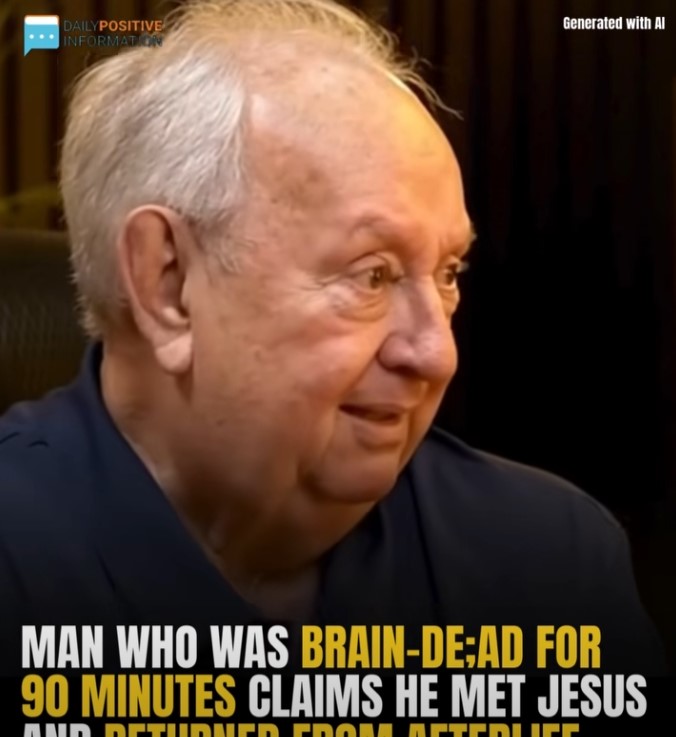
At the bottom of the article, you can watch the full podcast video where Robert tells his story in his own words — his emotions, his pauses, and his expressions make the account even more gripping.
Most people, at least once in their lives, quietly wonder what happens in those final moments after the heart stops beating. Does the world simply fade to black? Does the mind sputter out like a dying lightbulb? Or is there something else waiting — something we can’t measure, photograph, or fully explain?
For one man, that question is no longer theoretical.
Because according to him, he died. Not almost died, slipped into unconsciousness, or a brief medical scare. He died, remained brain-dead for over an hour and a half, and during that time — he says he crossed over, stepped into heaven, and met Jesus Himself.
And when he came back, he didn’t come back empty-handed.
He returned with a message.
His name is Robert Marshall, and his account has sparked intense fascination, skepticism, and soul-searching among believers and non-believers alike.
What happened inside those missing hours? And is there any scientific basis for the visions he describes?
Let’s dive into the extraordinary story of a man who claims to have seen the other side… and lived to talk about it.
The Sudden Collapse
In May 2024, Robert went to an outpatient emergency room after noticing a rapidly enlarging mass on his neck. It wasn’t subtle — he was struggling to breathe. The swelling was tightening around his airway, and he knew something was dangerously wrong.
Doctors rushed him through an MRI, ran blood tests, and tried to stabilize his breathing. But despite intervention, things took a turn no one expected.
His condition worsened dramatically. His lungs began filling with blood. His oxygen levels plummeted. And then — everything stopped.
According to medical records later documented in his book 44 Hours in Heaven, Robert went into cardiac arrest and acute hypoxic respiratory failure. His heart had stopped. His brain shut down from lack of oxygen. He entered what the hospital called “code blue” — three separate times.
For 90 minutes, there was no measurable brain activity.
To most physicians, that reads as one thing: irreversible death.
But Robert insists that his consciousness didn’t vanish. In fact, he says it went somewhere else entirely.
The Moment It Happened
During an interview on the Next Level Soul Podcast, Robert said:
“This wasn’t a near-death experience. I actually died. There was no coming back… until there was.”
He describes the moment of separation with chilling clarity. The pain stopped. The noise faded.
he chaos surrounding his failing body dimmed into silence.
And then — everything shifted.
He felt weightless, as if he had slipped out of his body like a hand leaving a glove. The hospital room dissolved around him. No machines. No doctors. No alarms. Only a vast, serene brightness.
Then he felt the ground under him… though it wasn’t ground the way we know it.
He claims that he was suddenly standing in what looked like an endless garden filled with massive oak trees, radiant flowers, and colors he says “don’t exist on Earth.” Colors so vibrant they seemed alive.
Robert doesn’t describe it as a dream. He doesn’t describe it as confusion. He describes it as the most real place he has ever been.
Science might raise an eyebrow at that — and we’ll discuss that shortly — but for Robert, there is no doubt.
He believed he was in heaven.
Meeting Jesus
What happened next, he says, changed him forever.
Amid the glowing landscape, he saw a figure approach — including a presence he describes as “pure love, pure peace, and overwhelming warmth.”
Robert claims: “I met Jesus. And it wasn’t symbolic. It wasn’t metaphorical. It was Him.”
He says Jesus stood in front of him with an expression that was both comforting and knowing, as if He understood every emotion Robert had ever experienced. The overwhelming feeling, he said, wasn’t judgment — but belonging.
But something else pulled at him too.
A sudden, burning awareness of his wife — not physically, but emotionally.
He felt her fear. Her grief. Her pain.
Even though he was “dead,” Robert says he could feel her suffering as clearly as his own heartbeat. He understood instantly what she was going through in that hospital, believing she might lose him forever.
That emotional tether became the reason he spoke the words he believes changed everything:
“I asked if I could go back.”
The Message He Received
Robert claims Jesus responded gently, almost with a sense of familiarity — as though the question didn’t surprise Him at all.
Before sending him back, Jesus told him:
“When you first came before Me, you asked if you could return.”
Robert remembers joking about whether Jesus could hear him, and the podcast host lightheartedly replied, “I don’t think Jesus is hard of hearing.”
But beneath the humor, Robert says the message hit him deeply. It meant that his plea — driven by love for his wife — had been heard instantly.
He believes he was sent back with the understanding that his time on Earth wasn’t finished, and that he still had purpose.
Moments later, he woke up in the hospital, surrounded by doctors who were stunned he had regained consciousness.
What Science Says About Experiences Like This
Near-death experiences (NDEs) have fascinated researchers for decades. Some people report floating above their bodies, traveling through tunnels, seeing deceased relatives, or encountering spiritual figures. Others describe peaceful landscapes, overwhelming love, or life reviews.
But what causes these visions?
There are competing theories.
1. Oxygen Deprivation in the Brain (Hypoxia)
When the brain is deprived of oxygen — known as hypoxia — it can produce vivid hallucinations.
Neurologists at the University of Michigan (Source: Proceedings of the National Academy of Sciences) have found that dying brains release a surge of organized electrical activity that can mimic consciousness, even after the heart stops.
In 2013, a study showed that rats exhibited heightened brain activity seconds after cardiac arrest — suggesting the same could occur in humans.
2. The Brain Releasing DMT
Some scientists believe the human brain releases dimethyltryptamine (DMT) near death, creating dream-like or spiritual visions. This remains controversial, but research from the University of Michigan and UC Davis has explored this possibility.
3. A Final Neurological “Comfort Mechanism”
Psychologists sometimes propose that near-death visions are the brain’s way of providing comfort in trauma — drawing from memories, beliefs, and emotional associations.
4. The Spiritual Interpretation
On the other end of the spectrum, many religious scholars argue that NDEs are evidence of consciousness surviving beyond biological death. They highlight the consistency of stories across cultures: the bright light, the feeling of peace, meeting a loving presence, a panoramic life review.
Cardiologist Dr. Pim van Lommel, whose NDE research has appeared in The Lancet, has documented cases where patients accurately described events in the operating room while clinically dead — raising questions science can’t yet fully explain.
How Long Can the Brain Survive Without Oxygen?
Robert said he was “dead for three days,” though medically the brain can only survive without oxygen for four to six minutes before major damage occurs.
However, the “90 minutes brain dead” refers to:
- loss of measurable brain activity
- no detectable consciousness
- medically categorized death
- later revival through emergency intervention
These definitions vary across hospitals.
Cases like Robert’s aren’t impossible — extremely rare, but documented.
For example:
- Anna Bågenholm, a Swedish woman, survived after being clinically dead for 80 minutes in icy water.
- Zack Dunlap, declared dead and scheduled for organ harvesting, suddenly moved his foot.
- Pam Reynolds, whose brain activity was completely flatlined during brain surgery, reported a detailed NDE later verified by medical staff.
These cases leave a lingering question: If the brain is “off,” where do these experiences come from?
Robert’s Life After Returning
Waking up after that long period of brain inactivity changed Robert profoundly.
He described waking with a level of peace he had never known — as though the fear of death had been completely erased. The anxiety, the dread, the uncertainty that most humans carry quietly in the back of their minds was simply gone.
But his physical recovery wasn’t instant. His body had undergone immense trauma. He had been intubated, shocked, resuscitated.
His lungs had been filled with blood. His neck mass still required treatment. He had to relearn certain movements and regain strength.
Yet emotionally and spiritually, he said he felt transformed — and that he understood now why he had returned.
It wasn’t just for his wife. It was to share what he saw.
Whether people believed him or not didn’t matter. He felt it was his duty to tell the story.
Why Stories Like His Fascinate Us
Near-death experiences strike a unique nerve in the human psyche.
They sit at the intersection of science and spirituality, skepticism and faith.
On one hand, neuroscientists can explain some elements with chemistry and biology. On the other, thousands of testimonies share strikingly similar patterns — even from people who were atheist, nonreligious, or medically unconscious.
The consistency leads many to wonder:
- Are these visions simply programmed into the human brain?
- Or are they glimpses into a reality beyond our senses?
- Is consciousness generated by the brain?
- Or does consciousness exist independently and simply use the brain as a vehicle?
It is, without exaggeration, one of the deepest mysteries of existence.
Robert’s story doesn’t solve that mystery — but it adds another intriguing piece to the puzzle.
What He Wants People to Know
Robert says that what he experienced wasn’t frightening.
It was peaceful. Warm. Comforting. Filled with a sense of understanding and love beyond anything on Earth.
His message, boiled down to its essence, is simple:
“There is something after this. And you are not alone.”
Whether viewed through spirituality, neuroscience, or a blend of both, his story continues to resonate — because it touches the universal question all humans eventually face.
