
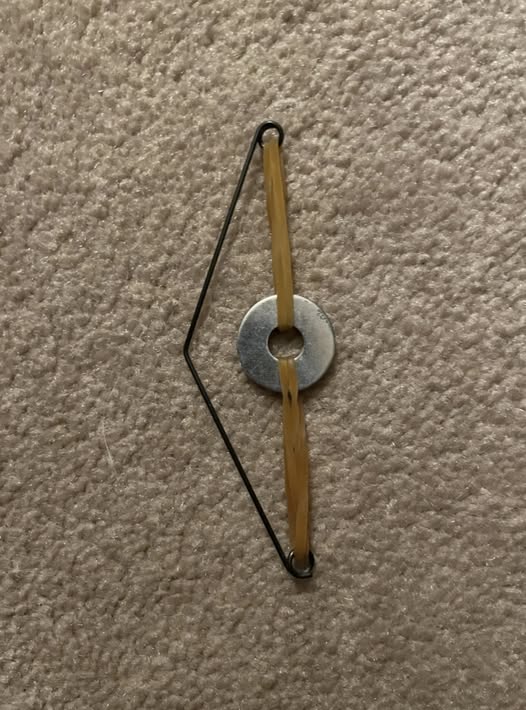
It usually begins during a routine clearing of a cluttered desk or while digging through a box of forgotten winter scarves. There, tucked away in the shadows of a drawer, lies a curious artifact: a skeletal contraption of bent wire, a weathered rubber band, and a single metal washer. At first glance, it appears to be nothing more than domestic debris—perhaps a mangled paperclip or the remains of a failed craft project.
But for those of a certain generation, the realization arrives with a sudden, knowing grin. This is no piece of junk. It is the heart of the “Rattlesnake Envelope” prank—a vintage piece of comedic engineering that has been engineering jump-scares for more than a hundred years.
Anatomy of a Prank: How the ‘Snake’ Strikes
Despite the evocative name, the gag involves no actual reptiles. Instead, the “rattlesnake” is a marvel of primitive physics—a simple, spring-loaded device designed to simulate the violent, buzzing strike of a viper the moment an envelope is breached.
The mechanics are deceptively straightforward:
-
The Set-Up: The wire gadget is wound tight, creating significant potential energy, and tucked flat inside a standard business-size envelope.
-
The Bait: The envelope is sealed, often adorned with “Open Carefully” or “Confidential” scribbled across the front to ensure the recipient’s full, focused attention.
-
The Strike: When the flap is lifted, the tension is instantaneously released. The coiled wire springs outward with a sharp, metallic snap, sending the envelope vibrating and the recipient jumping out of their skin.
It is a masterclass in timing and psychological misdirection—a relic of a pre-internet era when mischief required a stamp and a steady hand.
From Patent to Popularity: A History of Mischief
The lineage of the rattlesnake prank is long and storied. First patented in the early 1900s, it hit its cultural stride between the 1930s and 1950s. This was the golden age of the American joke shop, where mail-order catalogs like Johnson Smith & Co. sold the devices as the ultimate “jump scare.”
Marketed under various aliases such as “snake-in-the-box” or “envelope jacks,” the prank became a staple of domestic life. It was the weapon of choice for mischievous children targeting siblings, or bored office workers looking to liven up an April Fools’ Day. It represented a time when humor was tangible, physical, and arrived in the morning mail.
The Ethics of the Scare
While the device is constructed from light-gauge wire and harmless rubber—designed to startle rather than sting—the modern prankster must still exercise a degree of editorial judgment.
Journalistic standards for “harmless fun” have evolved. Experts suggest avoiding the prank when dealing with small children, the elderly, or anyone with a heart condition or anxiety disorder, as the physiological shock can be genuinely intense. Furthermore, the “packaging” matters: mimicking official government or legal mail can cross the line from a playful jab into causing legitimate distress.
The DIY Spirit: Building the Buzz
For those who wish to keep the tradition alive, the rattlesnake is remarkably easy to “reprint” at home. You only need three common household components:
-
A metal coat hanger (cut and twisted into a coil)
-
A rubber band (to provide the requisite tension)
-
A small washer or bead (to add the “rattle” and momentum)
The construction involves bending the wire into a tight spiral with a straight “tail” for anchoring. The rubber band is looped around the coil and secured to the tail, with the washer acting as the weighted head of the “snake.” Once folded flat and secured under an envelope flap, the trap is set. As a rule of thumb: always test your prototype on yourself first.
Why the ‘Rattle’ Still Resonates
In an age dominated by viral TikToks and digital memes, the rattlesnake envelope feels almost radically analog. It is a tactile reminder that humor doesn’t require Wi-Fi or a high-definition screen; sometimes, it just needs a rubber band and a sense of surprise.
Finding one of these gadgets in an old drawer isn’t just an exercise in nostalgia—it’s like uncovering a tiny time capsule of human creativity. It proves that even a century ago, we were looking for ways to make each other laugh through simple, clever disruption.
Final Thought
So, if you happen upon one of these odd little coils during your next spring cleaning, don’t be so quick to toss it in the bin. Smile at the history it represents. Perhaps even tuck it into an envelope and send it to a friend who could use a momentary, heart-pounding distraction.
After all, as long as we continue to send mail, there will be room for a rattlesnake waiting in the shadows. As the old adage goes: “The best pranks aren’t mean—they’re mischievous, momentary, and met with laughter.”
