
I only meant to spend a minute in the garage. That was all. The plan was simple, straightforward, and utterly mundane: grab an old toolbox from the corner.
Tighten a loose hinge on the kitchen cabinet that had been squeaking for weeks, and move on with the rest of the day. I had even glanced at the clock before stepping inside, thinking that ten minutes — maybe fifteen if I got distracted — would be more than enough.
Yet the instant I crossed the threshold, I noticed something different. The garage, normally a functional, familiar space where tools were stored, bicycles leaned against walls, and boxes of long-forgotten holiday decorations waited quietly in the corners, felt unusually still.
Not silent exactly — there was always the low hum of the refrigerator in the corner or the faint wind rattling a window pane — but a kind of suspended stillness, as if the room itself were holding its breath.
Dust motes drifted lazily in the narrow beam of light streaming down from the single exposed bulb on the ceiling, catching and reflecting in tiny, almost magical ways.
The familiar smells of cardboard, aged paper, sawdust, and metal seemed sharper, more noticeable, almost like the garage had been concentrating them into one concentrated scent.
I moved past the usual clutter: stacked boxes labeled “Holiday Decor,” “Old Paint Supplies,” “Winter Sports Gear,” and a shelf that bore the evidence of a thousand past projects — nails, screws, odd bits of wire, an old glue gun with a hardened stick of glue still inside, and a carefully dusted collection of empty jars.
Everything was as it should have been — except for one detail that immediately pulled my attention.
In the far corner, behind a tall, wobbly cabinet that we had used for storage of mostly forgotten tools, there was something that did not belong.
At first, it was just a vague outline, a subtle change in texture against the wall. But as my eyes adjusted and my curiosity drew me closer, the form became unmistakable. My steps slowed almost instinctively.
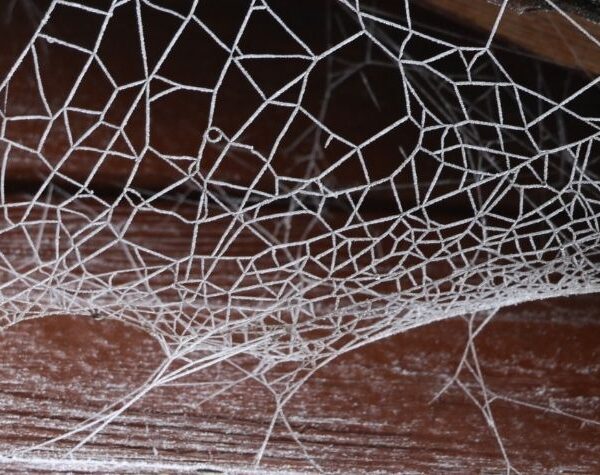
It was an enormous spider web, unlike anything I had ever seen inside a home. It spanned the corner, stretching across the wall in delicate, layered patterns that were almost lace-like in their complexity.
Each strand shimmered faintly in the light, fine and almost impossibly thin, yet incredibly strong — a testament to nature’s quiet engineering.

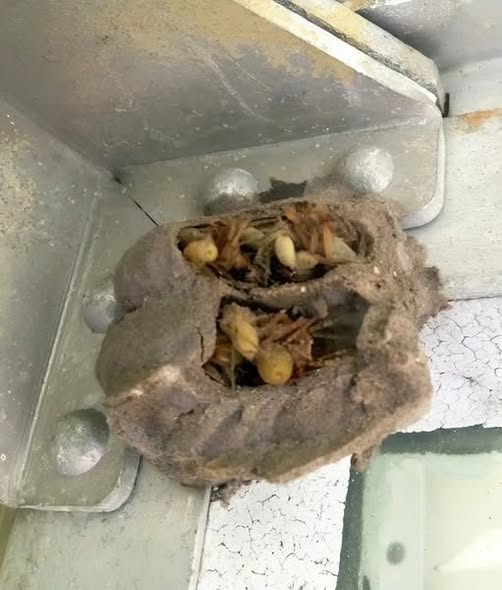
Tiny spiders moved carefully along the threads, attending to the web as if following a precise routine. Nestled among the strands were clusters of pale eggs, each one tucked safely into the intricate structure.
For a moment, I simply stood there, transfixed. There was nothing overtly threatening about the scene — it was not the sort of thing that caused fear or alarm in a cinematic, horror-movie sense.
Yet it was undeniably startling. This tiny, meticulously constructed world had been growing quietly, unnoticed, right under our noses for weeks, maybe months.
The scale of it, the sheer attention to detail, made me stop and marvel. How had we walked past this corner so many times without noticing? How had such a small ecosystem managed to thrive in a space we considered ordinary, mundane, and fully familiar?
Eventually, instinct told me to step back. I exited the garage, closing the door softly behind me, and took a few deep breaths. My mind raced through possibilities: Was it safe to remove it myself?
Was it home to venomous spiders? Could I disturb it without consequences? None of the answers were clear, so I waited.
Later, when my husband returned home, I asked him to take a look. He expected a minor issue, something easily solved. Perhaps a few cobwebs in a corner, maybe a nest of harmless spiders.
But as soon as he turned the corner and his eyes fell on the far wall, his expression shifted. The web was larger than we had initially estimated. It extended across shelves, weaving through small gaps we rarely examined.
The web’s delicate threads seemed to multiply as we observed it, each one perfectly aligned, each one serving a purpose.

It quickly became apparent that this was not a task for amateurs like us. Even with gloves, masks, and makeshift tools, attempting to dismantle the web ourselves risked disturbing the spiders in ways we couldn’t control. We made the responsible choice: call in a professional to safely remove the web and the spiders.
While we waited for the professional service, I found myself reflecting on the experience. The garage had always been an overlooked space — a utility area meant for storage, functional work, and clutter containment.
It wasn’t a place we paused to appreciate, at least not consciously. Yet in that ordinary corner, nature had quietly been conducting a remarkable act of creation, entirely unnoticed by humans.
It was a small but profound reminder that life — even in the most mundane spaces — continues in its intricate and often hidden ways.
When the professional arrived and carefully removed the web, there was a tangible sense of relief. The garage felt lighter, less crowded, but the memory of what had been there lingered.
That corner, once ignored, no longer seemed invisible. I found myself pausing whenever I passed it, not out of fear or discomfort, but with a renewed sense of awareness.
It was a subtle shift in perception: a reminder that the ordinary is often full of hidden wonder, waiting patiently for someone to look a little closer.
Over the following weeks, I began noticing details in other spaces of the house I had taken for granted. A small crack in the baseboard where dust had collected in intricate patterns.
A faint pattern of mold on the window frame, almost like abstract art. Even the way sunlight filtered through a dusty lamp shade in the living room revealed textures I had never consciously observed before. That brief encounter with the spider web had changed my perception.

Interestingly, the experience also sparked conversations. Friends and family who visited the house marveled at the idea of an unnoticed world flourishing in the garage.
We discussed the resilience and intelligence of spiders, the importance of observation, and the subtle ways in which life intersects with human spaces without us realizing.
What began as a simple errand — a minute-long task to grab a toolbox — became a lesson in attentiveness, curiosity, and respect for the small, unnoticed things around us.
Looking back, the incident holds multiple layers of meaning. On one level, it was a straightforward encounter with nature: spiders creating a home where humans had not paid attention.
On another, it was a personal reminder to slow down, to observe, and to appreciate the details that make ordinary life remarkable. There is a kind of humility in recognizing that even spaces we think we know completely can surprise us.
I also learned something about timing and patience. The spiders had not built the web overnight. It was the product of weeks, perhaps months, of meticulous effort.
Their quiet work went on entirely outside of human awareness, and when we finally noticed, it was both awe-inspiring and humbling. It reminded me that creation and persistence often occur in silence, unseen, and unacknowledged — a truth that extends far beyond a dusty garage corner.
Even now, months later, the story of that web feels significant. Whenever I step into the garage, I carry with me a heightened awareness of my surroundings.
I notice the subtle shapes of stacked boxes, the textures of the shelves, the faint shadows cast by tools hanging on hooks. There’s an almost meditative quality to moving carefully through a space I once took entirely for granted.
That ordinary, overlooked corner has become a point of reflection — a reminder that discovery can happen anywhere, at any time, and often when we least expect it.
Sometimes, I think about what would have happened if I hadn’t paused to look. The web might have persisted for months more, perhaps undisturbed, perhaps unnoticed by anyone.
It makes me wonder how many small wonders exist in everyday spaces, hidden just out of sight, waiting for someone to take a moment and truly see them.
That realization — that life quietly continues, even in forgotten corners — has reshaped the way I approach not just my home, but the world around me.
What started as a minute-long errand became a transformative experience. It taught me patience, attentiveness, and the value of observation.
It reminded me that even in places designed for utility rather than beauty, there is space for awe and wonder. The garage is no longer just a storage room; it is a reminder that small discoveries can change our perception of the ordinary forever.
In the end, the web itself was removed, but the lesson remained. Every corner of every space has the potential to surprise us, to make us stop and notice, to remind us that the world is far richer than we often acknowledge.
Now, when I open the garage door, I do so with a little more care, a little more attention, and a little more wonder. A simple task — retrieving a toolbox — led to an encounter with a hidden, meticulous world, and that encounter has stayed with me in ways I could never have anticipated.
Sometimes, life’s most unexpected moments happen not in grand adventures or planned experiences, but in ordinary spaces we pass by every day. And sometimes, all it takes is a single, curious step toward the unnoticed corner to see the extraordinary.
