
In the modern ethical landscape, few issues ignite as visceral a public reaction as the mistreatment of animals. Viewed through a sociological lens, cruelty toward defenseless creatures is often regarded as a red flag—a stark indicator of a deficit in empathy that society is increasingly unwilling to overlook. While legal frameworks and advocacy groups have made monumental strides in codifying animal rights, the frontline of this moral battle often resides in the quiet, everyday interactions of suburban neighborhoods. In an era where social media acts as both a digital courthouse and a public square, a single incident involving a cat, a child, and a bucket of water has surged through the internet, forcing a candid conversation about parenting, boundaries, and the “reflexive” pursuit of justice.

The Fence-Line Confrontation
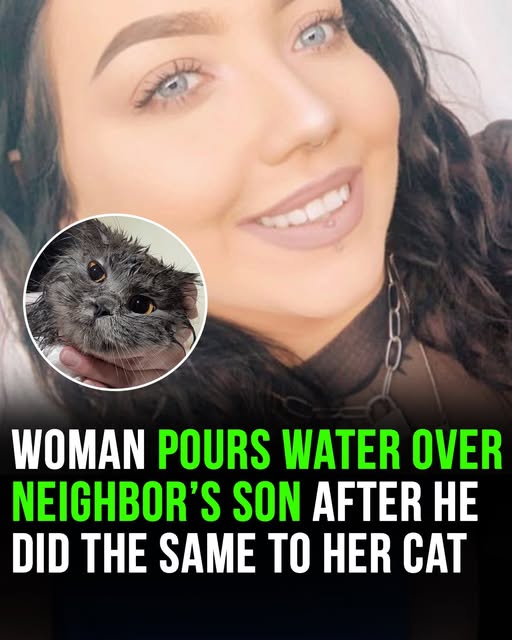
The incident centered on Shannon Cooper and a neighbor’s child, a scenario that began with what many might dismiss as “kids being kids,” but which Cooper viewed as a fundamental breach of decency. According to Cooper, she witnessed the child pouring water over her cat as it sat undisturbed on a fence. The child’s reaction—laughter in the face of the animal’s distress—served as the catalyst for an immediate and controversial intervention.
Driven by a surge of protective instinct, Cooper responded in kind: she poured water back on the child. Taking to the social media platform X to mark her territory, she posted a succinct, four-word warning: “Don’t touch my cat.”
A Digital Referendum on “Cause and Effect”
The post didn’t just go viral; it became a lightning rod for animal lovers and parents alike. For many, Cooper’s response was a masterclass in the law of reciprocity—a non-harmful but immediate lesson in cause and effect. Supporters argued that the act was a proportionate response that communicated a vital truth: harming a living being carries consequences.
Within the digital discourse, a consensus emerged among a vocal segment of parents: empathy is not always an innate trait; it is often a taught behavior. “Practical lessons,” as some commenters described them, can reinforce the gravity of an action far more effectively than a verbal reprimand.
Beyond Punishment: The Role of Experiential Learning
The debate has moved beyond the simple “eye-for-an-eye” narrative to explore the deeper ethical development of children. Sociologists and child development observers have noted that understanding empathy frequently requires experiential learning—seeing and feeling the immediate impact of one’s choices.
From this perspective, Cooper’s intervention was framed not as a punitive strike, but as a form of real-world feedback. By experiencing the same discomfort the child had inflicted upon the cat, the child was forced into a moment of unwanted perspective-taking.
The Moral Compass of the Community
Ultimately, the story of Shannon Cooper and her cat serves as a microcosm of a larger societal shift. It highlights the role of community norms in protecting those who cannot protect themselves. While the internet remains divided on the “right” way to handle a neighbor’s child, the underlying message of the viral event is clear: in 2026, the humane treatment of animals is no longer a peripheral concern—it is a core societal value.
Through this lens, small, carefully handled interventions are seen by many as essential tools for shaping a more compassionate future, reinforcing the principle that every living creature deserves a baseline of respect and protection.
While the internet remains a fertile ground for the “instant justice” narrative, a deeper dive into the viral confrontation between Shannon Cooper and her neighbor’s child reveals a more nuanced debate. Beyond the initial applause for Cooper’s protective stance, a vocal contingent of critics has emerged, sparking a sophisticated dialogue on the boundaries of discipline, the responsibilities of guardianship, and the psychological impact of adult modeling.
As a journalist who has spent a decade observing the intersection of digital culture and traditional morality, I find that this story serves as a critical junction for the modern debate on how we socialize the next generation to respect the vulnerable.
The Argument for Restraint
Critics of Cooper’s “eye-for-an-eye” intervention argue that she overstepped a fundamental social boundary. From this perspective, the responsibility for disciplining a minor rests solely with the parents or caregivers. The central concern is that by retaliating directly, an adult may inadvertently model the very reactive behavior they are trying to discourage.
Psychologists often emphasize that children learn social norms by observing how adults navigate conflict. If an adult responds to a minor’s transgression with a similar act of aggression—no matter how non-harmful the medium—it can muddy the waters of a constructive lesson. In this view, while the instinct to protect the cat was valid, the method was a missed opportunity for a more structured, cognitive learning experience.
Alternative Strategies in the “Empathy Gap”
The digital discourse has provided a laboratory for alternative conflict resolution strategies. Commentators have posited that a more effective long-term approach might have involved:
-
Cognitive Learning: Calmly explaining the physical and emotional distress caused to the animal.
-
Empathy Exercises: Guiding the child to imagine the situation from the perspective of the pet.
-
Parental Mediation: Involving the guardians to ensure that the behavioral expectations are reinforced within the home.
These methods prioritize emotional intelligence over immediate retribution, seeking to prevent future incidents without escalating neighborhood tensions.
The “Cooling Off” Period: Reconciliation and Context
In a move that added significant context to the viral firestorm, Cooper eventually posted a follow-up. She clarified that the “splash” had not resulted in a permanent feud. According to her update, the child’s father was able to laugh about the situation after the initial shock wore off, the child suffered no lasting ill effects, and the cat remained safe in its sanctuary.
This update illustrates a rare but vital phenomenon in the social media age: that visceral reactions can coexist with amicable resolutions. It reinforced the idea that accountability and humor can, at times, be intertwined, allowing for a lesson to be learned without fracturing the community fabric.
The Role of Legal and Social Frameworks
The public’s intense reaction to this story is also a reflection of the evolving legal and social frameworks surrounding animal welfare. In many jurisdictions, laws against animal cruelty are increasingly seen as more than just punitive measures; they are cultural touchpoints that reinforce the humane treatment of all living beings.
Educational initiatives and community programs are now being designed to supplement these laws, teaching children the “why” behind animal respect. Real-world stories like Cooper’s—even when they happen over a backyard fence—become anecdotal evidence of the principles that formal education seeks to instill.

A Microcosm of Moral Responsibility
Ultimately, the case of Shannon Cooper and her cat is a potent case study in the complexity of human behavior and child development. It challenges us to ask: What is the most constructive way to intervene when we witness an ethical breach?
While the debate between immediate action and reflective guidance continues, the story serves as a reminder that empathy is an ongoing responsibility. Communities are tasked with fostering environments where children learn respect and adults model intervention that is both firm and constructive.
In a world where small acts can be broadcast to millions in seconds, Cooper’s decision to act, share, and then clarify her story offers a lesson for us all. It reminds us that the line between instinctive protection and deliberate education is often thin, but the goal remains the same: the cultivation of a more compassionate society for every creature, great and small.
