
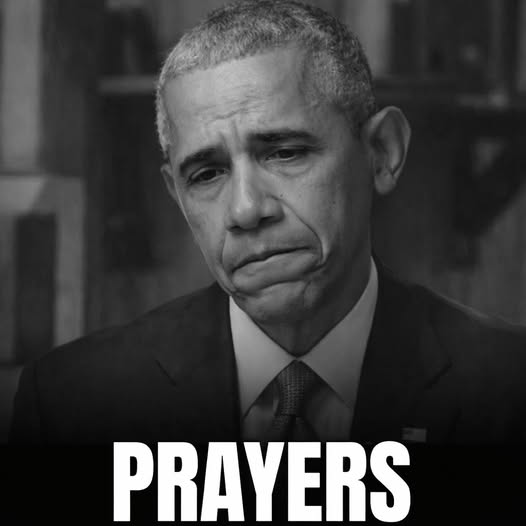
Barack Obama has long been admired for his calm demeanor, eloquence, and steady leadership in moments of national challenge. Yet behind the historic presidency, the bestselling books, and the global recognition, there is a deeply personal story shaped by loss, reflection, and resilience. While Obama rarely centers public attention on his private grief, the influence of family—particularly the absence of his parents—has quietly informed much of who he is and how he leads.
This is not a story of sudden tragedy. It is a story of remembrance.
A Life Marked Early by Absence
Barack Obama’s relationship with loss began long before the world knew his name. His father, Barack Obama Sr., died in a car accident in Kenya in 1982 when Obama was just 21 years old. Their relationship had been distant and complex, shaped by geography, politics, and time. Yet the absence of his father left a profound imprint.
Obama has spoken candidly about the struggle of growing up without a father present and how that absence fueled a lifelong search for identity, purpose, and understanding. In his memoir Dreams from My Father, he described that search not as bitterness, but as a quiet longing to reconcile heritage, responsibility, and selfhood.
That unresolved loss followed him into adulthood—not as an open wound, but as a shaping force.
Ann Dunham: The Moral Compass
If his father represented absence, his mother, Ann Dunham, represented grounding.
Ann Dunham died of ovarian cancer in 1995, when Obama was 34 years old and still years away from national office. Her death came at a formative moment, just as he was beginning to consider a life of public service.
Obama has frequently described his mother as his moral center — a woman of fierce intellect, empathy, and global curiosity. She raised him with an emphasis on compassion, responsibility, and the belief that ordinary people matter.
“She taught me that the world is complicated, but never an excuse to stop caring,” Obama once said.
Her death was not just a personal loss — it was the loss of his anchor.
Grief Without Spectacle
Unlike many public figures, Obama has never used personal grief as political currency. His mourning was quiet, internal, and reflective. Friends and colleagues have noted that he processes emotion through thought, writing, and listening rather than public display.
This restraint has sometimes been misinterpreted as emotional distance. In reality, it reflects a deeply private relationship with grief — one rooted in dignity rather than denial.
During his presidency, moments of national tragedy often revealed that private empathy. Those close to him observed that his ability to comfort grieving families stemmed from lived understanding rather than rehearsed language.
How Loss Shaped His Leadership
The absence of his parents shaped Obama’s leadership style in subtle but powerful ways:
-
Deliberation over impulse
-
Empathy over outrage
-
Listening over dominance
He governed not as someone untouched by loss, but as someone familiar with it.
In moments of crisis — mass shootings, natural disasters, military casualties — Obama often spoke with a tone that resonated deeply with families affected by grief. His words did not promise easy answers. Instead, they acknowledged pain without exploiting it.
That restraint came from experience.
Fatherhood as a Response to Loss
Perhaps the most visible legacy of Obama’s early loss is how intentionally he approached fatherhood.
Obama has spoken openly about his determination to be present for his daughters, Malia and Sasha, in ways his own father could not be. From attending school events to structuring his schedule around family dinners, he treated fatherhood not as secondary to leadership — but as foundational to it.
“Being a father is my most important job,” he once said.
In many ways, fatherhood became his response to absence — a commitment to continuity.
Michelle Obama and Shared Understanding
Michelle Obama has also spoken about the role family loss played in shaping their marriage. Her own father passed away in 1991, and both understood what it meant to grieve quietly while moving forward.
Their partnership was built not just on ambition, but on mutual emotional literacy — the ability to carry sorrow without being consumed by it.
That shared understanding allowed them to support each other through the pressures of public life without losing sight of private meaning.
Public Memory and Private Reflection
Each year, anniversaries of his parents’ deaths pass without public announcements. Obama rarely marks them openly. Instead, remembrance takes the form of action: mentorship programs, community work, education initiatives, and policies rooted in dignity.
Friends say he honors his parents not with ceremony, but with consistency.
A Different Kind of “Thoughts and Prayers”
To keep Barack Obama “in our thoughts” is not to imagine him in crisis — but to recognize the quiet weight he carries and the grace with which he carries it.
It is to remember that leadership does not emerge from invulnerability, but from lived experience, reflection, and restraint.
Memory, Meaning, and the Long Arc of Personal History
As Barack Obama moved further into public life, the influence of his family history became more visible—not through direct references, but through patterns of thought, discipline, and restraint. Those who worked closely with him often remarked that he approached decisions with a deep awareness of consequence, as though every choice existed within a longer moral timeline rather than a single news cycle. That perspective, many believe, was shaped by the early losses he experienced and the responsibility he felt to live deliberately in their aftermath.
Writing as a Way of Processing Loss
One of the most consistent ways Obama has processed personal history is through writing. From Dreams from My Father to A Promised Land, his reflections often circle back to questions of belonging, inheritance, and responsibility. Writing allowed him to engage with grief intellectually and emotionally without being overwhelmed by it.
In Dreams from My Father, Obama explored the idea that understanding one’s parents—even imperfectly—is a lifelong task. The book was not written as a tribute or a lament, but as a dialogue across time, culture, and absence. Through that process, Obama reframed loss as a source of inquiry rather than paralysis.
That same approach carried into his later works, where memory serves as context rather than conclusion. He does not seek closure in the traditional sense; instead, he seeks coherence—an understanding of how past experiences inform present choices.
Public Service as a Form of Honor
For Obama, public service has often functioned as a way of honoring those who came before him. His mother’s commitment to education, development, and social equity found echoes in his policy priorities. From healthcare reform to international diplomacy, he consistently emphasized dignity, opportunity, and shared responsibility.
Observers have noted that his leadership style reflected his mother’s belief in practical idealism—the idea that compassion must be paired with structure and accountability. In this way, her influence extended far beyond the family sphere, shaping policies that affected millions.
Similarly, Obama’s engagement with global issues, particularly in Africa, can be seen as part of an ongoing effort to understand and reconcile his paternal heritage. Rather than romanticizing it, he approached it with respect and realism, acknowledging both its promise and its complexity.
Grief and Emotional Discipline
One of the most striking aspects of Obama’s public presence has been his emotional discipline. In an era increasingly defined by performative outrage and instant reaction, his measured responses stood out. Critics sometimes framed this as detachment, but those familiar with his personal history suggest otherwise.
Loss taught Obama that emotions do not disappear when unexpressed publicly—they are managed, integrated, and channeled. This discipline allowed him to remain steady in moments of crisis, offering reassurance without false certainty and empathy without spectacle.
That balance resonated with many Americans who saw in him a model of leadership grounded not in invulnerability, but in self-awareness.
The Role of Faith and Reflection
While Obama’s relationship with faith has often been discussed in political terms, it also plays a quieter role in how he understands loss and continuity. He has spoken about faith not as a set of rigid answers, but as a framework for humility—an acknowledgment that life’s meaning unfolds over time rather than all at once.
This perspective aligns closely with how he speaks about family history. Rather than framing his parents’ lives and deaths as isolated events, he situates them within a broader narrative of human striving, imperfection, and connection.
Reflection, for Obama, is not passive. It is an active practice—one that informs decisions, shapes values, and sustains perspective amid pressure.
A Legacy Passed Forward
As his daughters have grown into adulthood, Obama has become increasingly mindful of how family stories are passed on. He has spoken about the importance of sharing history honestly, without idealization or omission. In doing so, he models a form of remembrance that is grounded in truth rather than nostalgia.
This approach ensures that loss does not become a burden, but a source of understanding. It allows future generations to see where they come from without being confined by it.
Closing Reflection
To continue keeping Barack Obama in our thoughts is to recognize the quiet architecture behind his public life—the unseen experiences that shaped his patience, empathy, and resolve. His story reminds us that leadership is often forged not in moments of triumph, but in how individuals respond to absence, uncertainty, and responsibility.
Loss did not define Obama, but it informed him. And through reflection, discipline, and service, he transformed personal history into public purpose.
