
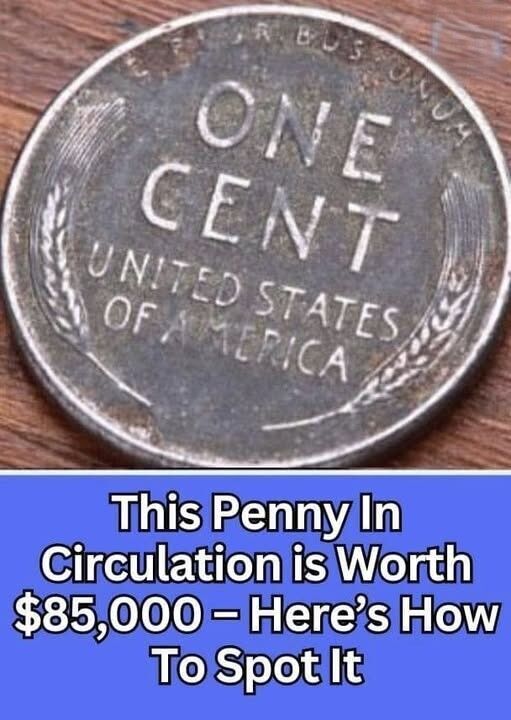
Most people drop loose change into jars, drawers, or cupholders without a second thought. Pennies feel disposable—too common to matter, too small to hold real value. Yet hidden among ordinary coins, there are rare exceptions that can be worth more than a yearly salary. One of the most famous examples is the legendary 1943 copper wheat penny.
To understand why this single cent can sell for $60,000 to $85,000, you have to look back to World War II. In 1943, the United States was deeply involved in the war effort, and copper was a critical resource. It was needed for ammunition, electrical wiring, and military equipment. As a result, the U.S. Mint was ordered to stop using copper for pennies.
Instead, pennies that year were made from zinc-coated steel. These coins looked noticeably different—silver-gray, lightweight, and slightly magnetic. It was the only year in U.S. history that pennies were struck from steel.
In theory, copper pennies from 1943 should not exist.
But mistakes happen.
A small number of leftover copper blanks from 1942 were accidentally mixed in with the steel blanks at the Mint. Those copper discs were stamped with the 1943 date and released into circulation without anyone noticing. What should have been a routine production year turned into one of the greatest coin errors in American history.
Today, experts believe fewer than 25 authentic 1943 copper pennies are known to exist. That extreme rarity is what drives their staggering value. A genuine example in excellent condition can fetch close to $85,000 at auction. Even worn or damaged versions often sell for around $60,000—all for a coin that was once worth a single cent.
That kind of value naturally attracts fakes.
Some counterfeiters alter 1948 pennies by reshaping the “8” to resemble a “3.” Others take common 1943 steel pennies and coat them with copper to mimic the real thing. At first glance, these fakes can look convincing.
Fortunately, there’s an easy test anyone can perform at home: use a magnet.
Copper is not magnetic.
Steel is.
If a supposed 1943 copper penny sticks to a magnet, it’s not authentic. This simple test has helped countless collectors avoid costly mistakes. More advanced checks—such as weight, thickness, and metal composition—can be done by professionals, but the magnet test is the quickest first step.
What many people don’t realize is that these rare pennies could still be hiding in everyday places. Old jars, inherited coin collections, dusty boxes in attics, or forgotten tins may contain one without anyone knowing. Coins circulated freely in the 1940s, and some of these copper pennies were likely saved casually or overlooked for decades.
If you’re curious, look for these key signs:
• The date reads 1943
• The coin has a copper color
• It does not stick to a magnet
• The reverse shows the wheat ear design
If all of those match, you could be holding something extraordinarily valuable.
The next step would be professional authentication. Reputable coin dealers or grading services can confirm whether the penny is genuine. Certification from a trusted authority can transform a lucky find into a highly sought-after collector’s piece.
The story of the 1943 copper penny is part history, part accident, and part modern-day treasure hunt. It’s proof that extraordinary value doesn’t always come in obvious forms. Sometimes, it’s hidden in plain sight.
Pennies are often ignored or tossed aside—but this one proves that even the smallest object can carry immense worth. So take a closer look at your spare change. That forgotten penny might just be a tiny piece of history capable of changing your life.
