
The last time Christmas felt like a celebration, I was forty-five years old. I remember the snow that year—it wasn’t a nuisance to be shoveled, but a blanket, softening the hard edges of the suburban Chicago landscape. I remember the smell of cinnamon wafting from the stovetop, mingling with pine needles and the sharp, metallic scent of cold air clinging to coats thrown over the banister. And I remember my daughter, Hannah, nineteen and radiant, belting out Mariah Carey songs off-key in the kitchen, her laughter bouncing off the walls like sunlight caught in a prism.
I am fifty-two now.
Christmas stopped being a holiday seven years ago. It became a season of endurance, a gauntlet of memories I had to survive while the rest of the world hung lights and drank eggnog.
Hannah disappeared on a Tuesday in December. It was a nothing day. A day that didn’t look like a tragedy. She said she was meeting a friend for coffee. She put on her favorite oversized hoodie—the one she stole from her ex-boyfriend—grabbed her keys with the jingling cat keychain, and walked out the door. She never came back.
There was no note. No phone call. The police found nothing—no digital footprint, no witnesses, no body. Just a void where my daughter used to be.
For seven years, I lived in a state of suspended animation. I slept in two-hour shifts, waking up with my heart hammering, convinced I heard the front door open. I kept her room exactly as she left it, a museum of an interrupted life. Her perfume—a lemony, youthful scent—lingered in her closet long after the molecules should have dissipated. I lived in the terrible, silent space between grief and hope, a limbo that felt like drowning in slow motion.
My husband, Mark, couldn’t swim in that deep water. He left three years after she vanished. He said he needed to “move on,” a phrase that sounded to me like a betrayal of the highest order. He wanted to sell the house. I refused. I had to be there in case she came back. So, I stayed alone in a house that echoed with the ghosts of a happy family.
The Bracelet in the Coffee Shop
It happened on a layover. I was returning from a visit to my sister, Margaret, in Boston. My flight had been delayed due to a blizzard, leaving me with four hours to kill in a city I didn’t know. I wandered out of the terminal, needing to escape the sterilized air of the airport, and found a small, crowded coffee shop near the train station.
The place was bursting with aggressive cheer. Tinsel draped over the espresso machine. Mariah Carey was back, her voice echoing from the speakers, mocking the hollow ache in my chest. A couple in the corner laughed over spilled cocoa. It was the kind of warmth that should have been comforting but only made me feel colder, emphasizing my isolation.
I ordered a latte I didn’t want and stood by the counter, waiting. I wasn’t looking for anything. I was just trying to exist until my flight boarded.
The barista slid a cup across the counter. “Latte for Elaine?”
I reached for it. And then I froze.
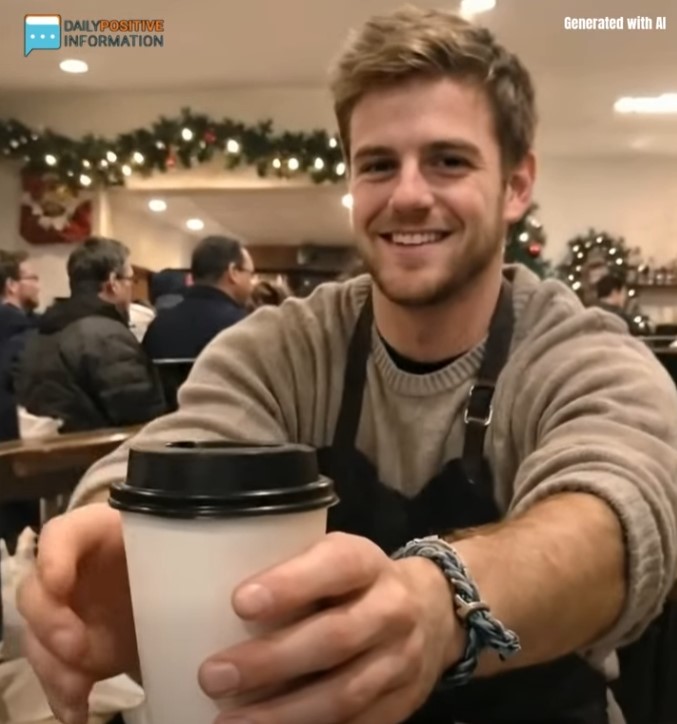
The barista was a young man, maybe mid-twenties, with tired eyes and sleeves rolled up to his elbows. He looked exhausted, the way young parents or students often do. On his left wrist, tied with a crooked, amateur knot, was a bracelet.
It wasn’t jewelry. It wasn’t gold or silver. It was a thick braid of embroidery thread, faded now to soft blues and grays, frayed at the edges.
I stopped breathing. The noise of the coffee shop—the grinder, the chatter, the music—dropped away into a dull roar. The world narrowed down to that wrist.
I knew that bracelet.
I knew the exact tension of the weave. I knew the specific shade of slate-blue thread because we had to go to three different craft stores to find it during a blizzard when Hannah was eleven. She had been obsessed with making friendship bracelets that winter. We had sat at the kitchen table while the wind howled outside, her small fingers struggling with the knots.
I knew the knot was crooked because Hannah, eleven years old and stubborn, had refused to let me fix it.
“It gives it character, Mom,” she had said, her tongue poking out between her teeth in concentration. “Perfection is boring.”
She wore it every day. It was on her wrist the night she walked out the door seven years ago.
My hand trembled so violently I almost knocked the cup over. Hot coffee sloshed onto the counter, but I didn’t feel the burn.
“Excuse me,” I whispered. My voice sounded foreign, brittle, like dry leaves stepping on pavement.
The barista looked up, wiping his hands on a rag. “Yeah? Something wrong with the drink? I can remake it.”
“That bracelet,” I said, pointing a shaking finger at his wrist. “Where did you get it?”
He looked down at his arm, then back at me. His expression shifted instantly. It was subtle—a flicker of wariness, a tightening of the jaw, the way a guard dog looks when it hears a twig snap.
“Sorry?”
“The blue and gray one,” I said, louder now, desperation clawing at my throat. “Where did you get that bracelet?”
He pulled his sleeve down, covering it. “It’s just something I’ve had for a while. Personal.”
“It’s mine,” I blurted out. “I made that bracelet. With my daughter. In 2012.”
He froze. His eyes darted to the door, then back to me. “Lady, I don’t know what you’re talking about. I’m busy. There’s a line.”
He turned his back on me and started steaming milk for the next order, the hiss of the machine acting as a wall between us.
I couldn’t move. I couldn’t leave. The world tilted on its axis. My daughter’s bracelet—the one she never took off, the one that was supposed to be on her wrist wherever she was—was on the wrist of a stranger in a coffee shop three states away from home.
The Vigil in the Booth
I didn’t leave. I couldn’t. Leaving felt like abandoning her all over again.
I took my cold latte to a corner booth and sat down. I watched him.
He knew I was watching. He kept glancing over his shoulder, his movements jerky and nervous. He dropped a spoon. He messed up an order. He whispered something to his coworker, a girl with purple hair, who looked at me with suspicion.
I waited for three hours. My flight began boarding. I let the notification on my phone buzz and fade. I wasn’t going anywhere.
I analyzed him. He didn’t look dangerous. He looked tired. He wore a wedding band—a simple silicone ring. He moved with a kind of efficiency that suggested he was used to hard work.
When his shift ended, he took off his apron and grabbed a heavy, worn coat. He headed for the door, eyes fixed on the pavement outside, clearly hoping to slip away unnoticed.
I intercepted him.
“Please,” I said, blocking his path on the sidewalk. The wind was biting, cutting through my coat, but I didn’t feel it. Adrenaline was keeping me warm. “Just listen to me. I’m not crazy. My daughter’s name is Hannah. She disappeared seven years ago.”
He stopped. He looked at me, really looked at me. He saw the desperation, the exhaustion, the mother who had nothing left to lose. I saw the color drain from his face.
“She vanished,” I choked out, the tears finally spilling over, hot tracks on my cold cheeks. “I haven’t heard her voice in seven years. The police stopped looking five years ago. My husband left. I have nothing. I just need to know if she’s alive. Please. That bracelet… she never took it off. She said it was her lucky charm.”
He stared at me for a long, agonizing moment. I saw a war playing out behind his eyes—fear battling with something else. Compassion? Guilt? Loyalty?
He sighed, a heavy plume of white in the cold air. He looked around the busy street, ensuring no one was close enough to hear.
“I didn’t steal it,” he said quietly. “She gave it to me.”
My knees buckled. I grabbed the rough brick wall of the coffee shop to stay upright. The world grayed out at the edges.
“She gave it to you?” I whispered. “You know her? Is she… is she okay?”
He looked around nervously. “I can’t talk here. This isn’t… I can’t just tell you things. It’s complicated.”
“Tell me she’s alive,” I begged, gripping his sleeve. “Just tell me that. I don’t need to know where. I just need to know she is breathing air on this earth.”
He pulled his arm away gently. “She’s alive. I promise. Just… give me your number. I have to talk to her first. I can’t betray her trust.”
“Betray her trust?” I asked, incredulous. “I’m her mother.”
“I know,” he said, and his voice was sad. “That’s why I have to ask. Write it down.”
I scribbled my number on a napkin with a shaking hand. He took it, shoved it in his pocket, and walked away fast, disappearing into the crowd of commuters, taking the only link to my daughter with him.
The Longest Night
I didn’t get on my flight. I checked into a generic hotel near the airport, the kind of place where the carpets smell of industrial cleaner and sadness. I sat on the edge of the bed and stared at my phone.
One day passed. Then two.
I lived on vending machine crackers and anxiety. I paced the small room, counting the steps. Twelve from the window to the door. Twelve back.
I watched the local news without hearing it. I jumped every time the ice machine rattled in the hallway. Had I hallucinated him? Was this some cruel prank? Maybe he was just a guy who found a bracelet at a thrift store and got scared by a crazy lady.
But the knot. The crooked knot. I knew what I saw.
On the evening of the second day, the phone rang. The screen said “Unknown Caller.”
“Hello?” I answered before the first ring finished, my heart slamming against my ribs.
“I talked to her,” a male voice said. It was him. The barista.
“Hannah?” I gasped. “Can I talk to her? Is she with you? Put her on.”
“She doesn’t want to talk to you,” he said.
The words hit me like a physical blow. The room spun. I sat down hard on the floor.
“What?” I whispered. “Why? Why wouldn’t she…”
“Look,” he said, his voice gentle but firm. “She told me everything. Or… her version of everything. She said she felt suffocated. She said you were always on her case about her future, about school, about everything. She felt like she was drowning in expectations.”
I closed my eyes, the memory of our last year together playing like a highlight reel of arguments. Why aren’t you studying? Why are you hanging out with him? You have so much potential, Hannah, don’t waste it.
Was I terrible? I thought I was just being a mother. I thought I was pushing her to be her best because I knew how hard the world could be.
“She was pregnant,” he added softly.
The air left my lungs. “Pregnant?”
“Yeah. Nineteen and pregnant. She thought if she told you, you’d never forgive her. She thought you’d be ashamed. She thought you would force her to give it up or control the situation. So she ran.”
Tears streamed down my face, hot and fast. “I wouldn’t have… Oh God. I would have helped her. I would have loved her. I would have loved the baby.”
“She wanted a clean slate,” he continued. “She changed her name. She moved here. We met at a diner a few months later. I was a cook; she was a waitress. My name is Luke. We’ve been married for three years.”
“Married?”
“Yeah. We have two kids. The one she left with… Emily. She’s six now. And a little one, Zoey. She’s two.”
I was a grandmother. My daughter was a wife. She had built an entire life, a whole universe, while I was freezing in time back home. She had gone through labor without me. She had nursed babies, walked the floor at night, celebrated birthdays—all without me.
“Luke,” I whispered. “Please. I don’t want to ruin her life. I don’t want to drag her back. I just… I need to see her. I need to know she’s real. I need to see my grandchildren.”
“I know,” he said. “I told her that. She’s scared, Elaine. She’s scared of the guilt. She thinks you hate her for leaving the way she did. She thinks you’ll be angry.”
“Hate her?” I sobbed. “I have loved her every second of every day for seven years. I kept her room, Luke. I kept her room.”
There was a silence on the line. I heard a child’s voice in the background, faint and sweet.
“I’ll keep trying,” Luke said. “She’s stubborn. You know that.”
“I know,” I said, a watery smile breaking through. “She gets that from me.”
“Give me time.”
The Breakthrough
A week went by. I stayed in the city. I extended my hotel stay, putting it on a credit card I didn’t care about paying off. I walked the streets, wondering if I would see her face in the crowd. I wondered if every young mother pushing a stroller was my Hannah.
I went to the coffee shop every day, but Luke wasn’t there. He must have switched shifts or taken time off to avoid me. I didn’t blame him.
Then, late one Tuesday night, my phone lit up. Unknown number.
I stared at it. My heart hammered against my ribs like a trapped bird.
I swiped answer.
“Hello?”
Silence. Then, a ragged intake of breath.
“Hi, Mom.”
The sound of her voice—older, deeper, but unmistakably hers—shattered me. It was the sound I had played in my dreams for two thousand, five hundred days. I dropped to my knees on the hotel carpet.
“Hannah,” I choked out. “Baby.”
“I’m sorry,” she whispered. “Mom, I’m so sorry.”
“Don’t,” I said. “Don’t apologize. You’re alive. That’s all that matters.”
We cried together on the phone for twenty minutes before we could speak in full sentences. She told me about the fear. The panic of being nineteen and pregnant. The split-second decision to get on a bus and never look back.
“I thought I was saving us both,” she said. “I thought I was a disappointment. I thought you wanted a daughter who went to law school, not a teenage mom.”
“I wanted you,” I told her. “I wanted you happy. I wanted you safe. Law school was just a dream; you were the reality.”
“Can we meet?” she asked. “There’s a park near my house. Luke said you’re still in town.”
“Name the time,” I said. “I’ll be there.”
The Park Bench
It was a cold, bright Saturday. The sun glinted off the snow in the park, blindingly white. I sat on a bench, my hands gripping my purse so hard my knuckles were white. I was wearing my best coat, trying to look put together, trying to hide the fact that I was vibrating with anxiety.
I saw them coming from down the path.
A woman in a winter coat pushing a double stroller. A tall man walking beside her—Luke.
She looked different. Her hair was short, cut in a practical bob. Her face had lost its baby fat; it was sharper, more defined. She looked tired. She looked like a mother. But she walked with the same stride, that slightly hurried pace she always had.
She stopped ten feet away. She looked at me, terrified. She looked like she was waiting for me to scream at her.
I stood up. I opened my arms.
Hannah ran. She abandoned the stroller and ran into my arms, burying her face in my neck just like she did when she was five years old and scraped her knee.
“Mom,” she sobbed. “Mom, Mom, Mom.”
I held her. I smelled the cold air on her coat and the faint scent of lemon soap—still the same. She felt solid. She felt real.
“I’ve got you,” I whispered, rocking her. “I’ve got you. I never stopped looking.”
We stood there for a long time, rocking in the cold, patching up seven years of holes in our hearts. Passersby stared, but we didn’t care.
Eventually, she pulled back and wiped her eyes. Her mascara was smeared. She laughed, a wet, hiccupping sound.
“Come meet them,” she said.
I walked to the stroller. Two little girls looked up at me.
Emily, the six-year-old, had Hannah’s dark eyes and a serious expression. She was the baby who had caused the flight. She was the secret.
Zoey, the toddler, had a wild mop of curls and was busy trying to eat her mitten.
“Girls,” Hannah said, her voice shaking. “This is Grandma.”
Emily looked at me curiously. “You’re the lady from the stories?”
“I hope they were good stories,” I managed to say, kneeling down in the snow.
“Mommy said you make the best cookies,” Emily said. “But she cries when she talks about them.”
“We can make some,” I promised. “We can make as many as you want. And no crying allowed.”
We sat on the bench. Luke hung back, giving us space, but I smiled at him. He nodded, a silent acknowledgement of the secret we shared. He had kept my daughter safe when I couldn’t.
Zoey, the toddler, climbed onto Hannah’s lap. She reached for her mother’s wrist.
Hannah wasn’t wearing the bracelet.
She saw me looking. She reached into her pocket and pulled it out. The faded blue and gray threads. The crooked knot.
“I gave it to Luke to wear because I was afraid I’d break it at work,” she said. “I wanted to keep a piece of you close, but safe. I touched it every time I felt lonely.”
She handed it to me.
“I remember the day we made this,” I said, running my thumb over the rough thread. “The snowstorm. We were trapped inside for two days.”
“I was so bossy,” Hannah laughed wetly. “I wouldn’t let you fix the knot.”
“It made it special,” I said. “It made it yours.”
I took her hand and tied the bracelet back onto her wrist. It looked right there.
“It belongs to you,” I said. “It always did.”
The Slow Rebuild
We didn’t fix everything that day. You don’t undo seven years of silence in an afternoon.
I flew home to pack a bag, and then I flew back. I rented a small apartment near them for the month of December. I needed to be close, but I knew I couldn’t crowd them.
I spent the weeks leading up to Christmas learning to be a grandmother. It was a steep learning curve. I learned that Emily loved dinosaurs and had a fierce temper. I learned that Zoey loved to throw spaghetti and refused to wear socks.
I also learned about their life. It wasn’t easy. They lived in a cramped two-bedroom walk-up. Luke worked two jobs. Hannah worked at a daycare so she could have the girls with her. They were tired. They were broke. But they were happy.
One evening, I went over for dinner. Their apartment was small, cluttered with toys and laundry. We ate spaghetti on a table that had a wobble.
“I’m sorry it’s not much,” Hannah said, looking around the room with embarrassment. “It’s not the big house you raised me in.”
“It’s a home,” I said. “It’s filled with love. That’s all the big house ever wanted to be.”
I looked at Luke. “You’ve taken good care of her.”
“She takes care of me,” Luke said, squeezing Hannah’s hand.
Later that night, after the girls were asleep, Hannah and I sat on the fire escape, wrapped in blankets, drinking cheap wine.
“Why didn’t you call?” I asked. I had to know. “Even after Emily was born? Even after you were safe?”
“Shame,” Hannah said simply. “It grows, Mom. First it was ‘I can’t tell her I’m pregnant.’ Then it was ‘I can’t tell her I ran away.’ Then it was ‘It’s been a year, she hates me.’ Then it was five years. It became a monster. I convinced myself you were better off without the disappointment.”
“Disappointment is a grade on a test,” I said. “Disappointment is a rainy vacation. Losing you was a death. It was a funeral that never ended.”
She leaned her head on my shoulder. “I know. I see that now. Luke told me. He said you looked like a ghost when you confronted him.”
“I felt like one,” I admitted. “Until I saw that bracelet.”
Christmas Morning
On Christmas morning, I walked to their apartment. The city was quiet, covered in a fresh layer of snow.
I walked up the three flights of stairs, carrying bags of gifts. Not expensive things—just things I knew they needed. Winter coats for the girls. A grocery gift card for Luke and Hannah. And cookies. Two tins of oatmeal raisin cookies.
Hannah opened the door. She was wearing pajamas, her hair messy. She looked happy.
“Merry Christmas, Mom,” she said.
“Merry Christmas, Hannah.”
The living room was chaos. The tree was small, a Charlie Brown twig of a thing, with ornaments hung only on the bottom branches by toddler hands.
I sat on the sofa, watching the girls tear into wrapping paper. Emily screamed when she saw the dinosaur encyclopedia. Zoey just ate the paper.
Hannah sat next to me.
“It’s loud,” she said, smiling.
“It’s perfect,” I said.
She leaned her head on my shoulder.
“Thank you,” she whispered.
“For what?”
“For stopping Luke. For not giving up. For waiting. For forgiving me.”
“I would have waited forever,” I said. “And there was nothing to forgive. You were just a child trying to survive.”
Luke walked in from the kitchen with a fresh pot of coffee. He saw us sitting there—three generations, stitched back together by a chance encounter and a crooked bracelet.
He smiled.
“Coffee, Elaine?” he asked.
“Yes, please.”
I looked around the room. It was messy. It was loud. It wasn’t the Christmas I had planned for myself ten years ago. It was better.
I touched the bracelet on Hannah’s wrist.
“You know,” I said. “I think we need to make another one.”
“Another bracelet?” Hannah asked.
“For Emily,” I said. “She needs one with a crooked knot. So she can always find her way home.”
Hannah smiled, tears glistening in her eyes. “Yeah. We do.”
Outside, the snow began to fall again, soft and steady, covering the city in white. But inside, for the first time in seven years, it wasn’t cold. It wasn’t silent.
It was Christmas. And I was home.
Let us know what you think about this story on the Facebook video! If you like this story, share it with friends and family—you never know who needs a reminder that hope is never truly lost.
