
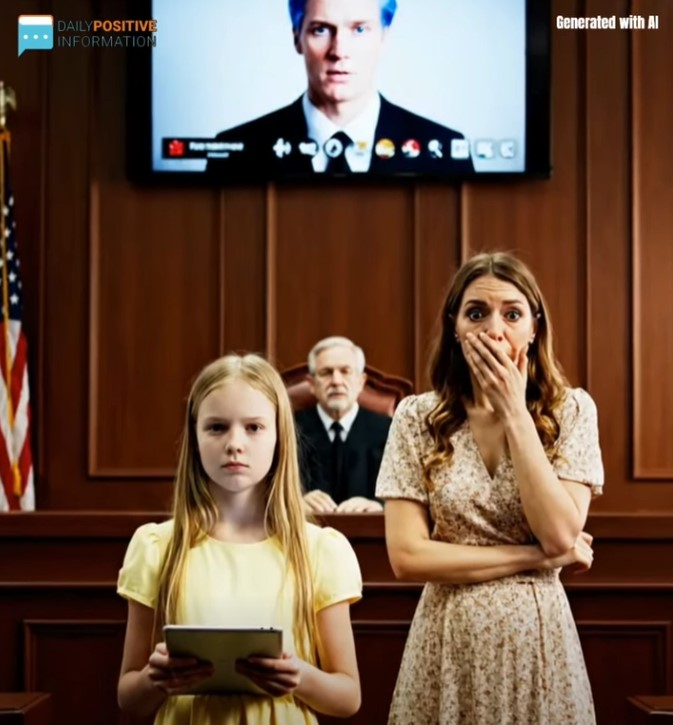
We didn’t go straight home. I couldn’t. My body was still vibrating with the residual adrenaline of the courtroom, a tremor that started in my hands and radiated down to my knees. The idea of returning to the small, sterile rental apartment I had secured—a place that smelled of lemon cleaner and desperation—felt impossible just yet. We needed a transition. We needed a buffer zone between the trauma of the courthouse and the reality of our new life.
I pulled into a diner on the edge of town, one of those chrome-and-neon establishments that seem to exist out of time. It was called “The Galaxy,” fitting for two people who felt like they had just been ejected from their own orbit.
We sat in a red vinyl booth. The waitress, a woman named Barb with hair the color of spun sugar, dropped two laminated menus in front of us.
“Coffee for the lady? Milkshake for the little one?” she asked, not looking up from her pad.
“Coffee. Black. And a chocolate milkshake with extra cherries,” I said. I looked at Harper. “Is that okay?”
Harper nodded. She was staring out the window at the parking lot, watching the rain sizzle against the asphalt. She hadn’t let go of my hand since we left the courtroom, only releasing it now to trace the condensation on the glass.
When the milkshake arrived, she didn’t drink it immediately. She stirred it with the straw, creating a slow, thick vortex.
“Mom?” she asked, her voice barely audible over the hum of the refrigerator unit.
“Yeah, baby?”
” is he going to jail?”

The question hung in the air, heavy and smelling of chocolate syrup. I took a deep breath. I wanted to lie. I wanted to tell her that everything was sunshine and rainbows now, that the bad man was gone forever. But lies were what got us here. Caleb’s lies. My lies of omission to myself.
“I don’t know,” I said honestly. “The judge was very angry. What Daddy did—threatening you—is against the law. But right now, the most important thing is that he can’t come near us. The police have a paper that says he has to stay away.”
Harper nodded slowly. She took a sip of the shake. “Good,” she said. “I don’t want to see him.”
“You don’t have to,” I promised. “Not for a long time.”
We sat there for an hour. I watched her eat fries with the kind of mechanical hunger that follows immense stress. I watched the color slowly return to her cheeks. She was ten, but in that booth, under the harsh fluorescent lights, she looked both incredibly young and ancient. She had carried a secret that would have crushed an adult. She had carried it in a folder labeled “Geometry Project.”
The Empty Apartment and the Fort of Safety
The rental apartment was in a complex called “The Oakes,” though there wasn’t an oak tree within three miles. It was a beige box on the second floor. When we unlocked the door, the emptiness hit me.
Caleb had frozen our assets days before the hearing. I had managed to scrape together enough cash for the deposit and first month’s rent by selling a few pieces of jewelry he hadn’t noticed were missing. We had two mattresses on the floor, a card table, and two folding chairs.
It looked bleak. It looked like poverty. But as I locked the deadbolt and slid the chain into place—a sound that was more satisfying than any symphony—it felt like a palace.
“It’s ugly,” Harper said, looking at the beige carpet.
I laughed. It was a rusty sound, scraping my throat. “It is. It is undoubtedly the ugliest carpet in America. But it’s ours.”
“Can we paint it?”
“No, but we can cover it.”
That night, we didn’t sleep on the mattresses. We pulled them into the living room. We took every sheet, blanket, and towel we owned and draped them over the card table and the chairs. We built a fortress. A soft, fabric castle in the middle of the beige wasteland.
We crawled inside with a flashlight. It smelled like laundry detergent and safety.
“Read to me?” Harper asked. She hadn’t asked for a bedtime story in two years. She usually claimed she was too old.
I opened a book on my phone because all her books were still at the house—Caleb’s house. I read The Hobbit. I read until my voice was hoarse and her breathing leveled out into the rhythmic, heavy sighs of sleep.
I stayed awake. I lay there in the dark, listening to the hum of the refrigerator and the distant sirens of the city. I checked my phone. Fourteen missed calls from numbers I didn’t recognize. Caleb. Or his lawyers. Or his flying monkeys.
I blocked them all.
I looked at my daughter, sleeping in a fortress of sheets. I realized then that the war wasn’t over. We had won the battle of the courtroom, but the siege was just beginning. Caleb wouldn’t let go easily. He was a man who viewed people as possessions, and he had just lost his two most valuable assets.
The Financial Stranglehold
The next morning, the reality of our financial situation set in. I tried to use my debit card at the grocery store to buy eggs and milk.
“Declined,” the cashier said, popping her gum.
“Can you try it again?” I asked, feeling the heat rise in my cheeks. “There should be money in there.”
“Declined,” she repeated, louder this time. The line behind me shifted impatiently.
I used the emergency twenty-dollar bill I kept in my phone case. We left with eggs, milk, and a profound sense of vulnerability.
Caleb had moved fast. Despite the judge’s orders, the banking system moves at the speed of bureaucracy. He had likely flagged the accounts for fraud or emptied them before the order was processed.
I sat in the car in the parking lot, gripping the steering wheel. I couldn’t cry. Crying was a luxury for women with access to their checking accounts.
I called Mrs. Higgins.
“He cut me off,” I said. “I have twelve dollars to my name.”
“I’m filing an emergency motion for support,” Mrs. Higgins said, her voice tight. “He’s violating the court order, Elena. He’s digging his own grave with a backhoe. But it will take a few days to get a hearing.”
“We have to eat in those few days,” I said.
“I know. Do you have family?”
My parents had passed away years ago. Caleb had isolated me from most of my friends, slowly and methodically, over the last decade. “They’re jealous of us, El,” he would say. “They don’t want to see you happy.” Now, I realized the isolation was a tactical strategy, not a quirk of his personality.
“I’ll figure it out,” I said.
I went to the only person I knew wouldn’t judge me. Sarah, my office mate.
I walked into work two hours late, looking like a woman who had slept in a blanket fort. I pulled Sarah into the breakroom.
“I need a loan,” I said, bypassing the pleasantries. “I need five hundred dollars. I will pay you back when the court releases my funds. But right now, I can’t buy food.”
Sarah didn’t ask questions. She didn’t ask for details. She opened her purse, took out her checkbook, and wrote a check for a thousand dollars.
“It’s an advance,” she said, handing it to me. “On the coffee campaign bonus. We’ll call it that.”
I hugged her. I hugged her until she patted my back awkwardly.
“He’s going to pay for this,” Sarah whispered fiercely. “I always thought he was too smooth. Like a dolphin. Too slippery.”

The Forensic Accountant and the Cayman Trail
Three days later, I met a man named Arthur Vance. Mrs. Higgins had hired him. He was a forensic accountant, a man who hunted money the way bloodhounds hunt convicts.
He was a small man with thick glasses and a sweater vest that looked like it belonged in 1950. He came to Mrs. Higgins’ office carrying a briefcase that looked older than me.
“Mr. Dawson thinks he is clever,” Mr. Vance said, spreading spreadsheets across the conference table. “And he is. He is clever in the way a magpie is clever. He hides shiny things in obvious places.”
“The Cayman account?” I asked.
“That was the decoy,” Mr. Vance said, tapping a paper with a manicured fingernail. “He put enough money there to satisfy a curiosity. About fifty thousand. He assumed if you looked, you would find that, get angry, claim half, and feel victorious.”
“There’s more?”
Mr. Vance smiled. It was a terrifying smile. It was the smile of a predator who has cornered its prey.
“Mrs. Dawson, your husband has been siphoning money through a shell company for seven years. He created a consulting firm called ‘Archon Designs.’ He billed his own firm for ‘structural consultations.’ The money went into Archon, and Archon purchased real estate. Not in his name. In the name of a trust.”
“Real estate?”
“Three condos in Miami. A cabin in Aspen. And a significant portfolio of cryptocurrency.”
I stared at the numbers. Seven years. He had been planning an exit strategy, or at least a secret life, for seven years. While I was pregnant with Harper? While I was nursing her? While I was planning his birthday parties?
“How much?” I whispered.
“Roughly four million dollars,” Mr. Vance said. “And because he failed to disclose it during the initial discovery phase, and because he perjured himself on his financial affidavit…”
“He loses it,” Mrs. Higgins finished, leaning back in her chair with a satisfied creak. “In this state, hiding assets is a cardinal sin. The judge is going to peel him like a grape.”
I didn’t feel triumphant. I felt sick. I had shared a bed with a stranger. A stranger who was worth millions while he yelled at me for buying brand-name cereal.
The Return of the Nightmares
While the legal and financial wars raged, the home front was struggling. Harper wasn’t bouncing back as fast as I had hoped. The euphoria of the courtroom victory had faded, replaced by the residual trauma.
She started having nightmares.
I would wake up at 3:00 AM to the sound of her screaming. Not a whimper, but a full-throated scream of terror.
“No! Don’t take it! I won’t tell!” she would yell in her sleep.
I would rush into her room—the second bedroom we had finally furnished with a cheap bed frame and a comforter covered in stars—and wake her up. She would be sweating, her eyes wide and unseeing.
“He was here,” she would sob. “He was looking for the tablet. He said he was going to lock me in the basement.”
“He’s not here,” I would soothe, stroking her damp hair. “The doors are locked. The police are watching. He can’t come in.”
But logic doesn’t work on trauma. The brain rewires itself to survive, and Harper’s brain was still in survival mode.
I decided to break the “no therapy” rule of my past. I found a child psychologist named Dr. Aris. She had a kind face and an office filled with sand trays and puppets.
“Harper is hyper-vigilant,” Dr. Aris told me after three sessions. “She felt responsible for your safety. That is a heavy burden for a child. She needs to learn that she is the child, and you are the protector. She needs to retire from the job of being the family savior.”
“How do I help her do that?”
“Consistency,” Dr. Aris said. “And time. And proving to her, over and over again, that the walls hold.”
Caleb’s Last Stand
Two weeks after the hearing, Caleb made his move. He didn’t come to the apartment. He knew better than to violate the restraining order so blatantly. Instead, he went for the jugular: my job.
I was called into the HR office on a Friday afternoon. My boss, David, looked uncomfortable. He wouldn’t meet my eyes.
“Elena, we’ve received… complaints,” he said, sliding a folder across the desk.
“Complaints?”
“Anonymous emails. Alleging that you’ve been embezzling company funds. And that you’re using company resources to run a personal legal campaign.”
I opened the folder. They were printouts of emails from throwaway accounts. They were written in a style I recognized immediately. The syntax. The “polite cruelty.”
“This is Caleb,” I said, slamming the folder shut. “David, you know me. I’ve been here six years. I asked Sarah for a personal loan, yes. But embezzlement?”
“We have to investigate,” David said, looking pained. “It’s corporate policy. Until the investigation is complete, we have to place you on unpaid leave.”
“Unpaid?” I stood up. “David, he’s trying to starve me out. If you do this, you’re helping him.”
“My hands are tied,” he said.
I walked out of the office carrying a box of my personal items. I felt like the world was collapsing again. He had four million dollars hidden in trusts, and he was taking away my paycheck just because he could.
I sat in my car in the parking garage and screamed. I screamed until my throat tasted like copper.
Then, my phone rang.
It was Mrs. Higgins.
“Don’t panic,” she said. “I just got a call from the District Attorney.”
“Why?”
“They saw the video, Elena. The judge forwarded it to the DA’s office immediately after the hearing. They aren’t just looking at a custody violation. They are looking at witness tampering. Extortion. And given the financial fraud Mr. Vance uncovered… they are building a RICO case.”
“RICO? Like for mobsters?”
“Like for organized criminal enterprises,” she said. “Caleb used his business, Archon, to launder money and hide assets to defraud a spouse and the court. And he used threats of kidnapping—because threatening to take a child away to an undisclosed location is effectively kidnapping in the eyes of the law—to cover it up.”
“What does this mean?”
“It means they are issuing a warrant. Tonight.”

The Arrest
I didn’t want Harper to see it. But we live in a world of screens, and bad news travels at the speed of light.
We were eating dinner—macaroni and cheese, the orange kind she loved—when my phone buzzed with a news alert. Local news.
“Prominent Architect Arrested in Financial Fraud and Extortion Scheme.”
I clicked the link. There was a video. It was shaky, shot from a distance outside Caleb’s pristine glass-and-steel house—the house I used to live in.
Police cars with flashing lights surrounded the driveway. Officers in vests were walking Caleb out. He wasn’t wearing his suit. He was wearing a tracksuit I had bought him for jogging, looking disheveled. His hands were cuffed behind his back.
He looked at the camera. For a split second, that same cold, dead look passed over his face. Then, the officer pushed his head down to guide him into the back of the cruiser.
Harper was watching me. She saw the reflection of the blue lights on my phone screen.
“Is that Dad?” she asked quietly.
I turned the phone over. “Yes.”
“Did the police get him?”
“Yes. He broke big rules, Harper. Grown-up rules. And now he has to answer for them.”
She took a bite of macaroni. She chewed slowly. Then she looked at me with eyes that were clear for the first time in months.
“He can’t come to the apartment if he’s in jail,” she stated.
“No. He can’t.”
“Okay.”
She took another bite. It was the most anticlimactic reaction possible, and yet, it was everything. It was the sound of fear leaving the building.
The Divorce Decree and the Windfall
The divorce took another six months to finalize. Caleb fought from jail for a while, but his money was frozen, and his high-priced lawyers started dropping him when the retainers ran dry.
Eventually, he took a plea deal on the criminal charges to avoid a twenty-year sentence. He got five years for fraud and witness tampering.
The civil court showed no mercy. Judge Patterson, true to Mrs. Higgins’ prediction, peeled him like a grape.
Because of the hidden assets and the fraudulent affidavits, the judge awarded me 100% of the hidden assets as a penalty. I got the Miami condos. I got the Aspen cabin. I got the crypto wallet. And I got full, permanent legal and physical custody of Harper, with Caleb’s visitation rights suspended until he completed his sentence and a strict psychiatric evaluation.
I walked out of the courthouse that final day a wealthy woman. But the money felt abstract. It was just numbers on a page. The real wealth was the girl holding my hand, skipping down the steps.
Rebuilding the Foundation
We bought a house. Not a glass-and-steel prison like Caleb’s. We bought a Victorian on the edge of town, with a wraparound porch and a garden that had gone wild. It needed work. It needed love. It was perfect.
We spent the summer painting. Harper chose the colors. Her room was painted a shade of turquoise that made my teeth ache, but I let her do it. I let her paint a mural on the ceiling.
One afternoon, I was in the kitchen—a kitchen filled with light and clutter, not sterile perfection—when I heard Harper humming.
I walked into the living room. She was lying on her stomach on the rug, surrounded by pencils and markers. She was drawing.
I stopped in the doorway, holding my breath. She hadn’t touched a sketchbook since the “Geometry Project” folder incident.
“What are you making?” I asked gently.
She held it up. It was a drawing of a dragon. But this dragon wasn’t scary. It was fierce. It had scales that shimmered in iridescent purples and greens. And riding on the dragon’s back was a girl with messy hair and a sword.
“It’s us,” she said. “I’m the dragon. You’re the girl with the sword.”
“I thought I was the dragon?” I teased, sitting down next to her.
“No,” she said seriously. “Dragons have tough skin. Nothing hurts them. I had to be tough, Mom. I had to be the dragon so I could keep the secret.”
Tears pricked my eyes. “You don’t have to be a dragon anymore, Harp. You can just be a girl.”
She looked at the drawing. She picked up a yellow marker and drew a sun in the corner.
“Maybe,” she said. “But it’s good to know I can breathe fire if I have to.”

A Year Later
I was back at work. My boss, David, had apologized profusely after the investigation cleared me (it took two days to prove the emails came from Caleb’s IP address). I accepted his apology, worked for two more months, and then quit to start my own agency. I named it “Phoenix Media.” A bit cliché, maybe, but apt.
It was a Tuesday afternoon. A courier walked into my new office. He was chewing gum.
My heart stopped for a beat. The muscle memory of trauma is strong.
He handed me an envelope.
“Sign here,” he said.
My hands shook slightly as I signed. I took the envelope. It was thin. Lightweight.
I opened it.
It was a letter from Harper’s school. It was her report card. And clipped to the front was a note from her art teacher.
“Harper has been selected for the District Art Showcase. Her piece, ‘The Dragon and the Warrior,’ has been awarded First Place in the mixed media category.”
I laughed. I laughed until I cried, sitting there in my sun-drenched office.
I texted Harper on the phone I finally let her have.
“You won,” I typed.
She replied instantly with a dragon emoji and a heart.
We weren’t just survivors anymore. We were winners. Caleb was sitting in a cell, wearing beige, staring at a wall. He had tried to crush us with silence and fear. He had tried to erase us.
But he forgot the most important rule of architecture: You can build the strongest walls in the world, but if the foundation is rotten, the house will always fall. And he forgot the most important rule of parenting: You never, ever underestimate a little girl who loves her mother.
I packed up my bag. I was going to pick up my daughter, get ice cream, and celebrate.
We had a lot of celebrating to do.
What do you think about Harper’s transformation and the justice served? Let us know your thoughts on the Facebook video, and “if you like this story share it with friends and family!”
