
The silence in Maine is different from the silence in Texas. In Texas, the silence is hot and expansive, filled with the hum of cicadas and the distant drone of highway traffic. Here, deep in the “Pine Tree State,” the silence has weight. It presses against the windows of our drafty cottage like a physical thing, smelling of damp earth and coming winter.
We had only been in town for three weeks when it happened.
My wife, Lily, our eight-year-old son, Ryan, and our Doberman, Brandy, were adjusting to the cold slower than I was. But after sixteen years of sweating through shirt collars in the suburbs of Dallas, I welcomed the sting of the crisp morning air in my lungs. I loved the soft hush of pine needles underfoot and the anonymity of a town that didn’t know our names.
We moved here for a reset. My architecture firm had gone remote, and Lily wanted to write her novel. We wanted a childhood for Ryan that didn’t involve tablets and strip malls.
“This place smells like Christmas,” Lily had whispered on the first morning, standing barefoot at the back door in a borrowed flannel shirt, clutching a mug of steaming coffee.
“It smells like freedom,” I had replied, wrapping my arms around her.
I remember smiling at her and at the way peace looked good on her face. I thought we had escaped the noise of the world. I didn’t realize we had walked directly into an echo chamber of my own past.

A Saturday walk turns into a nightmare
That Saturday, the sky was a bruised purple color, threatening snow that wasn’t quite ready to fall. We decided to go on a mushroom hunt behind the cottage. The realtor had mentioned the property line extended back into “old growth” forest, which sounded romantic until you actually stood at the edge of it.
It wasn’t for anything fancy or borderline dangerous as far as mushrooms go; just the kind that Lily could sauté in butter and garlic while Ryan boasted about his foraging skills.
Brandy barked at everything that moved. He was a city dog, used to fences and sidewalks. Here, the squirrels were bolder, and the shadows stretched longer. Ryan ran ahead of us with a bright orange plastic bucket, swiping at ferns like they were dragon tails.
“Stay close, bud!” I called out, my voice swallowed instantly by the canopy of spruce and hemlock.
It was the kind of day that settles into your memory before it even ends. The air was cold, the ground soft, the company perfect.
Until… it got twisted.
Suddenly, Brandy’s bark changed. It dropped an octave, shifting from playful yips to a guttural sound that vibrated in my chest. He wasn’t barking at a squirrel. He was alerting us. Then he growled—low and with warning.
I looked up, scanning the path ahead. The orange bucket was on its side, spilling moss onto the trail.
My son was gone.
“Ryan?” I called out.
Silence.
“Hey, buddy — answer me! This isn’t a game, okay?”
Panic is a cold bucket of water. It starts at the scalp and washes down, freezing your movements.
Brandy’s barking grew sharper ahead of me, echoing somewhere just beyond a dense thicket of brambles.
“Keep him safe, Bran,” I muttered to myself, breaking into a run. “I’m coming.”
I pushed through the brush, ignoring the thorns snagging my jeans and the branches whipping my face. I was careful not to trip over the exposed roots crisscrossing the path like skeletal fingers. The trail narrowed without warning, winding between tall pines that blocked out most of the afternoon light.
My boots sank into damp moss, and the air suddenly felt cooler and too quiet. The birds had stopped singing.
“Lily, come on!” I shouted at my wife, who was trailing behind with the foraging guide.
“Coming, honey,” she yelled back, sounding exhausted and scared at the same time. “Coming! Did you find him?”
“Ryan!” I shouted once more, my voice cracking.
A flicker of unease rose in my chest. It wasn’t just that he was missing; it was where we were. The woods felt watched.
Then I heard him. Not my son’s voice, no. But his laugh. It was a bright, bell-like sound that seemed out of place in the gloom. And Brandy was barking again, but not aggressively. It was his “I found something” bark.
I picked up my pace, bursting through a wall of ferns.
The graveyard that time forgot
I emerged into a clearing I hadn’t seen on any of the property maps. I stopped dead in my tracks, my breath fogging in the air.
“Uh… guys?” I called over my shoulder, just as Lily caught up to me, breathless and pale. She stopped beside me, her hand gripping my bicep, her eyes scanning the space.
“What is this place?” she asked, her voice low and cautious. “Travis… those are headstones, aren’t they?”
She walked a little further, then hesitated. My wife was right. There were a few headstones scattered around the clearing. They weren’t the polished granite of a modern cemetery. These were slate and rough-hewn stone, tilting at odd angles, reclaimed by the earth. It was eerie, but peaceful at the same time.
“And those are flowers,” Lily whispered, stepping closer to a small marker. “Look at this, honey. There are so many dried bouquets, everywhere!”
She pointed toward one of the graves. A dozen brittle stems lay across its base, tied together with faded ribbon that might have once been blue.
“Someone came here,” I said, rubbing the back of my neck. “Well… has been coming here for a long time. These aren’t wild. Someone is tending this place.”
Lily opened her mouth to respond, to ask why our property deed didn’t mention a family plot, but Ryan’s voice beat her to it.
“Daddy! Mommy! Come look! I found something… I found a picture of Dad!” he called out, the excitement palpable in his voice.
He was oblivious to the somber atmosphere. To him, this was a treasure hunt.
My son was crouched in front of a small headstone tucked between two elm trees. His finger was pressed to the front of the stone, like he was tracing something.
“What do you mean, my picture?” I asked, moving toward him carefully through the weeds. My chest felt tight, and I was starting to feel dizzy. A strange sense of déjà vu washed over me, a metallic taste in my mouth.
“It’s you, Daddy,” Ryan said, not even turning around. “It’s the baby you! Don’t we have a photo like this above the fireplace?”
I reached him. I looked down. And my world tilted on its axis.
A face in the stone
When I stepped beside him and looked down, my breath caught in my throat.
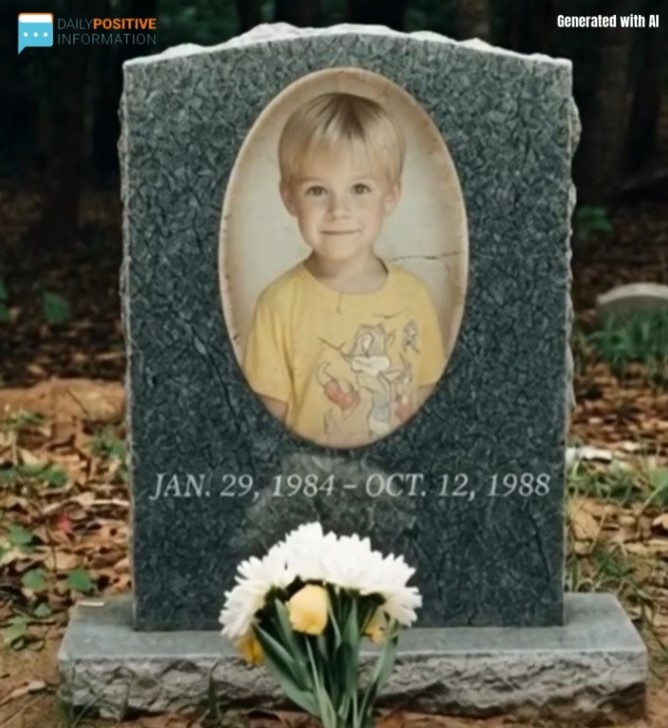
Set into the headstone was a ceramic photograph, an oval porcelain portrait typical of graves from the last century. It was worn from age, cracked down the middle, and chipped in the right corner… but it was still unmistakably clear.
It was me.
I was maybe four years old in the picture, my dark hair a little longer than Ryan’s was now. My eyes were wide and unsure, and I was wearing a yellow shirt with a darker collar—a shirt I only vaguely remembered from a torn Polaroid my adoptive mother kept in a scrapbook back home in Texas.
I stared at the child in the stone, and the child stared back.
Beneath the photograph was a single line etched into the granite, moss filling the grooves of the letters.
“January 29, 1984.”
It was my birthday.
Lily reached for my arm. In my shock, I hadn’t realized how close she’d gotten. Her voice was quiet but firm, carrying the edge of maternal protection.
“Travis, please. This is too strange. I don’t know what this is, but I want to go home. Come, Ryan,” she said, holding her hand out for our son.
“No. Wait! Just a minute, please, Lily,” I said, shaking my head once, trying to clear the fog. “I just want to… see.”
I knelt down, ignoring the damp earth soaking into my jeans. I touched the edge of the ceramic frame. It was cold. For a second, everything around me dulled—the wind, the dog, my wife’s breathing. I felt something shift inside me—not just panic exactly, but something deeper. A resonance.
It was like… recognition I wasn’t ready for. Like hearing a song you forgot you knew.
“Travis,” Lily said, sharper this time. “We are leaving.”
I took a picture with my phone, my hands shaking so badly the first one blurred. Then I stood up, took Ryan’s hand, and we walked back to the house in silence.
The mystery of the boy who lived
That night, the cottage felt different. The shadows in the corners seemed to stretch toward me. After Ryan was asleep, blissfully unaware that he had found his father’s grave, I sat at the kitchen table with the photo pulled up on my phone.
The blue light of the screen illuminated the whiskey glass in my hand.
“What on earth is going on here?” I muttered, zooming in on the pixelated eyes of the boy in the stone. “I don’t understand. That is me, there’s no doubt. But I’ve never been here before. I’m sure I’d remember that?”
My wife sat across from me, her expression unreadable, her hands wrapped around a mug of tea. She was the logical one, the editor who fixed plot holes. But this was a hole she couldn’t fix.
“Is there any chance your adopted mom ever mentioned Maine?” she asked softly.
“No,” I replied, running a hand through my hair. “I asked her once, when I was much younger. I just wanted to know my story, you know? She said she didn’t know much. Just that she got me from a firefighter named Ed, and that I was left outside a burning house when I was four. The only thing I had was a note pinned to my shirt.”
“What did it say, Travis?” Lily asked, her eyes wide.
We’d spoken about this before, early in our dating life. But after Ryan’s little discovery, everything had seemed… different and darker somehow. The details felt heavier.
“‘Please take care of this boy. His name is Travis.’ That was it,” I said, the words tasting like ash. “I’m pretty sure my mom has it stuck in a scrapbook or something. She said the fire was big, chaotic. The system was overwhelmed. I fell through the cracks and into her arms.”
Lily reached for my hand and squeezed gently.
“Maybe there’s someone in this town who knows more,” she said, her voice finding its strength. “Someone who remembers the fire… and maybe even your birth parents, Trav. Maybe fate allowed us to move here for a reason? Maybe you didn’t just buy a house. Maybe you came home.”
I nodded slowly. I didn’t know what else to say. I had always felt a little lost in my life, a drifting anchor. I couldn’t remember my birth parents. I couldn’t even remember if I’d had any siblings or grandparents. My memories started at age five, in a warm kitchen in Dallas. Before that? Static.
It was as though that time of my life had been redacted by some force higher than me.
The Keeper of History
The next day, Monday, I drove into town. The “downtown” was essentially a Main Street with a post office, a bakery, and a library that looked like a converted church.
I visited the local library and asked about the property behind our cottage. The woman at the front desk, a stern lady with glasses on a chain, looked confused when I showed her the map on my phone.
“There used to be a family who lived off-grid back there years ago,” she said, squinting. “The Millers, maybe? Or the Walkers? Hard to say. But the house burned down when a spark from the fireplace landed on a curtain. Tragedy. People don’t really talk about it anymore. It’s bad luck.”
I asked if anyone still living in town might know more. I needed a name. I needed a witness.
“Try Clara M.,” she said, scribbling on a sticky note. “She’s the old woman who sits at the apple stall in the daily market. She’s nearly 90 years old. And she’s lived here her whole life. She knows where every skeleton in this town is buried. That’s your best bet. Here’s her address.”
Clara’s house was small, situated on the edge of town where the paved road turned to gravel. It was shaded by thick pine trees, with lace curtains in the windows and a chipped mailbox in the shape of a bus.
When I knocked, it took a long time for the door to open. When it did, a woman who looked like she was made of dried apples and wisdom peered out.
When she looked at my face, her expression shifted from polite curiosity to startled recognition. She gasped, a dry, rasping sound.
“You… you’re Travis?” she asked, her cataract-clouded eyes widening.
I nodded slowly, a chill running down my spine. She knew my name.
“And you’ve come home? Well, you’d better come in then, hadn’t you?”
She spoke like a woman straight out of a fairytale, the gatekeeper to the next level of the quest.

The tale of the twin
Her living room smelled like cedar and something softly sweet, like apple tea and old paper. It reminded me of a school library, the kind with dusty windows and silence that meant something. Every surface was covered in doilies and porcelain figurines.
I sat on a floral sofa that felt like it was stuffed with straw. I handed her my phone with the photo I’d taken at the headstone displayed on the screen. Clara held it close, squinting slightly. Her hands were thin, the skin papered with time, trembling just a little.
She stared at the picture longer than I expected.
“That photo,” she said slowly, her voice trembling, “was taken by your father, Travis. Your real father, I mean. His name was Shawn, and it was the day after you and your brother turned four. I baked the cake for your birthday. Vanilla sponge and strawberry jam. And cream. You boys got it all over your faces.”
I sat back, the breath knocked out of me. Clara had just dropped a bombshell on me, and yet, here she was, talking about… cake.
“I had a twin? Ma’am, are you sure?”
“Yes, son,” she said, smiling gently at a memory only she could see. “His name was Caleb. You were inseparable — identical in every way. You had a small scar on your chin, he had one on his knee. That was the only way we could tell you apart half the time.”
The room swayed slightly. I pressed my hand to my forehead to steady myself. Caleb. The name tasted familiar, like a word I had forgotten how to pronounce.
“No one ever told me,” I said, my voice thick. “My adoptive mom… she never knew.”
“Maybe… they just didn’t know,” Clara said, folding her hands in her lap. “There was a fire… your family lived in a small cabin beyond the ridge. Your parents were young, Travis, and they didn’t have much. But they loved you both fiercely.”
She paused, looking out the window at the gray sky, like she was weighing how much truth I could handle.
“It was a ridiculously cold winter… and we all had our fireplaces going day and night. The fire started sometime during the night. By the time anyone noticed, the cabin was almost burnt to the ground. The volunteer fire department couldn’t get the trucks up the icy road. They found three bodies.”
“My parents and my brother?” I asked, tears stinging my eyes.
“Yes,” Clara agreed, nodding solemnly. “That’s what they believed. Shawn, your mother Mara, and little Caleb.”
“But I wasn’t in the cabin?”
“No, honey. You weren’t. We assumed you were. We assumed the fire was just… too hot. That there was nothing left of you to find.”
The horror of it washed over me. I had been a ghost in this town for thirty years.
“So how did I end up in Texas?” I asked, a soft ringing starting in my ears. “How did I survive?”
“That’s the part no one ever knew,” Clara said, giving a sad smile. “I always thought that maybe you had wandered out. Maybe you woke up, saw the smoke, and ran. Maybe someone found you on the road and took you, thinking they were saving you. I don’t know, son. I don’t know what else to tell you.”
The old woman reached for a photo album under her coffee table. Inside was a yellowed newspaper clipping from 1988.
“Fire Destroys Family Cabin — Three Dead, One Unaccounted.”
Below it was a grainy black and white photo of two boys standing in a field of tall grass. They were identical in every way but the tilt of one smile. One looked shy. The other looked ready to run.
I touched the page lightly. That was me. And that was Caleb.
“After the fire, your father’s younger brother, Tom, came back to the property,” Clara continued. “He was devastated. He stayed in town for a few months, trying to rebuild what he could, but the grief was too much. He placed a few memorial stones, including the one with your photo.”
I looked at her, confused.
“Why would he do that if I wasn’t confirmed dead?”
“Because no one knew for sure,” she said. “There were no dental records for four-year-olds. And no reliable filing systems back then in rural Maine. The clinic where you and your brother were born had burst pipes the following year. By then, all the medical records that could’ve helped identify you were gone. Tom always believed that one of you might’ve survived, but after a year… he needed a place to mourn. But the town had already moved on to the next tragedy.”
“Where is he now?” I asked. “Tom.”
“He still lives at the edge of town,” she said, pointing a crooked finger west. “The blue house near the river. But he keeps to himself. He’s not the same. He blames himself for not being there that night.”
The Reunion
The next morning, the sky finally opened up and snow began to fall. Lily came with me. She didn’t say much on the way there, but her hand sat on my thigh the entire drive, a warm weight keeping me grounded.
Tom’s front yard was wild and overgrown, but not abandoned. It was the yard of a man who loved nature but hated mowing. A row of fresh bird feeders hung from the porch beams, and a cracked wind chime swayed above the door, singing a lonely song.
When he answered the door, he looked tired. He was a man worn down by years of carrying something heavy. He looked at me for several long seconds, his eyes narrowing. Then he blinked like he had seen a ghost. He grabbed the doorframe to steady himself.
“I’m Travis,” I said, my voice barely a whisper. “I think… I’m your nephew.”
His face shifted, the lines of hard years softening in a way that made my throat catch. He didn’t ask for DNA. He didn’t ask for proof. He just looked at my eyes—his brother’s eyes.
He nodded, tears pooling in his lashes, and moved aside to let us in.
Inside, the house was warm. Books lined the corners—stacks and stacks of them. A pot of soup simmered quietly on the stove.
“You look just like your father,” Tom said finally, his voice raspy from disuse. “But you have your mother’s chin.”
I didn’t know how to respond. I felt like an intruder and a prodigal son all at once.
“I came back after the fire,” Tom said, pouring us coffee into mismatched mugs. “Everyone else said the boys were gone, but I couldn’t accept it. I kept thinking — maybe Mara got one of you out. She would’ve tried. Your mother would have done anything for you boys. She was fierce.”
My eyes burned. I looked at the man who had kept the memory alive when the world forgot.
“When I placed the headstone,” Tom said, staring into his black coffee, “I didn’t know it would bring you back… but I hoped. I put it there so you’d have a place. And I prayed that wherever you landed up, you were okay. That you were loved.”
“I was,” I said, looking at Lily. “I was loved.”
I nodded and held tightly onto my wife’s hand.
“Caleb was always quieter,” he said after a moment, a sad smile playing on his lips. “You were the wild one, Travis. Always climbing trees. Caleb liked to sit and watch the ants.”
We spent the afternoon going through smoke-stained boxes he kept in the closet. There were a few drawings on brittle, half-burned paper—stick figures of a family of four. There was a birthday card addressed to ‘Our boys,’ its ink faded and smudged by water damage.
At the bottom of the box was a small yellow shirt, scorched at one sleeve.
“I found this near the road,” Tom said. “A week after the fire.”
I touched the fabric. It was the shirt from the photo.
I took it home.
Closure in the clearing
A week later, we returned to the clearing behind our house. The snow had covered the moss, turning the graveyard into a white, silent room. Tom and Lily were with us, but they were hanging back, talking softly to each other.
The headstone was waiting. The boy in the picture looked less lonely now.
I knelt and placed the birthday card from the box at its base. I also placed a fresh white rose.
“Dad? Are we visiting your brother?” Ryan asked, his breath puffing in the cold air.
“Yes,” I said, pulling my son close. “His name was Caleb. And he was my best friend.”
“I wish I could’ve met him,” Ryan said, leaning against me. Brandy sniffed the card, his tail wagging slowly.
“Me too, son. Me too.”
The breeze rustled through the trees, knocking snow from the pine branches. It sounded like a sigh.
I glanced at Tom standing by the tree line, watching us with a look of peace I hadn’t seen on him before. And I wondered, just for a moment, if he was the one who’d written the note pinned to my shirt all those years ago. Maybe he had found me in the chaos. Maybe he realized he couldn’t raise a traumatized child alone in the ashes of a tragedy. Maybe giving me away was his way of keeping me alive… or giving me a chance at life without the heavy cloak of being a “survivor.”
I would never ask him. Some mysteries are better left as mercies.
I stood up, took my son’s hand, and walked back toward the warmth of the house. We were home.
Let us know what you think about this story on the Facebook video and if you like this story share it with friends and family!
